A-level Business Year 13 · Topic 3
The external environment (PESTLE) and risk
This topic examines the external environment in depth, using PESTLE to judge how outside changes affect strategy.
We look at political and legal change, the economy and government policy, social and technological trends, and the natural environment.
We finish with competition policy, and how businesses plan for risk and uncertainty.
- 8 subtopics
- 304 questions
- Free: 3.1 notes and 10 questions
In this topic
- 3.1Political and legal influences on strategyFree below · 26 questions
- 3.2Economic influences: growth, inflation, unemployment, interest rates and the business cycleOpen in Full Marks · 49 questions
- 3.3Government economic policy: fiscal, monetary and supply-sideOpen in Full Marks · 37 questions
- 3.4Social and demographic influencesOpen in Full Marks · 30 questions
- 3.5Technological change and digital disruptionOpen in Full Marks · 26 questions
- 3.6Environmental influences and sustainabilityOpen in Full Marks · 29 questions
- 3.7Competition policy and the regulation of marketsOpen in Full Marks · 74 questions
- 3.8Risk, uncertainty and scenario planningOpen in Full Marks · 33 questions
3.1 · Free notes
Political and legal influences on strategy
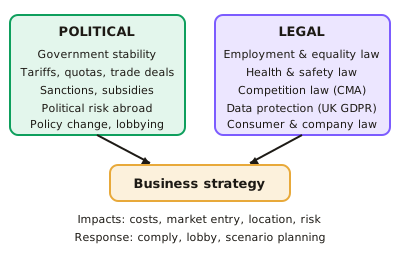
Key points
- Political influences come from government decisions and stability. Policy direction, trade policy (tariffs, quotas, trade agreements), sanctions and subsidies all shape strategic choices such as market entry, sourcing and location.
- A tariff is a tax on imports, e.g. 15% × £40,000 = £6,000, which raises costs or prices. A quota limits the quantity imported. Both can push firms to change suppliers, relocate production or raise prices.
- Political risk overseas includes nationalisation/expropriation, corruption, civil unrest, capital controls and sudden policy reversals. Firms manage it through risk indices, scenario planning, joint ventures and diversifying across markets.
- Legal influences are binding rules. Key UK examples are employment law (National Living Wage, working time), the Equality Act 2010, the Health and Safety at Work Act 1974, the Consumer Rights Act 2015, the Companies Act 2006 and the Modern Slavery Act 2015.
- Competition law (Competition Act 1998) bans cartels such as price-fixing and abuse of a dominant position. The CMA can investigate and block mergers (e.g. where the share of supply reaches 25%), which constrains growth by acquisition.
- Data protection law (UK GDPR and the Data Protection Act 2018) requires lawful, secure use of personal data. Serious breaches can be fined up to £17.5m or 4% of global turnover, whichever is higher.
- Regulation raises compliance costs (e.g. a higher wage bill) but protects consumers, levels the playing field and can support a USP. Deregulation cuts costs but increases reputational, ethical and safety risks.
- Political and legal change affects costs, market entry, location, product design, pricing and mergers. Typical responses are compliance, lobbying, adapting the product, relocating or diversifying.
- For evaluation, judge impact by magnitude, probability and timing, and by whether the change is predictable. Also consider firm size (SMEs may bear proportionally higher compliance costs), sector (finance and energy are heavily regulated) and flexibility.
- Exam tip: link the influence to the context and classify it as an opportunity or a threat. A trade deal opens markets, while rising employment costs threaten labour-intensive firms. Feed PESTLE findings into SWOT and scenario planning.
In more detail
- Brexit example: after the UK left the EU single market in 2021, many firms faced new customs paperwork and checks, raising the cost of exporting to the EU.
- Sanctions example: after Russia's full-scale invasion of Ukraine in 2022, many Western firms left the Russian market and wrote off their investments there.
- Worked compliance cost: a 5% rise in the minimum wage for a firm whose £2m wage bill is all paid at that rate adds £100,000 a year.
- Lobbying: firms and trade bodies lobby government to shape new rules, for example on tax, planning or the regulation of their industry.
Practice
Political and legal influences on strategy: 10 questions
Pick an answer to check it, or open the answer for the explanation.
1. Which of the following is a legal, rather than political, influence on a UK business?
- A trade deal signed with Australia
- New tariffs on imported steel
- The Equality Act 2010 banning discrimination in recruitment
- A change of government after a general election
Show answer
C: The Equality Act 2010 banning discrimination in recruitment. The Equality Act 2010 is legislation that firms must obey. Elections, tariffs and trade deals are political decisions or events, although they may later lead to new laws.
2. A UK retailer imports goods worth £40,000 per shipment. The government imposes a 15% tariff. What is the extra cost per shipment?
- £600
- £15,000
- £6,000
- £4,000
Show answer
C: £6,000. A tariff is a percentage tax on the import value: 15% × £40,000 = £6,000 extra per shipment.
3. A firm has 10 staff on the National Living Wage working 40 hours × 50 weeks. The hourly rate rises by £0.50. By how much do annual wage costs rise?
- £1,000
- £20,000
- £10,000
- £2,000
Show answer
C: £10,000. Total hours = 10 × 40 × 50 = 20,000. Extra cost = 20,000 × £0.50 = £10,000, excluding any knock-on costs.
4. Which UK body can investigate and block mergers that would substantially lessen competition?
- Office for Budget Responsibility
- Competition and Markets Authority
- Health and Safety Executive
- Bank of England
Show answer
B: Competition and Markets Authority. The CMA enforces UK competition law and reviews mergers. The Bank of England sets monetary policy, the HSE covers workplace safety and the OBR forecasts public finances.
5. What is the main difference between a tariff and a quota?
- A tariff bans imports entirely; a quota only taxes them
- A tariff limits quantity; a quota is a tax on imports
- A tariff is a tax on imports; a quota limits the quantity imported
- A tariff applies to exports only; a quota to imports only
Show answer
C: A tariff is a tax on imports; a quota limits the quantity imported. Tariffs are taxes on imported goods, which raise their price. Quotas are physical limits on the quantity that may be imported.
6. A UK mining firm invests in a country whose government might seize foreign-owned assets. This is an example of:
- Inflation menu costs
- Technological obsolescence
- Political risk of expropriation
- Cyclical demand risk
Show answer
C: Political risk of expropriation. Seizure of foreign-owned assets is expropriation or nationalisation, a classic political risk of operating overseas.
7. Which statement about regulation is most accurate?
- Deregulation lowers compliance costs but may raise ethical and safety risks
- Regulation never benefits businesses
- Laws only apply to large firms
- Deregulation always raises profits for every firm
Show answer
A: Deregulation lowers compliance costs but may raise ethical and safety risks. Deregulation can cut costs and red tape, but weaker protection can increase reputational, ethical and safety risks. Effects vary by firm.
8. A firm collecting customers' personal data online must comply mainly with which legislation?
- Companies Act 2006
- Health and Safety at Work Act 1974
- Consumer Rights Act 2015
- UK GDPR and the Data Protection Act 2018
Show answer
D: UK GDPR and the Data Protection Act 2018. UK GDPR and the Data Protection Act 2018 govern how personal data is collected, stored and used. The other Acts cover company reporting, consumer goods/services and workplace safety.
9. A UK manufacturer sells 60% of its output to the EU. Which political change would most directly threaten its strategy?
- Customs checks and new tariffs on UK–EU trade
- A rise in UK retail sales
- A cut in UK corporation tax
- Lower UK domestic energy prices
Show answer
A: Customs checks and new tariffs on UK–EU trade. Tariffs and customs barriers on its main export market directly raise costs and prices and reduce competitiveness. The other changes do not directly hit its EU sales.
10. Which Act prohibits anti-competitive agreements such as price-fixing between rival firms?
- Equality Act 2010
- Competition Act 1998
- Companies Act 2006
- Employment Rights Act 1996
Show answer
B: Competition Act 1998. The Competition Act 1998 bans cartels and other anti-competitive agreements, and abuse of a dominant position.
Keep going in Full Marks
Full Marks has 26 questions on Political and legal influences on strategy (16 more than here), set out in practice levels. You also get notes and 3D models for all 8 subtopics of The external environment (PESTLE) and risk, plus games, timed exams and past papers.