A-level Business Year 13 · Topic 2
Strategy and global business
This topic is about strategy, how a business decides where it is going and how it will get there.
We start with mission and objectives, then assess the firm's strategic position with SWOT, PESTLE, ratios and Porter's Five Forces.
We also preview strategic direction, change management and global business, which later topics cover in depth.
- 6 subtopics
- 168 questions
- Free: 2.1 notes and 10 questions
In this topic
- 2.1Analysing the strategic positionFree below · 14 questions
- 2.2Strategic direction and methodsOpen in Full Marks · 14 questions
- 2.3Managing change and global businessOpen in Full Marks · 52 questions
- 2.4Mission, corporate objectives, strategy and tacticsOpen in Full Marks · 30 questions
- 2.5SWOT analysis and assessing the strategic positionOpen in Full Marks · 23 questions
- 2.6Porter's Five Forces and competitor analysisOpen in Full Marks · 35 questions
2.1 · Free notes
Analysing the strategic position
Key points
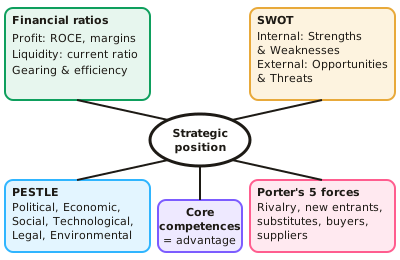
- Financial ratio analysis assesses performance: profitability (ROCE, margins), liquidity (current ratio), gearing and efficiency ratios.
- SWOT analysis identifies internal strengths and weaknesses and external opportunities and threats.
- PESTLE analysis examines political, economic, social, technological, legal and environmental factors.
- Porter's five forces analyses industry competitiveness: rivalry, threat of new entrants, threat of substitutes, buyer power and supplier power.
- Core competences and distinctive capabilities underpin competitive advantage.
- Businesses also assess political and legal change, the state of the economy, and ethical and environmental expectations.
In more detail
- Core competence example: Honda's expertise in engines runs through its cars, motorbikes, lawnmowers and generators, a classic core competence in Prahalad and Hamel's sense.
- Ratios as evidence: a falling ROCE, rising gearing and a current ratio below 1 together suggest a weak strategic position, even if revenue is growing.
- Combining tools: PESTLE and Five Forces feed the opportunities and threats of a SWOT, while ratios and core competences feed the strengths and weaknesses.
- A2 skill: always prioritise. Say which one or two factors matter most for the firm's next strategic decision, and why.
Practice
Analysing the strategic position: 10 questions
Pick an answer to check it, or open the answer for the explanation.
1. The current ratio equals:
- Current assets ÷ current liabilities
- Profit ÷ capital
- Debt ÷ equity
- Revenue ÷ assets
Show answer
A: Current assets ÷ current liabilities. It measures short-term liquidity.
2. In SWOT analysis, which factors are external?
- Strengths and weaknesses
- Opportunities and threats
- Strengths and threats
- Weaknesses and opportunities
Show answer
B: Opportunities and threats. Strengths and weaknesses are internal to the business.
3. What does Porter's five forces model analyse?
- Employee motivation
- The competitive forces shaping an industry
- Cash flow
- Marketing mix
Show answer
B: The competitive forces shaping an industry. It includes rivalry, entrants, substitutes, and buyer and supplier power.
4. ROCE equals:
- Operating profit ÷ capital employed × 100
- Revenue ÷ costs
- Net profit ÷ revenue
- Assets ÷ liabilities
Show answer
A: Operating profit ÷ capital employed × 100. It shows how efficiently capital generates profit.
5. What does the 'E' in PESTLE include?
- Only employment
- Economic and environmental factors
- Only ethics
- Efficiency
Show answer
B: Economic and environmental factors. PESTLE covers economic and environmental influences separately.
6. Which financial ratio would best indicate whether a business can pay its short-term debts?
- Gearing ratio
- Current ratio
- Gross profit margin
- Return on capital employed
Show answer
B: Current ratio. It compares current assets with current liabilities.
7. What does a high level of gearing indicate about a business?
- It relies mainly on retained profit
- It relies heavily on borrowed capital relative to equity, increasing financial risk
- It has no debt
- It is guaranteed to fail
Show answer
B: It relies heavily on borrowed capital relative to equity, increasing financial risk. High gearing increases risk, especially if interest rates rise.
8. A firm has sales of £80m, cost of sales of £48m and operating profit of £12m. What is its operating profit margin?
- 15%
- 25%
- 40%
- 60%
Show answer
A: 15%. Operating profit margin = operating profit ÷ revenue × 100 = 12 ÷ 80 × 100 = 15%. 40% is the gross margin ((80−48)÷80), and 60% is the cost of sales ratio.
9. In Porter's five forces, which situation would most clearly increase buyer power in an industry?
- Suppliers hold patents on key inputs
- A few large supermarkets buy most of a supplier's output
- High barriers to entry protect existing firms
- Many close substitutes exist for the industry's products
Show answer
B: A few large supermarkets buy most of a supplier's output. Buyer power rises when a few large customers account for most sales, so they can demand lower prices. The other options relate to new entrants, substitutes and supplier power.
10. A UK firm's distinctive capability is most likely to give sustainable competitive advantage if it is:
- Based on a temporary price cut
- Valuable to customers and hard for rivals to imitate
- Shared by most firms in the industry
- Easily bought on the open market
Show answer
B: Valuable to customers and hard for rivals to imitate. Distinctive capabilities and core competences create lasting advantage when they add customer value and are difficult to copy. Common, easily purchased or temporary features are readily imitated.
Keep going in Full Marks
Full Marks has 14 questions on Analysing the strategic position (4 more than here), set out in practice levels. You also get notes and 3D models for all 6 subtopics of Strategy and global business, plus games, timed exams and past papers.
On your exam board
- AQATopic 1.1: Analysing the strategic position: mission, objectives and internal position, Topic 1.2: Analysing the strategic position: the external environment and competition, Topic 2: Choosing strategic direction, Topic 4: Managing strategic change
- OCRTopic 1.1: Strategy, objectives and strategic analysis, Topic 1.2: Strategic choices: direction and growth, Topic 1.4: Managing strategic change
- EdexcelTopic 3.1: Business objectives and strategy, Topic 3.2: Business growth, Topic 3.6: Managing change
- CambridgeTopic 11: Strategic management