GCSE Physics · Topic 6
Waves
Waves carry energy from place to place without carrying matter, and they let us see, hear and communicate.
We will look at transverse and longitudinal waves, wave speed, and the required practical with ripple tanks and strings.
Then we explore sound, ultrasound and seismic waves, the electromagnetic spectrum, and how radio waves are used for communication.
- 7 subtopics
- 406 questions
- Free: 6.1 notes and 6 questions
In this topic
- 6.1Wave propertiesFree below · 44 questions
- 6.2The electromagnetic spectrumOpen in Full Marks · 37 questions
- 6.3Required practical: wave speed in a ripple tank and on a stringOpen in Full Marks · 67 questions
- 6.4Sound waves, hearing range and the speed of soundOpen in Full Marks · 66 questions
- 6.5Ultrasound and echo soundingOpen in Full Marks · 59 questions
- 6.6Seismic waves and the structure of the EarthOpen in Full Marks · 70 questions
- 6.7Radio waves, alternating current and communicationsOpen in Full Marks · 63 questions
6.1 · Free notes
Wave properties
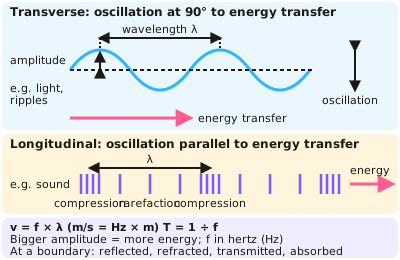
Key points
- In a transverse wave, oscillations are perpendicular to the direction of energy transfer (e.g. light, water ripples). In a longitudinal wave, oscillations are parallel to energy transfer (e.g. sound).
- Amplitude is the maximum displacement from rest; wavelength is the distance between equivalent points on adjacent waves; frequency is the number of waves per second in hertz.
- Wave speed: v = fλ. Period T = 1 ÷ f.
- Waves can be reflected, refracted (changing speed and often direction when entering a new medium), transmitted or absorbed at a boundary.
In more detail
- Worked wave speed: a wave with frequency 50 Hz and wavelength 0.40 m has v = 50 × 0.40 = 20 m/s.
- Worked period: f = 250 Hz → T = 1 ÷ 250 = 0.004 s (4 ms).
- Refraction explained: when a wave enters a medium where it slows down at an angle, one side of the wavefront slows first, so the wave bends towards the normal.
- Examples: light and water ripples are transverse; sound and P-waves are longitudinal, with compressions and rarefactions.
Practice
Wave properties: 6 questions
Pick an answer to check it, or open the answer for the explanation.
1. Which is a longitudinal wave?
- Light
- Sound
- Radio waves
- Water ripples
Show answer
B: Sound. Sound waves compress and rarefy the medium along the direction of travel.
2. A wave has frequency 20 Hz and wavelength 3 m. What is its speed?
- 6.7 m/s
- 23 m/s
- 60 m/s
- 0.15 m/s
Show answer
C: 60 m/s. v = fλ = 20 × 3 = 60 m/s.
3. What is the amplitude of a wave?
- Distance between two peaks
- Maximum displacement from the rest position
- Number of waves per second
- The speed of the wave
Show answer
B: Maximum displacement from the rest position. Amplitude relates to the energy carried by the wave.
4. What is the period of a wave with frequency 4 Hz?
- 0.25 s
- 4 s
- 40 s
- 0.04 s
Show answer
A: 0.25 s. T = 1 ÷ f = 1 ÷ 4 = 0.25 s.
5. What happens when a wave refracts?
- It bounces back
- It changes speed, often changing direction, on entering a new medium
- It is absorbed
- Its frequency changes
Show answer
B: It changes speed, often changing direction, on entering a new medium. Refraction occurs because wave speed differs between media.
6. Which type of wave has oscillations parallel to the direction of travel?
- Transverse
- Longitudinal
- Electromagnetic
- Standing
Show answer
B: Longitudinal. Sound is a common example.
Keep going in Full Marks
Full Marks has 44 questions on Wave properties (38 more than here), set out in practice levels. You also get notes and 3D models for all 7 subtopics of Waves, plus games, timed exams and past papers.