GCSE Physics · Topic 5
Forces
Forces explains how and why things move, speed up, slow down or stay still.
We will look at scalars and vectors, resultant forces and resolving forces, then Newton's three laws of motion, including the required practical on force, mass and acceleration.
We also cover elasticity and springs, moments, pressure, stopping distances and momentum.
- 9 subtopics
- 561 questions
- Free: 5.1 notes and 6 questions
In this topic
- 5.1Forces and motionFree below · 50 questions
- 5.2Elasticity, moments and pressureOpen in Full Marks · 53 questions
- 5.3Scalars, vectors and resultant forcesOpen in Full Marks · 70 questions
- 5.4Resolving forces and vector diagrams (Higher tier)Open in Full Marks · 57 questions
- 5.5Newton's first law and inertiaOpen in Full Marks · 66 questions
- 5.6Newton's second law (F = ma) and inertial massOpen in Full Marks · 68 questions
- 5.7Required practical: force, mass and accelerationOpen in Full Marks · 70 questions
- 5.8Newton's third law and interaction pairsOpen in Full Marks · 63 questions
- 5.9Moments, levers and gearsOpen in Full Marks · 64 questions
5.1 · Free notes
Forces and motion
Key points
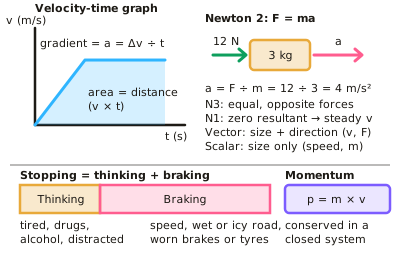
- Scalars have magnitude only (speed, distance, mass); vectors have magnitude and direction (velocity, displacement, force).
- Newton's first law: an object stays at rest or at constant velocity unless acted on by a resultant force. Second law: F = ma. Third law: when two objects interact, forces are equal and opposite.
- Acceleration a = Δv ÷ t; distance-time graph gradient gives speed; velocity-time graph gradient gives acceleration and area gives distance.
- Stopping distance = thinking distance + braking distance. Thinking distance increases with tiredness, alcohol, drugs and distractions; braking distance increases with speed, wet or icy roads and poor brakes or tyres.
- Momentum p = mv, and momentum is conserved in a closed system.
In more detail
- Worked acceleration: a car goes from 5 m/s to 25 m/s in 4.0 s → a = (25 − 5) ÷ 4.0 = 5.0 m/s².
- Worked distance from v–t graph: a car at a constant 20 m/s for 10 s travels 200 m (area of the rectangle).
- Equation of motion: v² − u² = 2as; e.g. from rest with a = 2.0 m/s² over 25 m → v = √(2 × 2.0 × 25) = 10 m/s.
- Worked momentum: a 70 kg runner at 8.0 m/s has p = 560 kg m/s.
Practice
Forces and motion: 6 questions
Pick an answer to check it, or open the answer for the explanation.
1. A resultant force of 12 N acts on a 3 kg mass. What is its acceleration?
- 0.25 m/s²
- 4 m/s²
- 9 m/s²
- 36 m/s²
Show answer
B: 4 m/s². a = F ÷ m = 12 ÷ 3 = 4 m/s².
2. Which quantity is a vector?
- Speed
- Distance
- Velocity
- Mass
Show answer
C: Velocity. Velocity has both magnitude and direction.
3. What does the area under a velocity-time graph represent?
- Acceleration
- Distance travelled
- Force
- Momentum
Show answer
B: Distance travelled. Area = velocity × time = distance.
4. What is the momentum of a 1500 kg car travelling at 20 m/s?
- 75 kg m/s
- 3 000 kg m/s
- 30 000 kg m/s
- 300 000 kg m/s
Show answer
C: 30 000 kg m/s. p = mv = 1500 × 20 = 30 000 kg m/s.
5. Which factor increases thinking distance?
- Worn brakes
- Icy road
- Tiredness or alcohol
- Under-inflated tyres
Show answer
C: Tiredness or alcohol. Thinking distance depends on reaction time, not the car's condition.
6. A 1000 kg car accelerates from rest to 20 m/s in 10 s. What is the resultant force? (assume constant acceleration)
- 200 N
- 1000 N
- 2000 N
- 20 000 N
Show answer
C: 2000 N. a = 2 m/s², F = ma = 1000 × 2 = 2000 N.
Keep going in Full Marks
Full Marks has 50 questions on Forces and motion (44 more than here), set out in practice levels. You also get notes and 3D models for all 9 subtopics of Forces, plus games, timed exams and past papers.