GCSE Physics · Topic 7
Magnetism and electromagnetism
Magnetism and electromagnetism explains how magnets and electric currents are linked, and how that link powers motors, speakers, generators and transformers.
We will look at magnetic fields, electromagnets and solenoids, and the motor effect, including Fleming's left-hand rule and F = BIl.
Then we cover electric motors and loudspeakers, electromagnetic induction in generators and microphones, and transformers.
- 7 subtopics
- 314 questions
- Free: 7.1 notes and 6 questions
In this topic
- 7.1Magnets and the motor effectFree below · 50 questions
- 7.2Induction and transformersOpen in Full Marks · 51 questions
- 7.3Electromagnets, solenoids and the magnetic field of a currentOpen in Full Marks · 64 questions
- 7.4Electric motorsOpen in Full Marks · 22 questions
- 7.5Loudspeakers and headphonesOpen in Full Marks · 24 questions
- 7.6Generators: alternators, dynamos and AC/DC potential difference graphsOpen in Full Marks · 70 questions
- 7.7MicrophonesOpen in Full Marks · 33 questions
7.1 · Free notes
Magnets and the motor effect
Key points
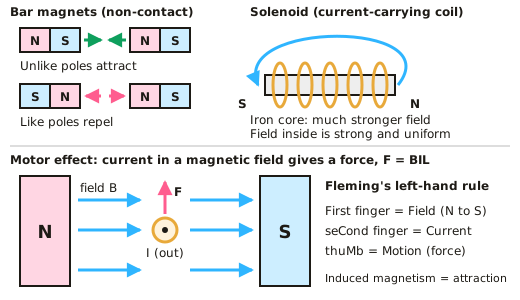
- Magnets have north and south poles; like poles repel and unlike poles attract. This force is non-contact.
- Permanent magnets produce their own magnetic field; induced magnetism occurs in magnetic materials placed in a field and is always attractive.
- A current-carrying wire produces a magnetic field; a solenoid produces a strong, uniform field inside, which is strengthened by an iron core (an electromagnet).
- The motor effect: a current-carrying conductor in a magnetic field experiences a force, F = BIL when the conductor is at right angles to the field. Fleming's left-hand rule gives the direction.
In more detail
- Field lines: go from north to south outside a magnet, never cross, and are closest together where the field is strongest (at the poles).
- Earth's field: a compass points north because the Earth has a magnetic field; the core behaves like a giant bar magnet.
- Magnetic materials: iron, steel, cobalt and nickel are magnetic; induced magnets lose most of their magnetism when the magnet is removed.
- Worked F = BIl: a 0.25 m wire carrying 2.0 A at right angles to a 0.30 T field feels F = 0.30 × 2.0 × 0.25 = 0.15 N.
Practice
Magnets and the motor effect: 6 questions
Pick an answer to check it, or open the answer for the explanation.
1. What happens when two north poles are brought together?
- They attract
- They repel
- Nothing happens
- They become neutral
Show answer
B: They repel. Like poles always repel.
2. What is induced magnetism?
- A permanent magnet losing its field
- Magnetism produced in a magnetic material placed in a magnetic field
- Magnetism from a battery only
- A field with no poles
Show answer
B: Magnetism produced in a magnetic material placed in a magnetic field. Induced magnetism always causes attraction.
3. How can the magnetic field of a solenoid be strengthened?
- Removing the current
- Adding an iron core
- Using fewer turns
- Increasing the resistance
Show answer
B: Adding an iron core. An iron core makes the field much stronger.
4. A wire of length 0.5 m carries 4 A at right angles to a 0.2 T field. What is the force on it?
- 0.1 N
- 0.4 N
- 2.5 N
- 4 N
Show answer
B: 0.4 N. F = BIL = 0.2 × 4 × 0.5 = 0.4 N.
5. What does Fleming's left-hand rule give?
- The size of the current
- The direction of the force in the motor effect
- The resistance of the wire
- The frequency of the supply
Show answer
B: The direction of the force in the motor effect. First finger field, second finger current, thumb motion.
6. What happens to a magnetic material placed near a permanent magnet?
- It is always repelled
- It becomes induced and attracted towards the magnet
- It loses all magnetism
- It becomes a permanent magnet immediately
Show answer
B: It becomes induced and attracted towards the magnet. Induced magnetism always results in attraction.
Keep going in Full Marks
Full Marks has 50 questions on Magnets and the motor effect (44 more than here), set out in practice levels. You also get notes and 3D models for all 7 subtopics of Magnetism and electromagnetism, plus games, timed exams and past papers.