GCSE Physics · Topic 8
Space physics
Space physics takes us from our own solar system to the edge of the observable universe.
We will look at the planets and moons, how stars are born, live and die, and how gravity keeps planets and satellites in orbit.
Then we see how red-shift and the cosmic microwave background give evidence for the Big Bang and an expanding universe.
- 3 subtopics
- 119 questions
- Free: 8.1 notes and 6 questions
In this topic
- 8.1The solar system and the life cycle of starsFree below · 10 questions
- 8.2Orbits and red-shiftOpen in Full Marks · 46 questions
- 8.3The Big Bang theory, expanding universe and cosmic microwave backgroundOpen in Full Marks · 63 questions
8.1 · Free notes
The solar system and the life cycle of stars
Key points
- Our solar system contains the Sun, eight planets and their moons, dwarf planets and asteroids, within the Milky Way galaxy.
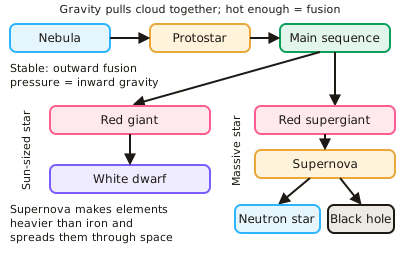
- A star forms when a cloud of dust and gas (a nebula) is pulled together by gravity, becoming a protostar; when the temperature is high enough, hydrogen nuclei fuse and a main sequence star forms.
- A star is stable in the main sequence because the outward pressure from fusion balances the inward force of gravity.
- A star like the Sun becomes a red giant, then a white dwarf. A much more massive star becomes a red supergiant, explodes as a supernova, and leaves a neutron star or black hole.
- Elements heavier than iron are produced in supernova explosions, which also distribute the elements through space.
In more detail
- Life cycle (Sun-sized): nebula → protostar → main sequence → red giant → white dwarf (→ black dwarf).
- Life cycle (massive star): nebula → protostar → main sequence → red supergiant → supernova → neutron star or black hole.
- Fusion in stars: main-sequence stars fuse hydrogen into helium; larger stars later fuse heavier elements up to iron in their cores.
- Our solar system: the Sun, 8 planets (Mercury, Venus, Earth, Mars, Jupiter, Saturn, Uranus, Neptune), dwarf planets such as Pluto, moons, asteroids and comets, all within the Milky Way galaxy.
Practice
The solar system and the life cycle of stars: 6 questions
Pick an answer to check it, or open the answer for the explanation.
1. What force pulls the dust and gas of a nebula together to form a star?
- Magnetism
- Gravity
- Friction
- Electrostatic attraction
Show answer
B: Gravity. Gravitational attraction compresses and heats the material.
2. Why is a main sequence star stable?
- No forces act on it
- The outward pressure from fusion balances the inward pull of gravity
- Gravity switches off
- It has stopped fusing hydrogen
Show answer
B: The outward pressure from fusion balances the inward pull of gravity. The two effects are in equilibrium.
3. What does a star much more massive than the Sun become after the red supergiant stage?
- A white dwarf immediately
- It explodes as a supernova
- A nebula only
- A planet
Show answer
B: It explodes as a supernova. The supernova can leave a neutron star or black hole.
4. Where are elements heavier than iron formed?
- In main sequence stars
- In supernova explosions
- In planets
- In nebulae only
Show answer
B: In supernova explosions. The explosion also spreads these elements through space.
5. What does the Sun become after the red giant stage?
- A black hole
- A white dwarf
- A neutron star
- A supernova
Show answer
B: A white dwarf. Lower mass stars end as white dwarfs.
6. Which force keeps planets in their elliptical orbits around the Sun?
- Magnetism
- Gravity
- Friction
- Nuclear force
Show answer
B: Gravity. Gravity provides the centripetal force needed.
Keep going in Full Marks
Full Marks has 10 questions on The solar system and the life cycle of stars (4 more than here), set out in practice levels. You also get notes and 3D models for all 3 subtopics of Space physics, plus games, timed exams and past papers.