GCSE Physics · Topic 9
Motion and momentum
Motion and momentum is about describing and explaining how things move, from a sprinter on a track to cars in a collision.
We will use speed, velocity and acceleration, read distance–time and velocity–time graphs, and use the equation v² − u² = 2as.
Then we look at weight and mass, terminal velocity, stopping distances, momentum and the safety features that protect us in crashes.
- 8 subtopics
- 450 questions
- Free: 9.1 notes and 9 questions
In this topic
- 9.1Speed, velocity and accelerationFree below · 67 questions
- 9.2Distance–time and velocity–time graphsOpen in Full Marks · 65 questions
- 9.3Equations of motion: v² − u² = 2asOpen in Full Marks · 55 questions
- 9.4Weight, mass and gravitational field strengthOpen in Full Marks · 59 questions
- 9.5Terminal velocity and falling objectsOpen in Full Marks · 62 questions
- 9.6Stopping distances, reaction time and brakingOpen in Full Marks · 20 questions
- 9.7Momentum and conservation of momentumOpen in Full Marks · 60 questions
- 9.8Force, change in momentum and safety featuresOpen in Full Marks · 62 questions
9.1 · Free notes
Speed, velocity and acceleration
Key points
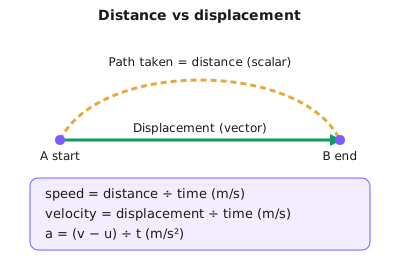
- Speed is a scalar (magnitude only): speed = distance ÷ time (v = s/t), measured in metres per second (m/s).
- Velocity is a vector: speed in a given direction, equal to displacement ÷ time. A change of direction is a change of velocity, even at constant speed.
- Distance is a scalar (total path length). Displacement is a vector (straight-line distance from start to finish, with direction). After a full lap, displacement is zero.
- Average speed = total distance ÷ total time. Use this for journeys with several stages. Do not take the mean of the stage speeds.
- Acceleration is the rate of change of velocity: a = (v − u) ÷ t, unit m/s². Here u is the initial velocity and v is the final velocity.
- A negative acceleration (deceleration) means slowing down in the direction of travel. The sign depends on which direction is chosen as positive.
- An object moving in a circle at constant speed is accelerating, because its direction, and so its velocity, is changing all the time.
- Typical values: walking ≈ 1.5 m/s, running ≈ 3 m/s, cycling ≈ 6 m/s, car ≈ 25 m/s, sound in air ≈ 330 m/s.
- Near Earth's surface, an object in free fall with no air resistance has acceleration due to gravity g ≈ 9.8 m/s². Many calculations use 10 m/s².
- Convert units first: km/h ÷ 3.6 = m/s, minutes × 60 = seconds, cm ÷ 100 = m. Show the substitution, the answer and the unit.
- Required practical (motion/acceleration): find a trolley's speed with a light gate (speed = card length ÷ time blocked) or a ticker timer. Repeat and take a mean to reduce random error.
In more detail
- Worked average speed: a train travels 120 km in 1.5 hours → 80 km/h = 80 ÷ 3.6 = 22 m/s.
- Worked acceleration: a sprinter goes from 0 to 10 m/s in 2.0 s → a = 5.0 m/s².
- Speed of sound and light: sound in air about 330–340 m/s; light 3.0 × 10⁸ m/s.
- Velocity changes with direction: a car driving round a roundabout at 20 m/s has constant speed but changing velocity.
Practice
Speed, velocity and acceleration: 9 questions
Pick an answer to check it, or open the answer for the explanation.
1. A car travels 150 m in 6.0 s at a constant speed. What is its speed?
- 900 m/s
- 144 m/s
- 25 m/s
- 0.040 m/s
Show answer
C: 25 m/s. speed = distance ÷ time = 150 ÷ 6.0 = 25 m/s.
2. A cyclist speeds up from 2.0 m/s to 8.0 m/s in 3.0 s. What is the acceleration?
- 2.0 m/s²
- 6.0 m/s²
- 3.3 m/s²
- 0.5 m/s²
Show answer
A: 2.0 m/s². a = (v − u) ÷ t = (8.0 − 2.0) ÷ 3.0 = 2.0 m/s².
3. A car travels round a roundabout at a constant 10 m/s. Which statement is correct?
- Its velocity is constant
- Its velocity is changing because its direction changes
- Its acceleration is zero because its speed is constant
- Its displacement from the start stays the same
Show answer
B: Its velocity is changing because its direction changes. Velocity is a vector. The direction keeps changing, so velocity changes and the car is accelerating even though its speed is constant.
4. A van travels at 72 km/h. What is this speed in m/s?
- 20 m/s
- 259 m/s
- 7.2 m/s
- 72 m/s
Show answer
A: 20 m/s. Divide km/h by 3.6: 72 ÷ 3.6 = 20 m/s. (72 × 3.6 = 259 is the common wrong step.)
5. Which is the most reasonable typical speed for a person walking?
- 1.5 m/s
- 15 m/s
- 150 m/s
- 0.15 m/s
Show answer
A: 1.5 m/s. A normal walking speed is about 1.5 m/s, roughly 5 km/h.
6. A trolley carries a 10 cm card that blocks a light gate for 0.050 s. What is the trolley's speed at the gate?
- 2.0 m/s
- 0.50 m/s
- 5.0 m/s
- 200 m/s
Show answer
A: 2.0 m/s. Convert 10 cm to 0.10 m. Speed = 0.10 ÷ 0.050 = 2.0 m/s.
7. Sound travels at 330 m/s in air. How long does it take to travel 1.65 km?
- 0.20 s
- 50 s
- 5.0 s
- 545 s
Show answer
C: 5.0 s. Convert 1.65 km to 1650 m. t = s ÷ v = 1650 ÷ 330 = 5.0 s.
8. Two cars travel at 20 m/s, one north and one south. Which statement is correct?
- Different speeds and different velocities
- Different speeds but same velocity
- Same speed but different velocities
- Same speed and same velocity
Show answer
C: Same speed but different velocities. Speed is a scalar, so both have the same speed. Velocity includes direction, so their velocities are different.
9. An object is dropped from rest. Taking g = 10 m/s² and ignoring air resistance, what is its speed after 3.0 s?
- 13 m/s
- 90 m/s
- 3.3 m/s
- 30 m/s
Show answer
D: 30 m/s. a = (v − u) ÷ t, so v = u + at = 0 + 10 × 3.0 = 30 m/s.
Keep going in Full Marks
Full Marks has 67 questions on Speed, velocity and acceleration (58 more than here), set out in practice levels. You also get notes and 3D models for all 8 subtopics of Motion and momentum, plus games, timed exams and past papers.