GCSE Physics · Topic 10
Forces and matter: springs and fluids
Forces and matter looks at how forces change the shape of objects and how fluids push on things.
We will carry out the required practical on springs and Hooke's law, and calculate the elastic potential energy stored in a stretched spring.
Then we explain pressure in liquids and the atmosphere, and why some objects float while others sink.
- 4 subtopics
- 219 questions
- Free: 10.1 notes and 10 questions
In this topic
- 10.1Required practical: force and extension of a spring (Hooke's law)Free below · 70 questions
- 10.2Elastic potential energy and force–extension graphsOpen in Full Marks · 64 questions
- 10.3Pressure in liquids and atmospheric pressureOpen in Full Marks · 65 questions
- 10.4Upthrust, floating and sinkingOpen in Full Marks · 20 questions
10.1 · Free notes
Required practical: force and extension of a spring (Hooke's law)
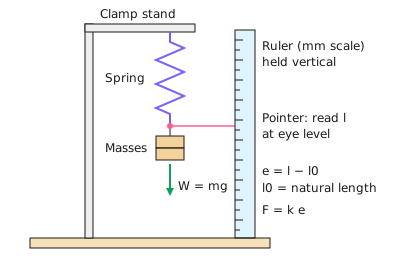
Key points
- Aim: investigate how the extension of a spring changes with the force applied, and test whether the spring obeys Hooke's law.
- Apparatus: clamp stand with boss and clamp, spring, mass hanger with 100 g masses (each weighs about 1 N), a 30 cm ruler (resolution 1 mm) and a pointer or marker on the bottom of the spring.
- Method: measure the natural length l₀ with no load. Add one 100 g mass at a time, wait for the spring to stop moving, then record the new length l each time.
- Extension e = l − l₀ (new length minus natural length). Convert cm to m before using it in equations.
- Force = weight W = m × g, with g = 9.8 N/kg (or 10 N/kg). A 0.100 kg mass weighs about 1 N.
- Variables: independent = force (mass added); dependent = extension; control = same spring, same ruler, same fixed top support.
- Reducing error: keep the ruler vertical and read at eye level next to the pointer to avoid parallax error. Repeat the readings and take a mean.
- Hooke's law: F = k e. Extension is directly proportional to force up to the limit of proportionality. k is the spring constant in N/m (F in N, e in m).
- Graph: plot force (y-axis) against extension (x-axis). A straight line through the origin shows direct proportionality, and the gradient = k. The line curves once the limit of proportionality is exceeded.
- Safety and validity: wear eye protection (a spring or mass may fly off) and place a soft pad under the masses. Do not overload the spring. Check that it returns to l₀ when unloaded, which shows the elastic limit was not exceeded.
In more detail
- Worked spring constant: a 4.0 N force gives an extension of 0.080 m → k = 4.0 ÷ 0.080 = 50 N/m.
- Gradient method: on a force (y) against extension (x) graph, the gradient of the straight part equals k.
- Using a pointer: fix a pointer (e.g. a splint) to the bottom of the spring and read its position against a vertical ruler, using a set square for accuracy.
- Limit of proportionality: the point where the graph starts to curve; beyond it, extension increases more for each extra newton.
Practice
Required practical: force and extension of a spring (Hooke's law): 10 questions
Pick an answer to check it, or open the answer for the explanation.
1. Why is the natural length of the spring measured before any masses are added?
- To work out the weight of the hanger
- To check the ruler is accurate
- To calculate each extension by subtracting it from the loaded length
- To find the spring's mass
Show answer
C: To calculate each extension by subtracting it from the loaded length. Extension = new length − natural length, so the unloaded length is needed as the starting reference for every reading.
2. A spring has natural length 8.0 cm. With a 3.0 N load its length is 14.0 cm. What is the extension in metres?
- 0.060 m
- 6.0 m
- 0.22 m
- 0.14 m
Show answer
A: 0.060 m. Extension = 14.0 − 8.0 = 6.0 cm = 0.060 m. Using the total length, or leaving the answer in cm, are common errors.
3. A force of 4.0 N stretches a spring by 5.0 cm. Assuming Hooke's law applies, what is its spring constant?
- 0.0125 N/m
- 80 N/m
- 20 N/m
- 0.80 N/m
Show answer
B: 80 N/m. k = F ÷ e = 4.0 N ÷ 0.050 m = 80 N/m. The extension must be converted from cm to m first.
4. A 200 g mass hangs from a spring. Taking g = 10 N/kg, what force does it exert on the spring?
- 2.0 N
- 20 N
- 0.020 N
- 200 N
Show answer
A: 2.0 N. Convert to kg: 0.200 kg. W = mg = 0.200 × 10 = 2.0 N.
5. Which method best reduces parallax error when reading the spring's length?
- Add the masses more quickly
- Use a longer spring
- Read the ruler from above the spring
- Read the ruler at eye level, with a pointer touching the scale
Show answer
D: Read the ruler at eye level, with a pointer touching the scale. Parallax error arises when the eye is not level with the reading. A pointer next to the scale, read at eye level, avoids it.
6. Which graph shows that a spring obeys Hooke's law?
- A curve through the origin getting steeper
- A horizontal line
- A straight line through the origin of force against extension
- A straight line with a positive intercept on the force axis
Show answer
C: A straight line through the origin of force against extension. Hooke's law means force is directly proportional to extension, so the graph is a straight line through the origin.
7. On a force–extension graph, the line is straight and then curves over at point P. What does this show?
- The limit of proportionality has been exceeded
- The spring has become heavier
- The natural length has doubled
- The force is no longer being applied
Show answer
A: The limit of proportionality has been exceeded. After P, extension is no longer directly proportional to force, so the spring has passed its limit of proportionality.
8. For a graph of force (y-axis) against extension in metres (x-axis), what does the gradient of the straight section give?
- The extension per newton
- The spring constant in N/m
- The natural length
- The work done
Show answer
B: The spring constant in N/m. Gradient = change in F ÷ change in e = k. The extension per newton would be the gradient if the axes were swapped.
9. In the Hooke's law investigation, which is the dependent variable?
- The extension of the spring
- The force applied
- The spring used
- The ruler used
Show answer
A: The extension of the spring. The force is changed by the student (independent). The extension is measured as a result, so it is the dependent variable.
10. Forces of 1, 2, 3 and 4 N give extensions of 2.0, 4.0, 6.0 and 9.0 cm. Between which forces does the spring stop obeying Hooke's law?
- It obeys it throughout
- 2 N and 3 N
- 3 N and 4 N
- 1 N and 2 N
Show answer
C: 3 N and 4 N. Up to 3 N the extension is 2.0 cm per newton. At 4 N it should be 8.0 cm but is 9.0 cm, so proportionality fails between 3 N and 4 N.
Keep going in Full Marks
Full Marks has 70 questions on Required practical: force and extension of a spring (Hooke's law) (60 more than here), set out in practice levels. You also get notes and 3D models for all 4 subtopics of Forces and matter: springs and fluids, plus games, timed exams and past papers.