GCSE Physics · Topic 11
Light and optics
Light and optics explores how light reflects, refracts and is focused by lenses, and how objects get their colour.
We will draw ray diagrams for mirrors and lenses, carry out the required practicals on reflection and refraction, and work out magnification.
Then we look at infrared radiation, black-body radiation, and the required practical on how surfaces emit and absorb infrared.
- 7 subtopics
- 273 questions
- Free: 11.1 notes and 10 questions
In this topic
- 11.1Reflection of light, plane mirrors and ray diagramsFree below · 51 questions
- 11.2Refraction of light and required practical with a glass blockOpen in Full Marks · 51 questions
- 11.3Colour, transmission and absorption of lightOpen in Full Marks · 52 questions
- 11.4Convex and concave lensesOpen in Full Marks · 33 questions
- 11.5Lens ray diagrams, real and virtual images and magnificationOpen in Full Marks · 31 questions
- 11.6Black-body radiation and infrared emissionOpen in Full Marks · 28 questions
- 11.7Required practical: infrared radiation emission and absorption by surfacesOpen in Full Marks · 27 questions
11.1 · Free notes
Reflection of light, plane mirrors and ray diagrams
Key points
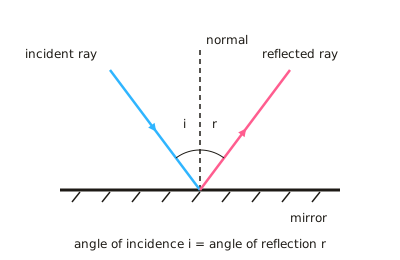
- Reflection is when a wave bounces off a boundary. Light follows the law of reflection: angle of incidence = angle of reflection (i = r).
- The normal is an imaginary line drawn at 90° to the surface at the point of incidence. All angles are measured between the ray and the normal, never between the ray and the mirror.
- The incident ray, the reflected ray and the normal all lie in the same plane. A ray that travels along the normal has i = 0° and is reflected straight back along its own path.
- The angle between the incident and reflected rays is 2i. If a ray makes 30° with the mirror surface, then i = 90° − 30° = 60°.
- Specular reflection happens at a smooth, shiny surface such as a mirror. Parallel rays stay parallel after reflection, so a clear image forms.
- Diffuse reflection happens at a rough or matt surface such as paper. The normals point in many directions, so the reflected rays scatter. The law of reflection is still obeyed at every point.
- A plane mirror forms an image that is virtual, upright, the same size as the object and laterally inverted (left and right swapped).
- The image appears as far behind the mirror as the object is in front, so the object-to-image distance is twice the object-to-mirror distance.
- A virtual image cannot be projected onto a screen. The light does not actually pass through the image position; the rays only appear to come from it.
- In ray diagrams, draw real rays as solid lines with arrows. Extend the reflected rays backwards behind the mirror as dashed lines to locate the virtual image where they meet.
- Required practical (reflection): shine a narrow ray from a ray box at a plane mirror. Mark the ray and the normal, measure i and r with a protractor for several angles, and show that r = i within experimental error.
- Use a sharp pencil and a narrow ray to reduce uncertainty in the angles. Repeat the readings to spot anomalies.
In more detail
- Worked angles: a ray hits a mirror at 40° to the surface → angle of incidence (from the normal) = 50°, so the angle of reflection is 50°.
- Periscope: two plane mirrors at 45° reflect light twice, letting you see over obstacles.
- Why you see an image: reflected rays reach your eye and your brain assumes light travels in straight lines, so the image appears behind the mirror.
- Lateral inversion: writing looks reversed left to right in a plane mirror, which is why 'AMBULANCE' is written backwards on the front of ambulances.
Practice
Reflection of light, plane mirrors and ray diagrams: 10 questions
Pick an answer to check it, or open the answer for the explanation.
1. A ray of light hits a plane mirror with an angle of incidence of 35°. What is the angle between the incident ray and the reflected ray?
- 110°
- 70°
- 55°
- 35°
Show answer
B: 70°. The angle of reflection also equals 35°, so the angle between the two rays is 35° + 35° = 70°.
2. A ray hits a plane mirror so that it makes an angle of 25° with the surface of the mirror. What is the angle of reflection?
- 90°
- 65°
- 50°
- 25°
Show answer
B: 65°. Angles are measured from the normal. i = 90° − 25° = 65°, and the angle of reflection equals the angle of incidence, so r = 65°.
3. What is the 'normal' in a ray diagram for reflection?
- A line along the mirror surface
- A line at 90° to the surface at the point of incidence
- The path of the reflected ray
- A line joining object and image
Show answer
B: A line at 90° to the surface at the point of incidence. The normal is an imaginary line drawn perpendicular (90°) to the surface where the ray strikes. Both angles are measured from it.
4. Sam stands 2.0 m in front of a plane mirror. How far is Sam from his image?
- 8.0 m
- 4.0 m
- 2.0 m
- 1.0 m
Show answer
B: 4.0 m. The image is as far behind the mirror as the object is in front. So the distance from Sam to his image is 2.0 m + 2.0 m = 4.0 m.
5. Which list correctly describes the image formed by a plane mirror?
- Virtual, inverted, magnified
- Virtual, upright, same size, laterally inverted
- Real, inverted, same size
- Real, upright, laterally inverted
Show answer
B: Virtual, upright, same size, laterally inverted. A plane mirror gives a virtual, upright image the same size as the object, with left and right swapped (laterally inverted).
6. Why can the image in a plane mirror not be shown on a screen?
- The image is too small
- Light only appears to come from the image; it does not pass through it
- The mirror absorbs the light
- The image is upside down
Show answer
B: Light only appears to come from the image; it does not pass through it. It is a virtual image. The reflected rays only appear to diverge from a point behind the mirror, so no light actually arrives there to land on a screen.
7. Why can you see a sheet of white paper from any direction?
- It gives out its own light
- It reflects light diffusely in many directions
- It breaks the law of reflection
- It absorbs and re-emits all light
Show answer
B: It reflects light diffusely in many directions. The rough surface has normals pointing in many directions, so light scatters (diffuse reflection). The law of reflection still holds at each point.
8. Maya walks from 3.0 m to 2.0 m in front of a plane mirror. What is the new distance between her and her image?
- 2.0 m
- 3.0 m
- 4.0 m
- 6.0 m
Show answer
C: 4.0 m. Image distance equals object distance, so she is now 2.0 m from the mirror and her image is 2.0 m behind it: 2.0 + 2.0 = 4.0 m.
9. In a ray diagram, how should the lines behind a plane mirror used to locate the image be drawn?
- They should not be drawn
- Dashed lines with no arrows
- Solid lines with arrows
- Solid lines along the normal
Show answer
B: Dashed lines with no arrows. Virtual rays are not real light paths. They are drawn as dashed lines extending the reflected rays backwards to where they appear to meet.
10. In a practical, i = 20°, 40°, 60° and 80° gave r = 20°, 41°, 59° and 80°. What is the best conclusion?
- r is unrelated to i
- r is always smaller than i
- r is always bigger than i
- r equals i within measurement error
Show answer
D: r equals i within measurement error. The values differ by only ±1°, which is within the uncertainty of reading a protractor. This supports the law of reflection: r = i.
Keep going in Full Marks
Full Marks has 51 questions on Reflection of light, plane mirrors and ray diagrams (41 more than here), set out in practice levels. You also get notes and 3D models for all 7 subtopics of Light and optics, plus games, timed exams and past papers.