GCSE Maths · Topic 3
Ratio, proportion and rates of change
Ratio, proportion and rates of change is about comparing quantities and seeing how one changes with another.
We will share in ratios, use compound measures like speed and density, convert units, and work with percentages and interest.
Then we look at direct and inverse proportion, their graphs, and proportionality equations with squares, cubes and roots.
- 7 subtopics
- 371 questions
- Free: 3.1 notes and 10 questions
In this topic
- 3.1Ratio and proportionFree below · 57 questions
- 3.2Compound measures and ratesOpen in Full Marks · 68 questions
- 3.3Units and conversions (metric, imperial, time and currency)Open in Full Marks · 62 questions
- 3.4Reverse percentages and percentage changeOpen in Full Marks · 52 questions
- 3.5Compound interest, growth and decayOpen in Full Marks · 47 questions
- 3.6Direct and inverse proportion with graphsOpen in Full Marks · 47 questions
- 3.7Proportionality equations (y ∝ x², y ∝ 1/x, y ∝ x³)Open in Full Marks · 38 questions
3.1 · Free notes
Ratio and proportion
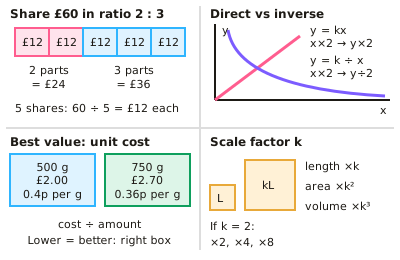
Key points
- To share an amount in a ratio, add the parts to find the total number of shares, then divide the amount by that total.
- Direct proportion: y = kx, so doubling one quantity doubles the other. Inverse proportion: y = k ÷ x, so doubling one halves the other.
- Best value problems compare unit cost (cost per gram, per item, etc.).
- Scale factors for similar shapes: length ×k, area ×k², volume ×k³.
In more detail
- Worked sharing: £240 in the ratio 3 : 5 → 8 parts, £30 each → £90 and £150.
- Worked difference: in the ratio 2 : 7 one share is £35 more than the other → 5 parts = £35 → 1 part = £7 → £14 and £49.
- Worked best value: 500 g for £2.40 is 48p per 100 g; 750 g for £3.45 is 46p per 100 g, so the larger pack is better value.
- Worked ratio to fraction: boys : girls = 3 : 4 → boys are 3/7 of the class.
- Worked scale factors: multiplying lengths by 3 multiplies area by 3² = 9 and volume by 3³ = 27.
Practice
Ratio and proportion: 10 questions
Pick an answer to check it, or open the answer for the explanation.
1. Share £60 in the ratio 2 : 3
- £20 and £40
- £24 and £36
- £30 and £30
- £25 and £35
Show answer
B: £24 and £36. 5 parts, so one part is £12: 2 × 12 = £24 and 3 × 12 = £36.
2. y is directly proportional to x, and y = 12 when x = 3. What is y when x = 5?
- 15
- 20
- 24
- 4
Show answer
B: 20. k = 4, so y = 4 × 5 = 20.
3. Two similar shapes have lengths in ratio 1 : 3. What is the ratio of their areas?
- 1 : 3
- 1 : 6
- 1 : 9
- 1 : 27
Show answer
C: 1 : 9. Area scale factor is the square of the length scale factor.
4. If y is inversely proportional to x and y = 10 when x = 2, what is y when x = 5?
- 4
- 10
- 25
- 2
Show answer
A: 4. k = 20, so y = 20 ÷ 5 = 4.
5. A recipe for 4 people uses 200 g of rice. How much is needed for 10 people?
- 400 g
- 500 g
- 800 g
- 250 g
Show answer
B: 500 g. 200 ÷ 4 × 10 = 500 g.
6. Share 84 in the ratio 3 : 4
- 36 and 48
- 42 and 42
- 30 and 54
- 21 and 63
Show answer
A: 36 and 48. 7 parts, so one part is 12.
7. Two similar solids have lengths in ratio 1 : 2. What is the ratio of their volumes?
- 1 : 2
- 1 : 4
- 1 : 6
- 1 : 8
Show answer
D: 1 : 8. Volume scale factor is the cube of the length scale factor.
8. A 500 g pack costs £2.00 and a 750 g pack costs £2.85. Which is better value?
- The 500 g pack
- The 750 g pack
- They are the same
- Cannot be determined
Show answer
B: The 750 g pack. £0.40 per 100 g against £0.38 per 100 g.
9. £150 is shared in the ratio 2 : 3 : 5. What is the largest share?
- £15
- £30
- £50
- £75
Show answer
D: £75. Total shares = 10, so one share = £15. The largest share is 5 × £15 = £75. £50 comes from dividing by 3, and £15 is just one share.
10. What is 18 : 24 in its simplest form?
- 3 : 4
- 6 : 8
- 9 : 12
- 4 : 3
Show answer
A: 3 : 4. Divide both parts by the highest common factor, 6, to get 3 : 4. 6 : 8 and 9 : 12 are equivalent but not simplest. 4 : 3 is in the wrong order.
Keep going in Full Marks
Full Marks has 57 questions on Ratio and proportion (47 more than here), set out in practice levels. You also get notes and 3D models for all 7 subtopics of Ratio, proportion and rates of change, plus games, timed exams and past papers.