GCSE Maths · Topic 4
Geometry and measures
Geometry and measures is about shapes, angles, lengths, areas and volumes, and how shapes move and relate to each other.
We will use angle rules, Pythagoras and trigonometry, and calculate areas, volumes and surface areas.
Then we study transformations, vectors, circle theorems, congruence and similarity, constructions and loci, and bearings.
- 8 subtopics
- 489 questions
- Free: 4.1 notes and 10 questions
In this topic
- 4.1Angles, shapes and PythagorasFree below · 54 questions
- 4.2Trigonometry, area and volumeOpen in Full Marks · 69 questions
- 4.3Transformations: translation, reflection, rotation and enlargementOpen in Full Marks · 59 questions
- 4.4Vectors and vector geometryOpen in Full Marks · 53 questions
- 4.5Circle theoremsOpen in Full Marks · 65 questions
- 4.6Congruence and similarityOpen in Full Marks · 60 questions
- 4.7Constructions and lociOpen in Full Marks · 68 questions
- 4.8Bearings and scale drawingsOpen in Full Marks · 61 questions
4.1 · Free notes
Angles, shapes and Pythagoras
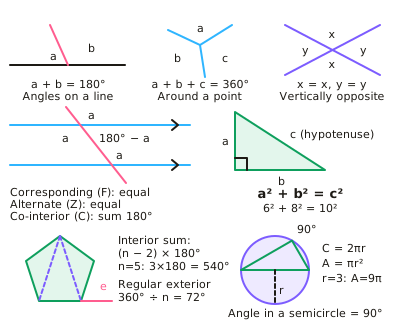
Key points
- Angles on a straight line sum to 180°; angles around a point sum to 360°; vertically opposite angles are equal.
- For parallel lines: corresponding angles are equal, alternate angles are equal, and co-interior angles sum to 180°.
- The interior angles of a polygon sum to (n − 2) × 180°; each exterior angle of a regular polygon is 360° ÷ n.
- Pythagoras' theorem: a² + b² = c², where c is the hypotenuse of a right-angled triangle.
- Circle facts: circumference = 2πr, area = πr²; the angle in a semicircle is 90°.
In more detail
- Worked parallel lines: if one angle is 65°, its alternate angle is 65° and its co-interior angle is 180° − 65° = 115°.
- Worked polygon angles: a hexagon's interior angles add to (6 − 2) × 180° = 720°; a regular hexagon has 120° each.
- Worked number of sides: a regular polygon with exterior angle 24° has 360 ÷ 24 = 15 sides.
- Worked Pythagoras: legs 6 cm and 8 cm → hypotenuse √(36 + 64) = 10 cm; hypotenuse 13 cm and leg 5 cm → other leg √(169 − 25) = 12 cm.
- Worked circle: radius 7 cm → circumference 2π × 7 = 44.0 cm, area π × 7² = 153.9 cm².
- Worked 3D Pythagoras: a 3 × 4 × 12 cuboid has a space diagonal of √(9 + 16 + 144) = 13.
Practice
Angles, shapes and Pythagoras: 10 questions
Pick an answer to check it, or open the answer for the explanation.
1. A right-angled triangle has shorter sides 6 cm and 8 cm. How long is the hypotenuse?
- 10 cm
- 12 cm
- 14 cm
- 48 cm
Show answer
A: 10 cm. √(36 + 64) = √100 = 10 cm.
2. What is the sum of the interior angles of a pentagon?
- 360°
- 540°
- 720°
- 900°
Show answer
B: 540°. (5 − 2) × 180 = 540°.
3. What is the area of a circle with radius 3 cm?
- 6π cm²
- 9π cm²
- 3π cm²
- 12π cm²
Show answer
B: 9π cm². A = πr² = 9π cm².
4. Each exterior angle of a regular polygon is 40°. How many sides does it have?
- 8
- 9
- 10
- 12
Show answer
B: 9. 360 ÷ 40 = 9 sides.
5. Two parallel lines are cut by a transversal. Co-interior angles:
- Are equal
- Sum to 180°
- Sum to 90°
- Sum to 360°
Show answer
B: Sum to 180°. Co-interior (allied) angles are supplementary.
6. What is the size of each exterior angle of a regular hexagon?
- 45°
- 60°
- 72°
- 120°
Show answer
B: 60°. 360 ÷ 6 = 60°.
7. A triangle has sides 5 cm and 12 cm with a right angle between them. What is the hypotenuse?
- 13 cm
- 17 cm
- 7 cm
- 60 cm
Show answer
A: 13 cm. √(25 + 144) = 13.
8. What is the circumference of a circle with diameter 10 cm?
- 10π cm
- 20π cm
- 25π cm
- 5π cm
Show answer
A: 10π cm. C = πd = 10π cm.
9. Angles on a straight line meet at a point. One angle is 65°. What is the other angle?
- 105°
- 295°
- 25°
- 115°
Show answer
D: 115°. Angles on a straight line sum to 180°, so 180° − 65° = 115°. 25° comes from wrongly using 90°, and 295° from using 360°.
10. Angles of 90°, 130° and 75° meet at a point with a fourth angle x. What is x?
- 65°
- 95°
- 115°
- 25°
Show answer
A: 65°. Angles around a point sum to 360°. 90 + 130 + 75 = 295, so x = 360° − 295° = 65°.
Keep going in Full Marks
Full Marks has 54 questions on Angles, shapes and Pythagoras (44 more than here), set out in practice levels. You also get notes and 3D models for all 8 subtopics of Geometry and measures, plus games, timed exams and past papers.