GCSE Maths · Topic 2
Algebra
Algebra is the language of maths: using letters to describe patterns, solve problems and prove results.
We will expand and factorise, solve equations and inequalities, and work with straight-line graphs, sequences and simultaneous equations.
Then we solve quadratics, complete the square, handle algebraic fractions, functions and iteration, and write algebraic proofs.
- 8 subtopics
- 300 questions
- Free: 2.1 notes and 10 questions
In this topic
- 2.1Expressions, equations and inequalitiesFree below · 33 questions
- 2.2Graphs, sequences and simultaneous equationsOpen in Full Marks · 45 questions
- 2.3Solving quadratic equations by factorising and the formulaOpen in Full Marks · 30 questions
- 2.4Completing the square and turning pointsOpen in Full Marks · 49 questions
- 2.5Algebraic fractions and rearranging formulaeOpen in Full Marks · 29 questions
- 2.6Functions: notation, composite and inverse functionsOpen in Full Marks · 27 questions
- 2.7Iteration and numerical methodsOpen in Full Marks · 50 questions
- 2.8Algebraic proof and identitiesOpen in Full Marks · 37 questions
2.1 · Free notes
Expressions, equations and inequalities
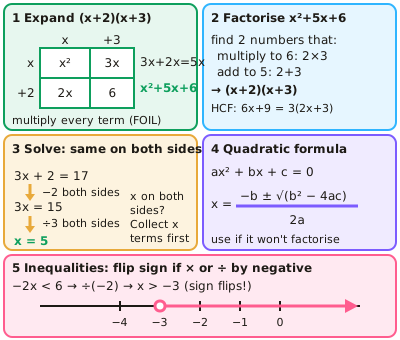
Key points
- Expanding brackets: multiply every term inside by the term outside; for double brackets use FOIL.
- Factorising: take out common factors, or for quadratics x² + bx + c find two numbers that multiply to c and add to b.
- Solving equations: do the same operation to both sides. For equations with unknowns on both sides, collect terms first.
- Quadratic formula: x = (−b ± √(b² − 4ac)) ÷ 2a, used when a quadratic doesn't factorise easily.
- Inequalities are solved like equations, but the inequality sign reverses when multiplying or dividing by a negative number.
In more detail
- Worked expanding: (x + 3)(x − 5) = x² − 5x + 3x − 15 = x² − 2x − 15; 3(2x − 4) − 2(x − 1) = 6x − 12 − 2x + 2 = 4x − 10.
- Worked factorising: 6x² + 9x = 3x(2x + 3); x² + 7x + 12 = (x + 3)(x + 4); x² − 49 = (x − 7)(x + 7).
- Worked equations: 5x − 3 = 2x + 9 → 3x = 12 → x = 4; (x + 2)/3 = 5 → x + 2 = 15 → x = 13.
- Worked inequality: 7 − 2x > 1 → −2x > −6 → x < 3 (the sign flips when dividing by −2).
- Worked integer values: −2 < x ≤ 3 gives x = −1, 0, 1, 2, 3.
Practice
Expressions, equations and inequalities: 10 questions
Pick an answer to check it, or open the answer for the explanation.
1. Expand (x + 3)(x + 2)
- x² + 6
- x² + 5x + 6
- x² + 5x + 5
- 2x + 5
Show answer
B: x² + 5x + 6. x² + 2x + 3x + 6 = x² + 5x + 6.
2. Solve 3x + 5 = 20
- x = 3
- x = 5
- x = 8.3
- x = 15
Show answer
B: x = 5. 3x = 15, so x = 5.
3. Factorise x² + 7x + 12
- (x + 3)(x + 4)
- (x + 2)(x + 6)
- (x + 12)(x + 1)
- (x − 3)(x − 4)
Show answer
A: (x + 3)(x + 4). 3 × 4 = 12 and 3 + 4 = 7.
4. Solve −2x > 6
- x > −3
- x < −3
- x > 3
- x < 3
Show answer
B: x < −3. Dividing by a negative reverses the inequality.
5. Solve x² − 5x + 6 = 0
- x = 1 or 6
- x = −2 or −3
- x = 2 or 3
- x = −1 or 6
Show answer
C: x = 2 or 3. (x − 2)(x − 3) = 0.
6. Solve 5x − 7 = 2x + 8
- x = 3
- x = 5
- x = 15
- x = 1
Show answer
B: x = 5. 3x = 15, so x = 5.
7. Factorise 6x + 9
- 3(2x + 3)
- 6(x + 9)
- 3(2x + 9)
- 9(x + 1)
Show answer
A: 3(2x + 3). 3 is the highest common factor.
8. Solve the inequality 4x + 3 ≤ 19
- x ≤ 4
- x ≥ 4
- x ≤ 5.5
- x ≥ 5.5
Show answer
A: x ≤ 4. 4x ≤ 16, so x ≤ 4.
9. Expand and simplify (x + 5)².
- x² + 10x + 25
- x² + 10x + 10
- x² + 25
- x² + 5x + 25
Show answer
A: x² + 10x + 25. (x + 5)(x + 5) = x² + 5x + 5x + 25 = x² + 10x + 25. Squaring a bracket does not just square each term, so x² + 25 is wrong.
10. A taxi charges £3 plus £2 per km. A journey costs £15. How far was the journey?
- 36 km
- 7.5 km
- 6 km
- 9 km
Show answer
C: 6 km. 3 + 2d = 15, so 2d = 12 and d = 6 km. Dividing 15 by 2 ignores the £3 fixed charge.
Keep going in Full Marks
Full Marks has 33 questions on Expressions, equations and inequalities (23 more than here), set out in practice levels. You also get notes and 3D models for all 8 subtopics of Algebra, plus games, timed exams and past papers.
On your exam board
- AQATopic 2.1: Algebra: notation, manipulation and proof, Topic 2.3: Algebra: solving equations and inequalities, Topic 2.4: Algebra: sequences
- OCR ATopic 2.1: Algebra: notation, manipulation and proof, Topic 2.3: Algebra: solving equations and inequalities, Topic 2.4: Algebra: sequences
- EdexcelTopic 2.1: Algebra: notation, manipulation and proof, Topic 2.3: Algebra: solving equations and inequalities, Topic 2.4: Algebra: sequences
- CambridgeTopic 2: Algebra and graphs