GCSE Maths · Topic 5
Probability
Probability is the maths of chance: how likely things are, and what we should expect to happen.
We will use probability scales, tree diagrams and two-way tables, and estimate probabilities from experiments.
Then we use set notation and Venn diagrams, and work with conditional probability and dependent events.
- 4 subtopics
- 256 questions
- Free: 5.1 notes and 10 questions
In this topic
- 5.1Probability and diagramsFree below · 68 questions
- 5.2Relative frequency and expected outcomesOpen in Full Marks · 66 questions
- 5.3Set notation and Venn diagramsOpen in Full Marks · 58 questions
- 5.4Conditional probability and dependent eventsOpen in Full Marks · 64 questions
5.1 · Free notes
Probability and diagrams
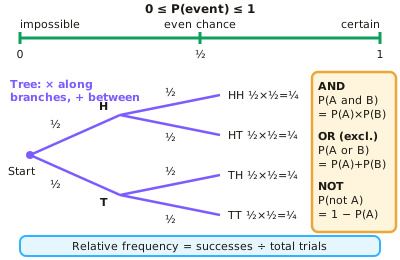
Key points
- Probability of an event is between 0 and 1; P(not A) = 1 − P(A).
- For independent events, P(A and B) = P(A) × P(B). For mutually exclusive events, P(A or B) = P(A) + P(B).
- Tree diagrams show successive events: multiply along branches and add between different branches.
- Venn diagrams and two-way tables organise data for probability calculations, including 'and', 'or' and 'not' situations.
- Relative frequency = number of successes ÷ total trials, becoming more reliable with more trials.
In more detail
- Worked complement: P(rain) = 0.35 → P(no rain) = 1 − 0.35 = 0.65.
- Worked independent events: P(head and a six) = ½ × 1/6 = 1/12.
- Worked tree diagram: P(pass test 1) = 0.8 and P(pass test 2) = 0.7 → P(exactly one pass) = 0.8 × 0.3 + 0.2 × 0.7 = 0.24 + 0.14 = 0.38.
- Worked missing probability: red 0.3, blue 0.25, green x, yellow 2x → 3x = 1 − 0.55 = 0.45 → x = 0.15, so P(yellow) = 0.30.
- Worked two-way table: in a class of 30, 5 are girls who wear glasses → P(girl with glasses) = 5/30 = 1/6.
Practice
Probability and diagrams: 10 questions
Pick an answer to check it, or open the answer for the explanation.
1. P(rain) = 0.35. What is P(no rain)?
- 0.35
- 0.55
- 0.65
- 1.35
Show answer
C: 0.65. 1 − 0.35 = 0.65.
2. A fair coin is flipped twice. What is P(two heads)?
- 1/2
- 1/4
- 1/3
- 3/4
Show answer
B: 1/4. ½ × ½ = ¼.
3. On a tree diagram, how do you find the probability of a specific path?
- Add the probabilities along the branches
- Multiply the probabilities along the branches
- Subtract them
- Divide them
Show answer
B: Multiply the probabilities along the branches. Successive independent events multiply.
4. A bag has 3 red and 5 blue balls. What is P(red)?
- 3/5
- 3/8
- 5/8
- 1/3
Show answer
B: 3/8. 3 red out of 8 balls in total.
5. What makes relative frequency a better estimate of probability?
- Fewer trials
- More trials
- A biased sample
- Using theory only
Show answer
B: More trials. Larger samples reduce the effect of random variation.
6. A bag has 4 red and 6 green counters. Two are taken without replacement. What is P(both red)?
- 4/25
- 2/15
- 1/5
- 1/15
Show answer
B: 2/15. (4/10) × (3/9) = 12/90 = 2/15.
7. A spinner has 5 equal sections numbered 1-5. What is P(even number)?
- 1/5
- 2/5
- 1/2
- 3/5
Show answer
B: 2/5. 2 and 4 are even, out of 5 sections.
8. Events A and B are mutually exclusive with P(A) = 0.3 and P(B) = 0.45. What is P(A or B)?
- 0.135
- 0.75
- 0.15
- 0.3
Show answer
B: 0.75. For mutually exclusive events, add the probabilities.
9. Which of these values could NOT be the probability of an event?
- 1
- 1.2
- 0
- 0.07
Show answer
B: 1.2. Probabilities lie between 0 and 1 inclusive. 1.2 is greater than 1, so it is impossible. 0 means impossible and 1 means certain, and both are allowed.
10. The probability a bus is late is 0.15 on any day, independently. What is P(late on both Monday and Tuesday)?
- 0.0225
- 0.15
- 0.225
- 0.3
Show answer
A: 0.0225. For independent events multiply: 0.15 × 0.15 = 0.0225. Adding gives 0.3, which is wrong because 'and' needs multiplication.
Keep going in Full Marks
Full Marks has 68 questions on Probability and diagrams (58 more than here), set out in practice levels. You also get notes and 3D models for all 4 subtopics of Probability, plus games, timed exams and past papers.
On your exam board
- AQATopic 5: Probability
- OCR ATopic 5: Probability
- EdexcelTopic 5: Probability
- CambridgeTopic 1: Number, Topic 8: Probability