GCSE Maths · Topic 1
Number
Number is the foundation of GCSE Maths: working accurately with fractions, percentages, powers and very large or small numbers.
We will practise calculations, indices, surds and standard form, and use factors, primes, H C F and L C M.
Then we round and estimate, find error intervals and bounds, convert recurring decimals to fractions, and count outcomes systematically.
- 7 subtopics
- 347 questions
- Free: 1.1 notes and 10 questions
In this topic
- 1.1Calculations, fractions and percentagesFree below · 55 questions
- 1.2Indices, surds and standard formOpen in Full Marks · 17 questions
- 1.3Factors, multiples, primes, HCF and LCMOpen in Full Marks · 68 questions
- 1.4Rounding, significant figures and estimationOpen in Full Marks · 54 questions
- 1.5Error intervals and upper and lower boundsOpen in Full Marks · 47 questions
- 1.6Recurring decimals and converting to fractionsOpen in Full Marks · 54 questions
- 1.7Systematic listing and the product rule for countingOpen in Full Marks · 52 questions
1.1 · Free notes
Calculations, fractions and percentages
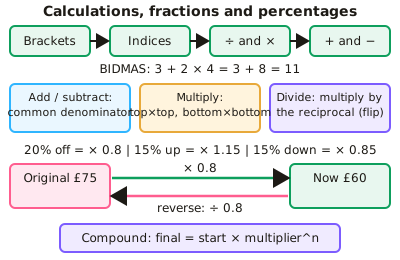
Key points
- Order of operations (BIDMAS): brackets, indices, division and multiplication, then addition and subtraction.
- To add or subtract fractions, use a common denominator; to multiply, multiply numerators and denominators; to divide, multiply by the reciprocal.
- Percentage increase/decrease: multiply by a decimal multiplier, e.g. a 15% increase means × 1.15, a 15% decrease means × 0.85.
- Reverse percentages: divide by the multiplier, e.g. if £60 is the price after a 20% discount, the original was 60 ÷ 0.8 = £75.
- Compound interest: final amount = initial × (multiplier)ⁿ for n years.
In more detail
- Worked BIDMAS: 3 + 4 × 2² = 3 + 4 × 4 = 3 + 16 = 19, not (3 + 4) × 4 = 28.
- Worked fractions: 2/3 + 1/4 = 8/12 + 3/12 = 11/12; 2/3 × 9/10 = 18/30 = 3/5; 3/4 ÷ 1/2 = 3/4 × 2/1 = 3/2 = 1½.
- Worked mixed numbers: 2⅓ × 1½ = 7/3 × 3/2 = 21/6 = 3½ (always change to top-heavy fractions first).
- Worked multipliers: £250 up 12% → 250 × 1.12 = £280; £250 down 12% → 250 × 0.88 = £220.
- Worked reverse percentage: after a 20% discount the price is £60 → original = 60 ÷ 0.80 = £75 (not 60 × 1.2 = £72).
- Worked compound interest: £2000 at 3% a year for 5 years → 2000 × 1.03⁵ = £2318.55.
Practice
Calculations, fractions and percentages: 10 questions
Pick an answer to check it, or open the answer for the explanation.
1. Work out 3 + 4 × 2
- 14
- 11
- 24
- 9
Show answer
B: 11. Multiplication comes before addition: 3 + 8 = 11.
2. What is 20% of 150?
- 15
- 20
- 30
- 75
Show answer
C: 30. 0.2 × 150 = 30.
3. A coat costs £60 after a 20% discount. What was the original price?
- £72
- £75
- £80
- £48
Show answer
B: £75. 60 ÷ 0.8 = £75.
4. £1000 is invested at 5% compound interest for 2 years. What is the final amount?
- £1100
- £1102.50
- £1050
- £1105
Show answer
B: £1102.50. 1000 × 1.05² = £1102.50.
5. Work out 2/3 ÷ 4/9
- 8/27
- 1/2
- 3/2
- 6/12
Show answer
C: 3/2. 2/3 × 9/4 = 18/12 = 3/2.
6. Work out 5 − 2 × (3 + 1)
- 12
- −3
- 8
- 0
Show answer
B: −3. Brackets first: 5 − 2 × 4 = 5 − 8 = −3.
7. Increase £240 by 15%
- £255
- £276
- £288
- £36
Show answer
B: £276. 240 × 1.15 = £276.
8. Write 3/8 as a decimal
- 0.38
- 0.375
- 0.83
- 2.67
Show answer
B: 0.375. 3 ÷ 8 = 0.375.
9. Work out 2/5 + 3/4. Give your answer as a fraction.
- 11/20
- 6/20
- 23/20
- 5/9
Show answer
C: 23/20. Use common denominator 20: 8/20 + 15/20 = 23/20. Adding the numerators and denominators (5/9) is a common mistake.
10. A mass of 80 kg is decreased by 12%. What is the new mass?
- 70.4 kg
- 89.6 kg
- 9.6 kg
- 68 kg
Show answer
A: 70.4 kg. Multiplier is 0.88, so 80 × 0.88 = 70.4 kg. 9.6 kg is only the amount of the decrease, not the new mass.
Keep going in Full Marks
Full Marks has 55 questions on Calculations, fractions and percentages (45 more than here), set out in practice levels. You also get notes and 3D models for all 7 subtopics of Number, plus games, timed exams and past papers.
On your exam board
- AQATopic 1: Number
- OCR ATopic 1: Number
- EdexcelTopic 1: Number
- CambridgeTopic 1: Number