GCSE Economics · Topic 2
How the economy works
This topic looks at the economy as a whole, rather than individual markets.
We will cover the government's main economic objectives, international trade and money, and the circular flow of income.
Then we look at economic growth and the economic cycle, unemployment, and how income and wealth are distributed.
- 7 subtopics
- 358 questions
- Free: 2.1 notes and 10 questions
In this topic
- 2.1The national economy and government objectivesFree below · 19 questions
- 2.2International trade, money and marketsOpen in Full Marks · 60 questions
- 2.3The circular flow of income and aggregate demand and supplyOpen in Full Marks · 52 questions
- 2.4Economic growth, GDP and the economic cycleOpen in Full Marks · 36 questions
- 2.5Unemployment: types, causes and measurementOpen in Full Marks · 79 questions
- 2.6Distribution of income and wealth, inequality and povertyOpen in Full Marks · 43 questions
- 2.7The labour market: wages, trade unions and the minimum wageOpen in Full Marks · 69 questions
2.1 · Free notes
The national economy and government objectives
Key points
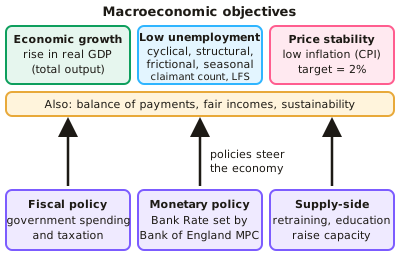
- Main macroeconomic objectives: economic growth, low unemployment, price stability (low inflation), a balance of payments equilibrium, and often fairer income distribution and environmental sustainability.
- GDP measures total output; growth is usually measured by the change in real GDP.
- Inflation is a sustained rise in the general price level, measured in the UK by the CPI, with a target of 2%.
- Unemployment types include cyclical, structural, frictional and seasonal; it is measured by the claimant count and Labour Force Survey.
- Fiscal policy uses government spending and taxation; monetary policy uses interest rates, set by the Bank of England's Monetary Policy Committee; supply-side policies aim to raise productive capacity.
In more detail
- Worked inflation: a basket of goods cost £200 last year and £206 this year → inflation = (206 − 200) ÷ 200 × 100 = 3%, above the 2% target.
- Worked conflict: cutting interest rates to boost growth and jobs may push inflation above 2%, so objectives can conflict.
- Who does what: the Bank of England's Monetary Policy Committee sets interest rates (monetary policy); the Chancellor sets taxes and spending in the Budget (fiscal policy).
- Exam tip: name the objective, give the measure (e.g. CPI for inflation, real GDP for growth) and quote any data from the question.
Practice
The national economy and government objectives: 10 questions
Pick an answer to check it, or open the answer for the explanation.
1. Which index measures UK inflation for the government's target?
- RPI
- CPI
- GDP
- FTSE
Show answer
B: CPI. The target is 2% CPI inflation.
2. Who sets UK interest rates?
- The Treasury
- The Bank of England's Monetary Policy Committee
- Parliament
- Commercial banks
Show answer
B: The Bank of England's Monetary Policy Committee. The MPC sets Bank Rate to meet the inflation target.
3. What is structural unemployment?
- Temporary unemployment between jobs
- Unemployment caused by a mismatch of skills as industries decline
- Unemployment in winter
- Unemployment during a recession
Show answer
B: Unemployment caused by a mismatch of skills as industries decline. Retraining and mobility policies are typical responses.
4. What is fiscal policy?
- Changing interest rates
- Using government spending and taxation to influence the economy
- Controlling the money supply only
- Regulating monopolies
Show answer
B: Using government spending and taxation to influence the economy. Expansionary fiscal policy raises spending or cuts taxes.
5. What does real GDP adjust for?
- Population
- Inflation
- Exchange rates
- Unemployment
Show answer
B: Inflation. Real GDP shows output changes rather than price changes.
6. What is a likely effect of a fall in the value of the pound on UK inflation?
- No effect
- Import prices rise, which can increase inflation
- Import prices fall
- Deflation is guaranteed
Show answer
B: Import prices rise, which can increase inflation. More expensive imports can feed through into the general price level.
7. UK imports of goods and services far exceed exports for several years. Which objective is most directly threatened?
- Environmental sustainability
- Balance of payments equilibrium
- Low unemployment
- Fairer income distribution
Show answer
B: Balance of payments equilibrium. Persistent spending abroad above export earnings creates a trade deficit, which is part of the balance of payments. It threatens the aim of an equilibrium.
8. The MPC raises the Bank Rate to reduce inflation. Which type of policy is this?
- Monetary policy
- Fiscal policy
- Supply-side policy
- Protectionist policy
Show answer
A: Monetary policy. Changing interest rates is monetary policy, carried out by the Bank of England's MPC. Fiscal policy uses tax and government spending.
9. The CPI rises from 120 to 126 in one year. What is the rate of inflation?
- 5%
- 6%
- 126%
- 4.8%
Show answer
A: 5%. Inflation = (126 − 120) ÷ 120 × 100 = 5%. The 6 is a change in index points, not a percentage.
10. Why might cutting interest rates to boost growth conflict with the objective of price stability?
- It increases the value of the pound
- It raises unemployment
- Higher AD may push up the price level
- It reduces AD, lowering prices
Show answer
C: Higher AD may push up the price level. Lower rates encourage borrowing and spending, so AD rises. If the economy is near capacity, the extra demand raises prices, so growth and low inflation can conflict.
Keep going in Full Marks
Full Marks has 19 questions on The national economy and government objectives (9 more than here), set out in practice levels. You also get notes and 3D models for all 7 subtopics of How the economy works, plus games, timed exams and past papers.
On your exam board
- AQATopic 7: Introduction to the national economy, Topic 9: International trade and the global economy
- OCRTopic 2.3: The labour market, Topic 3.1: Economic objectives, Topic 4: International trade and the global economy
- CambridgeTopic 3: Microeconomic decision makers, Topic 4: Government and the macroeconomy, Topic 5: Economic development