GCSE Economics · Topic 1
How markets work
This topic introduces the basic ideas of economics: scarcity, choice and how markets decide what gets produced.
We will cover opportunity cost, the factors of production, economic agents, demand and supply, and specialisation.
We will also see how economists use models, and the difference between facts and opinions in economics.
- 8 subtopics
- 330 questions
- Free: 1.1 notes and 10 questions
In this topic
- 1.1Economic foundations and resource allocationFree below · 36 questions
- 1.2Demand, supply and priceOpen in Full Marks · 37 questions
- 1.3Production, competition and market failureOpen in Full Marks · 35 questions
- 1.4Scarcity, choice and opportunity costOpen in Full Marks · 36 questions
- 1.5Factors of production and their rewardsOpen in Full Marks · 45 questions
- 1.6Economic agents (households, firms, government) and rational decision-makingOpen in Full Marks · 43 questions
- 1.7Specialisation, division of labour and exchangeOpen in Full Marks · 32 questions
- 1.8Positive and normative statements and how economists use modelsOpen in Full Marks · 66 questions
1.1 · Free notes
Economic foundations and resource allocation
Key points
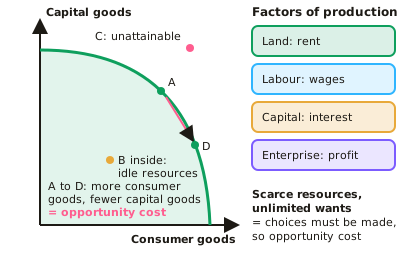
- The basic economic problem: resources are scarce but wants are unlimited, so choices must be made.
- Opportunity cost is the value of the next best alternative given up when a choice is made.
- The factors of production are land, labour, capital and enterprise; each earns a reward (rent, wages, interest, profit).
- Economic agents are consumers, producers and government, each making choices with different objectives.
- Production possibility diagrams show maximum possible output combinations; points inside show unused resources, points outside are unattainable with current resources.
- There are three main economic systems: a free market economy (resources allocated by the price mechanism and private firms), a command (planned) economy (the government decides what to produce, such as the former Soviet Union) and a mixed economy (a combination of both, such as the UK).
In more detail
- Worked opportunity cost: a council has £2 million and can build a new library or resurface 40 km of roads. If it builds the library, the opportunity cost is the 40 km of resurfaced roads.
- Three key questions: every economy must decide what to produce, how to produce it and for whom. Markets answer these through prices; governments may answer them through planning.
- Mixed economy: the UK is a mixed economy. Most goods are produced by private firms, but the government provides services such as the NHS and state schools.
- Worked PPF point: an economy makes 60 cars and 20 tractors but could make 60 cars and 35 tractors with its resources, so it is inside its PPF and has unemployed resources.
Practice
Economic foundations and resource allocation: 10 questions
Pick an answer to check it, or open the answer for the explanation.
1. What is the basic economic problem?
- Inflation
- Scarcity of resources relative to unlimited wants
- Unemployment
- High taxes
Show answer
B: Scarcity of resources relative to unlimited wants. This forces choices and creates opportunity cost.
2. What is opportunity cost?
- The money price of a good
- The value of the next best alternative forgone
- Total spending
- The cost of production
Show answer
B: The value of the next best alternative forgone. Every choice means giving something else up.
3. Which are the four factors of production?
- Land, labour, capital, enterprise
- Money, machines, workers, tax
- Supply, demand, price, profit
- Goods, services, trade, money
Show answer
A: Land, labour, capital, enterprise. Enterprise combines the other three and takes the risk.
4. What does a point inside a production possibility curve show?
- Maximum efficiency
- Unemployed or inefficiently used resources
- An unattainable output
- Perfect competition
Show answer
B: Unemployed or inefficiently used resources. The economy could produce more with the same resources.
5. Which is the reward to labour?
- Rent
- Wages
- Interest
- Profit
Show answer
B: Wages. Land earns rent, capital earns interest and enterprise earns profit.
6. Which economic agent aims to maximise utility from limited income?
- Firms
- Consumers
- Government
- Trade unions
Show answer
B: Consumers. Consumers make choices based on their preferences and budget.
7. What is shown by a point on the production possibility frontier itself?
- Unemployment of resources
- Efficient use of all available resources
- An impossible level of output
- A decrease in resources
Show answer
B: Efficient use of all available resources. Points on the curve represent maximum efficient output combinations.
8. A café owner pays all costs and keeps £30,000 for taking the risk of running the business. What is this reward called?
- Interest
- Profit
- Rent
- Wages
Show answer
B: Profit. Enterprise is rewarded with profit for risk-taking. Wages go to labour, rent to land and interest to capital.
9. Which factor of production earns rent as its reward?
- Enterprise
- Labour
- Capital
- Land
Show answer
D: Land. Land, including natural resources, earns rent. Labour earns wages, capital earns interest and enterprise earns profit.
10. Maya can work a £50 shift, play in a £15 football match or revise. She picks the shift; football is her next best. Her opportunity cost is...
- The £50 she earns
- Both football and revising
- The football match
- The revision time only
Show answer
C: The football match. Opportunity cost is only the next best alternative given up, here football. It is not every alternative, and not the £50 she gains.
Keep going in Full Marks
Full Marks has 36 questions on Economic foundations and resource allocation (26 more than here), set out in practice levels. You also get notes and 3D models for all 8 subtopics of How markets work, plus games, timed exams and past papers.
On your exam board
- AQATopic 1: Economic foundations, Topic 2: Resource allocation, Topic 3: How prices are determined, Topic 5: Competitive and concentrated markets
- OCRTopic 1: Introduction to economics, Topic 2.1: Markets: demand, supply and price, Topic 2.2: Competition and production
- CambridgeTopic 1: The basic economic problem, Topic 2: The allocation of resources, Topic 3: Microeconomic decision makers