GCSE Chemistry · Topic 6
The rate and extent of chemical change
The rate and extent of chemical change asks two questions: how fast does a reaction go, and how far does it go?
We will use collision theory to explain how temperature, concentration, surface area and catalysts change the rate, and calculate rates from graphs and experiments.
Then we look at reversible reactions, dynamic equilibrium and Le Chatelier's principle, and how they decide the conditions for making ammonia in the Haber process.
- 6 subtopics
- 325 questions
- Free: 6.1 notes and 10 questions
In this topic
- 6.1Rates of reactionFree below · 63 questions
- 6.2Reversible reactions and equilibriumOpen in Full Marks · 19 questions
- 6.3Calculating rates of reaction: mean rates and tangents on graphsOpen in Full Marks · 62 questions
- 6.4Required practical: rate of reaction by gas volume or mass lossOpen in Full Marks · 66 questions
- 6.5Required practical: rate of reaction by turbidity (sodium thiosulfate and hydrochloric acid)Open in Full Marks · 53 questions
- 6.6The Haber process and choosing industrial conditionsOpen in Full Marks · 62 questions
6.1 · Free notes
Rates of reaction
Key points
- Rate of reaction can be measured by how quickly a reactant is used up or a product forms, e.g. loss of mass, volume of gas produced, or time for a precipitate to obscure a mark.
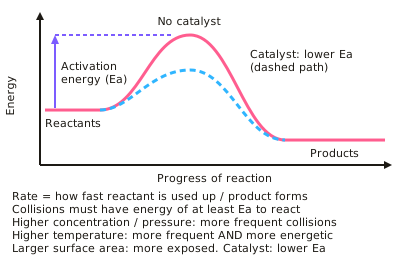
- Collision theory: reactions happen when particles collide with enough energy (activation energy); increasing the frequency or energy of collisions increases rate.
- Increasing concentration or pressure (gases) increases collision frequency; increasing temperature increases both collision frequency and energy.
- Increasing surface area (smaller pieces) increases the frequency of collisions by exposing more particles to react.
- A catalyst provides an alternative reaction pathway with lower activation energy, increasing rate without being used up.
In more detail
- Why temperature has a big effect: particles move faster, so they collide more often, and a larger proportion of collisions have energy greater than the activation energy.
- Worked surface area: a 2 cm cube has SA 24 cm²; cut into eight 1 cm cubes the total SA is 48 cm², doubling the area exposed to collisions.
- Catalysts are not used up: the same mass of catalyst remains at the end, and only a small amount is needed; enzymes are biological catalysts.
- Collision frequency vs energy: concentration, pressure and surface area increase how often particles collide; temperature also increases how energetic the collisions are.
Practice
Rates of reaction: 10 questions
Pick an answer to check it, or open the answer for the explanation.
1. According to collision theory, for a reaction to occur particles must:
- Just touch
- Collide with enough energy (activation energy)
- Be at low temperature
- Be the same substance
Show answer
B: Collide with enough energy (activation energy). A successful collision needs sufficient energy.
2. Why does increasing temperature increase the rate of reaction?
- Particles collide less often
- Particles have more energy and collide more frequently with enough energy to react
- Particles become bigger
- Catalysts are destroyed
Show answer
B: Particles have more energy and collide more frequently with enough energy to react. Both the frequency and energy of collisions increase.
3. Why does a powdered solid react faster than the same mass as a large lump?
- It has less surface area
- It has a greater surface area exposed for collisions
- It is always cooler
- It becomes a gas
Show answer
B: It has a greater surface area exposed for collisions. More particles are exposed for reactant particles to collide with.
4. What does a catalyst do?
- Is used up in the reaction
- Provides a pathway with lower activation energy, without being used up
- Raises the activation energy
- Slows down the reaction
Show answer
B: Provides a pathway with lower activation energy, without being used up. Catalysts speed up reactions without being consumed.
5. How does increasing the concentration of a reactant affect rate?
- Decreases rate
- Increases the frequency of collisions and rate
- Has no effect
- Stops the reaction
Show answer
B: Increases the frequency of collisions and rate. More particles in the same volume means more frequent collisions.
6. Which factor increases the rate of a reaction between a gas and a solid?
- Lowering the gas pressure
- Increasing the gas pressure
- Removing the solid
- Cooling the reaction
Show answer
B: Increasing the gas pressure. Higher pressure increases the frequency of collisions.
7. A reaction produces 60 cm³ of gas in 20 s. What is the mean rate of reaction?
- 80 cm³/s
- 1200 cm³/s
- 0.33 cm³/s
- 3.0 cm³/s
Show answer
D: 3.0 cm³/s. Mean rate = volume ÷ time = 60 ÷ 20 = 3.0 cm³/s. Dividing time by volume (0.33) is the inverted calculation.
8. A flask loses 0.48 g in mass over 4 minutes as a reaction proceeds. What is the mean rate of reaction?
- 0.12 g/min
- 1.92 g/min
- 0.48 g/min
- 8.3 g/min
Show answer
A: 0.12 g/min. Mean rate = mass lost ÷ time = 0.48 ÷ 4 = 0.12 g/min. 1.92 comes from multiplying instead of dividing.
9. Marble chips react with acid in an open flask on a balance. Why does the mass reading fall?
- Carbon dioxide gas escapes
- The marble chips dissolve and vanish
- Water evaporates from the acid
- The acid is destroyed
Show answer
A: Carbon dioxide gas escapes. Carbon dioxide is produced and escapes into the air, so the total mass of the flask and contents falls. Mass is not destroyed; it leaves as gas.
10. In the sodium thiosulfate and acid experiment, which result shows a faster reaction?
- More sulfur dioxide is made
- The cross disappears in a longer time
- The cross disappears in a shorter time
- The solution stays clear
Show answer
C: The cross disappears in a shorter time. Sulfur precipitate makes the solution cloudy. A shorter time for the cross to be hidden means a faster rate. A longer time means slower.
Keep going in Full Marks
Full Marks has 63 questions on Rates of reaction (53 more than here), set out in practice levels. You also get notes and 3D models for all 6 subtopics of The rate and extent of chemical change, plus games, timed exams and past papers.
On your exam board
- AQATopic 6: The rate and extent of chemical change, Topic 10: Using resources
- OCR ATopic C5: Monitoring and controlling chemical reactions, Topic C6: Global challenges
- OCR BTopic C6: Making useful chemicals
- EdexcelTopic 4: Extracting metals and equilibria, Topic 5: Separate chemistry 1, Topic 7: Rates of reaction and energy changes
- CambridgeTopic 6: Chemical reactions