GCSE Chemistry · Topic 5
Energy changes
Energy changes is about the energy taken in or given out when chemicals react, from hand warmers to the batteries in your phone.
We will compare exothermic and endothermic reactions, read reaction profiles, and calculate energy changes using bond energies.
Then we look at the required practical on temperature changes, and at chemical cells, batteries and hydrogen fuel cells.
- 4 subtopics
- 192 questions
- Free: 5.1 notes and 10 questions
In this topic
- 5.1Exothermic and endothermic reactionsFree below · 57 questions
- 5.2Cells and fuel cellsOpen in Full Marks · 22 questions
- 5.3Reaction profiles, activation energy and bond energy calculationsOpen in Full Marks · 54 questions
- 5.4Required practical: investigating temperature changes in reacting solutionsOpen in Full Marks · 59 questions
5.1 · Free notes
Exothermic and endothermic reactions
Key points
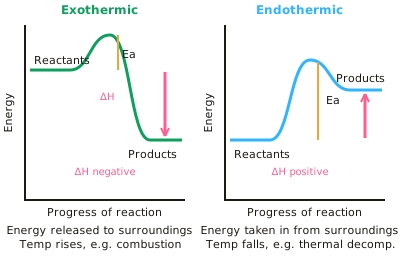
- Exothermic reactions transfer energy to the surroundings, so temperature increases (e.g. combustion, neutralisation). Endothermic reactions take in energy, so temperature decreases (e.g. thermal decomposition).
- Reaction profiles show the relative energies of reactants and products; activation energy is the minimum energy needed for a reaction to occur.
- Breaking bonds requires energy (endothermic); forming bonds releases energy (exothermic). A reaction is exothermic overall if more energy is released forming bonds than is used breaking them.
- Everyday uses: exothermic reactions in hand warmers and self-heating cans; endothermic reactions in some sports injury cold packs.
In more detail
- Exothermic examples: combustion, respiration, neutralisation and most oxidation reactions. Endothermic examples: thermal decomposition, citric acid + sodium hydrogencarbonate, photosynthesis.
- Reading a profile: if products are below reactants, energy is released (exothermic, ΔH negative); if above, energy is taken in (endothermic, ΔH positive).
- Activation energy arrow: drawn from the reactant level up to the peak of the curve, not from the products.
- Why reactions need a spark: even exothermic reactions like burning need activation energy to start, but then release enough energy to keep going.
Practice
Exothermic and endothermic reactions: 10 questions
Pick an answer to check it, or open the answer for the explanation.
1. What happens to temperature in an exothermic reaction?
- It increases
- It decreases
- It stays the same
- It becomes negative
Show answer
A: It increases. Energy is transferred to the surroundings, warming them.
2. What is activation energy?
- The total energy released
- The minimum energy needed for a reaction to start
- The energy of the products
- The mass of reactants
Show answer
B: The minimum energy needed for a reaction to start. Particles need at least this much energy to react when they collide.
3. Which process is endothermic?
- Combustion
- Neutralisation
- Thermal decomposition
- Respiration
Show answer
C: Thermal decomposition. Thermal decomposition takes in energy to break down a compound.
4. In an exothermic reaction, which is true?
- Energy released forming bonds is more than energy used breaking them
- Bond breaking releases more energy than bond making
- No bonds are broken
- No energy change occurs
Show answer
A: Energy released forming bonds is more than energy used breaking them. The net energy change transfers energy to the surroundings.
5. Which everyday device uses an exothermic reaction?
- A cold pack
- A hand warmer
- A fridge
- An ice cube
Show answer
B: A hand warmer. Hand warmers use an exothermic reaction (e.g. oxidation of iron) to release heat.
6. Which type of reaction always releases energy to the surroundings?
- Endothermic
- Exothermic
- Reversible
- Neutral
Show answer
B: Exothermic. Exothermic reactions raise the temperature of the surroundings.
7. A sports cold pack gets cold when the inner bag bursts and ammonium nitrate mixes with water. Why does it feel cold?
- The change takes in energy from the surroundings
- The change releases energy to the surroundings
- Water evaporates from the pack surface
- The ammonium nitrate is below 0 °C when stored
Show answer
A: The change takes in energy from the surroundings. The dissolving is endothermic: it absorbs thermal energy from its surroundings, including your skin, so the pack and the skin cool down.
8. On the reaction profile of an exothermic reaction, where are the products compared with the reactants?
- At a lower energy level
- At the same energy level
- At the same level as the activation energy peak
- At a higher energy level
Show answer
A: At a lower energy level. In an exothermic reaction, energy is released to the surroundings, so the products have less energy than the reactants. The profile slopes down overall.
9. A reaction profile: reactants at 200 kJ/mol, peak at 350 kJ/mol, products at 120 kJ/mol. What is the activation energy?
- 230 kJ/mol
- 150 kJ/mol
- 80 kJ/mol
- 350 kJ/mol
Show answer
B: 150 kJ/mol. Activation energy is the rise from reactants to the peak: 350 − 200 = 150 kJ/mol. 80 kJ/mol is the overall energy change, not activation energy.
10. Which statement about bonds in a chemical reaction is correct?
- Breaking bonds is exothermic and forming bonds is endothermic
- Breaking and forming bonds are both exothermic
- Breaking bonds is endothermic and forming bonds is exothermic
- Breaking and forming bonds are both endothermic
Show answer
C: Breaking bonds is endothermic and forming bonds is exothermic. Energy must be supplied to break bonds (endothermic). Energy is released when new bonds form (exothermic). A common mistake is to reverse these.
Keep going in Full Marks
Full Marks has 57 questions on Exothermic and endothermic reactions (47 more than here), set out in practice levels. You also get notes and 3D models for all 4 subtopics of Energy changes, plus games, timed exams and past papers.