GCSE Chemistry · Topic 7
Organic chemistry
Organic chemistry is the chemistry of carbon compounds, from the fuels that power our cars to the plastics, alcohols and proteins around us.
We will start with crude oil, alkanes and fractional distillation, then cracking and alkenes, alcohols, carboxylic acids and esters.
Finally we look at how polymers form, by addition and by condensation, including natural polymers like proteins, DNA, starch and cellulose.
- 6 subtopics
- 191 questions
- Free: 7.1 notes and 10 questions
In this topic
- 7.1Crude oil and hydrocarbonsFree below · 26 questions
- 7.2Alkenes, alcohols and polymersOpen in Full Marks · 26 questions
- 7.3Cracking of hydrocarbons: catalytic and steam crackingOpen in Full Marks · 22 questions
- 7.4Carboxylic acids and estersOpen in Full Marks · 34 questions
- 7.5Condensation polymerisation (polyesters and polyamides)Open in Full Marks · 32 questions
- 7.6Naturally occurring polymers: amino acids, proteins, DNA, starch and celluloseOpen in Full Marks · 51 questions
7.1 · Free notes
Crude oil and hydrocarbons
Key points
- Crude oil is a finite resource formed from ancient organisms; it's a mixture of hydrocarbons, mostly alkanes.
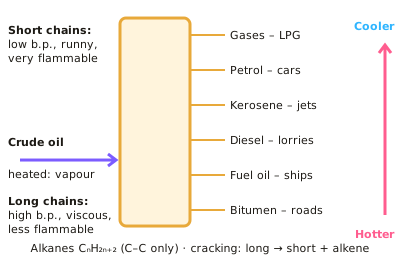
- Fractional distillation separates crude oil into fractions with similar boiling points: the oil is heated and vaporised, then fractions condense at different heights in a fractionating column.
- Alkanes have the general formula CₙH₂ₙ₊₂, are saturated (only single C-C bonds), and burn in combustion reactions to release energy.
- Properties change with chain length: longer chains have higher boiling points and are less flammable and more viscous.
- Cracking breaks longer, less useful hydrocarbon chains into shorter, more useful ones (including alkenes), using heat and a catalyst, to meet demand.
In more detail
- Fractions and uses (top to bottom): refinery gases (bottled gas), petrol (cars), kerosene (aircraft), diesel (lorries, trains), heavy fuel oil (ships), bitumen (roads).
- Complete combustion: propane + oxygen → carbon dioxide + water: C₃H₈ + 5O₂ → 3CO₂ + 4H₂O.
- Homologous series: a family of compounds with the same general formula, similar chemical properties, and a gradual change in physical properties.
- First four alkanes: methane CH₄, ethane C₂H₆, propane C₃H₈, butane C₄H₁₀ (mnemonic: Monkeys Eat Peanut Butter).
Practice
Crude oil and hydrocarbons: 10 questions
Pick an answer to check it, or open the answer for the explanation.
1. What is crude oil mainly a mixture of?
- Alkenes
- Hydrocarbons, mostly alkanes
- Alcohols
- Metals
Show answer
B: Hydrocarbons, mostly alkanes. Crude oil is a mixture of many different hydrocarbon molecules.
2. What does fractional distillation separate crude oil based on?
- Colour
- Boiling point
- Density only
- Reactivity
Show answer
B: Boiling point. Fractions with similar boiling points condense together.
3. What is the general formula of alkanes?
- CₙH₂ₙ
- CₙH₂ₙ₊₂
- CₙHₙ
- CₙH₂ₙ₋₂
Show answer
B: CₙH₂ₙ₊₂. This formula applies to every member of the alkane series.
4. What is cracking used for?
- Making crude oil
- Breaking long-chain hydrocarbons into shorter, more useful ones
- Removing carbon dioxide
- Making metals
Show answer
B: Breaking long-chain hydrocarbons into shorter, more useful ones. It helps meet the greater demand for smaller, more useful molecules like fuels.
5. How does boiling point change with hydrocarbon chain length?
- It decreases as chains get longer
- It increases as chains get longer
- It stays the same
- Chain length has no effect
Show answer
B: It increases as chains get longer. Longer chains have stronger intermolecular forces, raising the boiling point.
6. Which fraction of crude oil has the shortest carbon chains and the lowest boiling point?
- Bitumen
- Diesel
- Petrol/gases
- Fuel oil
Show answer
C: Petrol/gases. Shorter chains condense near the top of the fractionating column.
7. Which two products are formed when a hydrocarbon burns completely in plenty of oxygen?
- Carbon dioxide and water
- Carbon monoxide and water
- Carbon and hydrogen
- Carbon dioxide and hydrogen
Show answer
A: Carbon dioxide and water. Complete combustion of a hydrocarbon gives carbon dioxide and water. Carbon monoxide or carbon (soot) forms only when the oxygen supply is limited.
8. An alkane molecule contains 8 carbon atoms. What is its molecular formula?
- C8H20
- C8H14
- C8H16
- C8H18
Show answer
D: C8H18. Alkanes follow CnH2n+2, so n = 8 gives 2(8)+2 = 18 hydrogens: C8H18. C8H16 is the formula of an alkene.
9. Why is crude oil described as a finite resource?
- It is a pure compound that runs out
- It is only found in one country
- It forms far more slowly than we use it
- It cannot be burned efficiently
Show answer
C: It forms far more slowly than we use it. Crude oil took millions of years to form from ancient organisms, much slower than it is used, so it will run out. It is a mixture, not a pure compound.
10. Which poisonous gas can form when hydrocarbons burn in a limited supply of air?
- Carbon dioxide
- Sulfur trioxide
- Carbon monoxide
- Hydrogen sulfide
Show answer
C: Carbon monoxide. Incomplete combustion produces carbon monoxide, which binds to haemoglobin and reduces oxygen transport. Carbon dioxide is not poisonous in this way.
Keep going in Full Marks
Full Marks has 26 questions on Crude oil and hydrocarbons (16 more than here), set out in practice levels. You also get notes and 3D models for all 6 subtopics of Organic chemistry, plus games, timed exams and past papers.