GCSE Biology · Topic 7
Ecology
Ecology is the study of how living things interact with each other and with their surroundings.
We will look at communities and adaptations, food chains and the cycles that recycle carbon and water, and how we measure where organisms live using quadrats and transects.
Then we turn to people: biodiversity, pollution, global warming, food security, and what we can do to protect ecosystems.
- 9 subtopics
- 407 questions
- Free: 7.1 notes and 10 questions
In this topic
- 7.1Communities and adaptationsFree below · 29 questions
- 7.2Ecosystem organisation and cyclesOpen in Full Marks · 69 questions
- 7.3Biodiversity and human impactOpen in Full Marks · 25 questions
- 7.4Trophic levels and food production (Biology only)Open in Full Marks · 63 questions
- 7.5Required/core practical: Field investigation using quadrats and transects; estimating population sizeOpen in Full Marks · 70 questions
- 7.6Environmental change, species distribution and indicator speciesOpen in Full Marks · 33 questions
- 7.7Decomposition: required practical on rate of decay, composting and biogasOpen in Full Marks · 29 questions
- 7.8Eutrophication, bioaccumulation and water pollutionOpen in Full Marks · 69 questions
- 7.9The water cycle and the nitrogen cycleOpen in Full Marks · 20 questions
7.1 · Free notes
Communities and adaptations
Key points
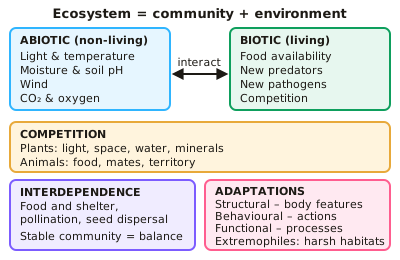
- An ecosystem is the interaction of a community of organisms with the non-living parts of their environment.
- Plants compete for light, space, water and minerals; animals compete for food, mates and territory.
- Interdependence: species depend on each other for food, shelter, pollination and seed dispersal. A stable community keeps species and environment in balance.
- Abiotic factors: light, temperature, moisture, soil pH, wind, CO₂, oxygen. Biotic factors: food availability, new predators, new pathogens and competition.
- Adaptations can be structural, behavioural or functional. Extremophiles live in extreme conditions.
In more detail
- Levels of organisation: individual organism → population (one species in a habitat) → community (all the populations) → ecosystem (the community plus the non-living environment).
- Stable community: all the species and environmental factors are in balance, so population sizes stay roughly constant, e.g. tropical rainforests and old oak woodland.
- Adaptation types: structural = body features (e.g. thick fur, small ears); behavioural = actions (e.g. migration, hibernation); functional = processes (e.g. making concentrated urine, antifreeze proteins).
- Extremophiles live in very hot, salty, high-pressure or acidic places, such as bacteria in deep-sea hydrothermal vents.
Practice
Communities and adaptations: 10 questions
Pick an answer to check it, or open the answer for the explanation.
1. Which is an abiotic factor?
- Predators
- Temperature
- Competition
- Pathogens
Show answer
B: Temperature. Abiotic factors are non-living.
2. What do plants compete for?
- Mates
- Light, water, space and minerals
- Territory
- Food
Show answer
B: Light, water, space and minerals. These are needed for photosynthesis and growth.
3. What is interdependence?
- Living alone
- Species depending on each other
- Competing for mates
- Adapting to cold
Show answer
B: Species depending on each other. For example, plants rely on insects for pollination.
4. What is an extremophile?
- An extinct species
- An organism living in extreme conditions
- A predator
- A plant
Show answer
B: An organism living in extreme conditions. For example, bacteria in deep-sea vents.
5. A camel storing fat in its hump is which type of adaptation?
- Structural
- Behavioural
- Functional
- Abiotic
Show answer
A: Structural. It is a physical feature.
6. Which is a biotic factor affecting a community?
- Temperature
- Predation
- Light intensity
- Soil pH
Show answer
B: Predation. Biotic factors involve living organisms.
7. What is a behavioural adaptation?
- A physical feature like thick fur
- A way an organism acts, such as migration
- A chemical produced by an organism
- The shape of an organ
Show answer
B: A way an organism acts, such as migration. Hibernation and migration are common examples.
8. A non-native crayfish is introduced to a river and native crayfish numbers fall. Which factor is most likely responsible?
- Reduced wind speed
- Lower carbon dioxide level
- Competition for food and shelter
- Increased soil pH
Show answer
C: Competition for food and shelter. A new species competing for food and shelter is a biotic factor. Soil pH, wind and CO₂ are abiotic and do not fit this situation.
9. What do animals compete with each other for in a habitat?
- Food, mates and territory
- Oxygen, soil and wind
- Carbon dioxide and sunlight
- Light, water and minerals
Show answer
A: Food, mates and territory. Animals compete for food, mates and territory. Light, water and minerals are what plants compete for.
10. A cactus has spines instead of leaves and a thick, waxy stem. How does this help it survive in a desert?
- It reduces water loss
- It absorbs more light
- It attracts more pollinators
- It speeds up photosynthesis
Show answer
A: It reduces water loss. Spines have a small surface area and a waxy stem stores water, so water loss is reduced. This is a structural adaptation. Spines do not increase light absorption.
Keep going in Full Marks
Full Marks has 29 questions on Communities and adaptations (19 more than here), set out in practice levels. You also get notes and 3D models for all 9 subtopics of Ecology, plus games, timed exams and past papers.
On your exam board
- AQATopic 7: Ecology
- OCR ATopic B4: Community level systems, Topic B6: Global challenges
- OCR BTopic B3: Living together – food and ecosystems, Topic B6: Life on Earth – past, present and future
- EdexcelTopic 9: Ecosystems and material cycles
- CambridgeTopic 19: Organisms and their environment, Topic 20: Human influences on ecosystems