GCSE Biology · Topic 6
Inheritance, variation and evolution
Inheritance, variation and evolution explains how characteristics pass from parents to offspring, and how living things change over millions of years.
We will look at sexual and asexual reproduction, DNA and genes, how proteins are made, mutations, genetic diagrams and inherited disorders.
Then we zoom out to variation, natural selection and evolution, selective breeding, genetic engineering, cloning and how we classify life.
- 11 subtopics
- 217 questions
- Free: 6.1 notes and 7 questions
In this topic
- 6.1Reproduction and meiosisFree below · 10 questions
- 6.2DNA and inheritanceOpen in Full Marks · 18 questions
- 6.3Variation, evolution and evidenceOpen in Full Marks · 20 questions
- 6.4Selective breeding and genetic engineeringOpen in Full Marks · 10 questions
- 6.5ClassificationOpen in Full Marks · 9 questions
- 6.6Protein synthesis: transcription and translationOpen in Full Marks · 26 questions
- 6.7Mutations and their effects on proteins and phenotypeOpen in Full Marks · 28 questions
- 6.8Cloning: tissue culture, cuttings, embryo transplants and adult cell cloningOpen in Full Marks · 32 questions
- 6.9DNA structure: nucleotides, base pairing and extracting DNAOpen in Full Marks · 24 questions
- 6.10Fertilisers, biological control and GM crops: benefits and risksOpen in Full Marks · 16 questions
- 6.11Sexual reproduction in flowering plants: pollination, fertilisation, seeds and germinationOpen in Full Marks · 24 questions
6.1 · Free notes
Reproduction and meiosis
Key points
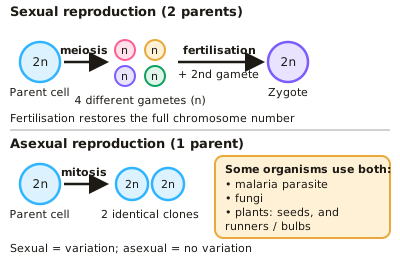
- Sexual reproduction involves fusion of male and female gametes, giving variation. Asexual reproduction involves one parent and gives identical clones by mitosis.
- Meiosis halves the chromosome number, producing four genetically different gametes.
- At fertilisation, gametes join and restore the normal chromosome number.
- Some organisms use both, for example malaria parasites, some fungi, and plants with seeds and runners or bulbs (Biology only).
In more detail
- Advantages of sexual reproduction: variation means a species is more likely to survive a change in the environment, and humans can use it in selective breeding.
- Advantages of asexual reproduction: only one parent is needed, it is faster, it uses less energy, and many identical offspring can be made when conditions are good.
- Meiosis in steps: chromosomes are copied, then the cell divides twice to form four gametes, each with a single set of chromosomes (23 in humans), all genetically different.
- After fertilisation: the cell divides by mitosis, the number of cells increases, and as the embryo develops the cells differentiate.
Practice
Reproduction and meiosis: 7 questions
Pick an answer to check it, or open the answer for the explanation.
1. How many cells does meiosis produce?
- 1
- 2
- 4
- 8
Show answer
C: 4. Meiosis makes four genetically different gametes.
2. What is an advantage of sexual reproduction?
- It is faster
- It produces variation
- Only one parent is needed
- Offspring are identical
Show answer
B: It produces variation. Variation helps survival when the environment changes.
3. Asexual reproduction produces:
- Genetically different offspring
- Clones
- Gametes
- Only males
Show answer
B: Clones. Only mitosis is involved.
4. How many chromosomes does a human egg cell have?
- 23
- 46
- 92
- 22
Show answer
A: 23. Gametes have half the normal number.
5. What happens at fertilisation?
- Chromosome number halves
- Gametes fuse and restore the full number
- DNA is copied
- Mitosis stops
Show answer
B: Gametes fuse and restore the full number. The fertilised egg then divides by mitosis.
6. Which type of reproduction produces genetically identical offspring?
- Sexual reproduction
- Asexual reproduction
- Both equally
- Neither
Show answer
B: Asexual reproduction. Asexual reproduction uses mitosis, giving clones.
7. How many divisions occur in meiosis?
- One
- Two
- Three
- Four
Show answer
B: Two. Two divisions produce four haploid gametes.
Keep going in Full Marks
Full Marks has 10 questions on Reproduction and meiosis (3 more than here), set out in practice levels. You also get notes and 3D models for all 11 subtopics of Inheritance, variation and evolution, plus games, timed exams and past papers.
On your exam board
- AQATopic 6: Inheritance, variation and evolution
- OCR ATopic B1: Cell level systems, Topic B5: Genes, inheritance and selection, Topic B6: Global challenges
- OCR BTopic B1: You and your genes, Topic B3: Living together – food and ecosystems, Topic B4: Using food and controlling growth, Topic B6: Life on Earth – past, present and future
- EdexcelTopic 3: Genetics, Topic 4: Natural selection and genetic modification
- CambridgeTopic 1: Characteristics and classification of living organisms, Topic 4: Biological molecules, Topic 16: Reproduction, Topic 17: Inheritance, Topic 18: Variation and selection, Topic 21: Biotechnology and genetic modification