GCSE Biology · Topic 8
Biological molecules and enzymes
Biological molecules and enzymes looks at the chemistry inside living things: the carbohydrates, proteins and lipids we are made of, and the enzymes that build and break them.
We will learn how big molecules are made from small units, how to test foods for them, and how enzymes work.
You will also meet the required practicals on food tests and on how pH or temperature affects the enzyme amylase.
- 5 subtopics
- 211 questions
- Free: 8.1 notes and 10 questions
In this topic
- 8.1Carbohydrates, proteins and lipids: structure, monomers and polymersFree below · 38 questions
- 8.2Required/core practical: Food tests for sugars, starch, protein and lipidsOpen in Full Marks · 23 questions
- 8.3Enzyme action: lock and key model, specificity, temperature, pH and substrate concentrationOpen in Full Marks · 69 questions
- 8.4Required/core practical: Effect of pH or temperature on enzyme activity (amylase)Open in Full Marks · 63 questions
- 8.5Core practical: the energy in food by calorimetryOpen in Full Marks · 18 questions
8.1 · Free notes
Carbohydrates, proteins and lipids: structure, monomers and polymers
Key points
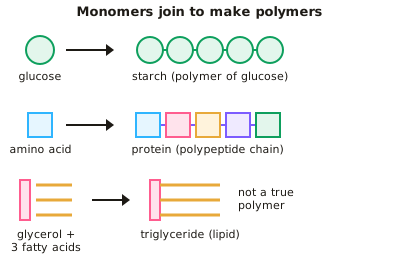
- Carbohydrates contain only carbon, hydrogen and oxygen. Simple sugars such as glucose are the monomers (single units), and long chains of them form polymers.
- Starch is the energy store in plants. Glycogen is the energy store in animals, found in the liver and muscles. Cellulose forms strong fibres in plant cell walls. All three are polymers of glucose.
- Proteins contain carbon, hydrogen, oxygen and nitrogen, and sometimes sulfur. Their monomers are amino acids, joined by peptide bonds into a long polypeptide chain.
- In an unbranched chain of n amino acids there are n − 1 peptide bonds. A chain of 120 amino acids has 119 peptide bonds.
- The sequence of amino acids decides how the chain folds into a specific 3D shape. This shape decides the protein's job, for example the active site of an enzyme.
- Protein functions include enzymes (biological catalysts), hormones, antibodies, structural proteins such as collagen, and transport proteins such as haemoglobin.
- Lipids (fats and oils) contain carbon, hydrogen and oxygen. One glycerol molecule joined to three fatty acids makes a triglyceride. Lipids are not true polymers because they are not long chains of many repeating units.
- Lipids are an energy store (about twice as much energy per gram as carbohydrate) and provide insulation. They are also a part of cell membranes.
- Digestive enzymes break large molecules into small ones. Carbohydrases (e.g. amylase) make simple sugars, proteases make amino acids, and lipases make fatty acids and glycerol.
- Polymers are built by condensation reactions, which release water. They are broken down by hydrolysis, which adds water. Large molecules are insoluble and cannot cross the gut wall, but small soluble products are absorbed into the blood.
In more detail
- Carbohydrate examples: monosaccharides like glucose and fructose; disaccharides like sucrose and maltose; polysaccharides like starch (plants), glycogen (animals) and cellulose (plant cell walls).
- Worked peptide bonds: a chain of 120 amino acids has 119 peptide bonds; every bond formed releases one water molecule in a condensation reaction.
- Saturated vs unsaturated: saturated fats (mostly from animals, solid at room temperature) have no C=C double bonds; unsaturated fats (mostly oils from plants) have C=C double bonds.
- Energy per gram: lipids release about 37 kJ/g, compared with about 17 kJ/g for carbohydrates and proteins, so fat is a compact energy store.
Practice
Carbohydrates, proteins and lipids: structure, monomers and polymers: 10 questions
Pick an answer to check it, or open the answer for the explanation.
1. Which molecules are the monomers that join together to form a protein?
- Glycerol molecules
- Amino acids
- Fatty acids
- Simple sugars
Show answer
B: Amino acids. Proteins are polymers of amino acids joined by peptide bonds. Simple sugars form carbohydrates; fatty acids and glycerol form lipids.
2. Which element is found in all proteins but not in carbohydrates or lipids?
- Nitrogen
- Carbon
- Hydrogen
- Oxygen
Show answer
A: Nitrogen. Amino acids contain an amino group (–NH₂), so proteins contain nitrogen. Carbohydrates and lipids contain only carbon, hydrogen and oxygen.
3. A triglyceride (fat) molecule is made from:
- three glucose molecules
- one glycerol molecule and three fatty acids
- one glycerol molecule and three amino acids
- three glycerol molecules and one fatty acid
Show answer
B: one glycerol molecule and three fatty acids. A triglyceride has a glycerol 'backbone' with three fatty acid molecules attached to it.
4. Starch, glycogen and cellulose are all polymers made from which monomer?
- Glycerol
- Amino acids
- Fatty acids
- Glucose
Show answer
D: Glucose. All three are long chains of glucose units. They differ in how the chains are arranged and so in their function.
5. A student says 'lipids are not true polymers'. What is the best reason?
- They are made only from amino acids
- They are broken down by amylase
- They do not contain any carbon atoms
- They are small molecules, not long chains of many repeating units
Show answer
D: They are small molecules, not long chains of many repeating units. A triglyceride is one glycerol joined to three fatty acids. It is not a long chain of many repeating monomers.
6. A polypeptide is an unbranched chain of 120 amino acids. How many peptide bonds does it contain?
- 120
- 121
- 119
- 60
Show answer
C: 119. Each bond joins two neighbouring amino acids, so a chain of n amino acids has n − 1 bonds: 120 − 1 = 119.
7. Which enzyme and product pair is correct?
- Carbohydrase: fatty acids
- Amylase: amino acids
- Protease: simple sugars
- Lipase: fatty acids and glycerol
Show answer
D: Lipase: fatty acids and glycerol. Lipase digests lipids into fatty acids and glycerol. Protease makes amino acids, and carbohydrases such as amylase make simple sugars.
8. Which carbohydrate is the main energy store in animal liver and muscle cells?
- Starch
- Cellulose
- Glucose
- Glycogen
Show answer
D: Glycogen. Animals store glucose as glycogen. Plants store it as starch. Cellulose is structural, not a store.
9. What mainly determines the specific 3D shape of a protein?
- The order of its amino acids
- The mass of glycerol present
- Only the temperature of the cell
- The number of fatty acids attached
Show answer
A: The order of its amino acids. The sequence of amino acids decides how the polypeptide folds, giving the protein its specific shape and function.
10. Why is cellulose well suited to its role in plant cell walls?
- It is a store of energy for respiration
- Its long straight chains form strong fibres
- It is rapidly digested for energy
- It dissolves easily in the cytoplasm
Show answer
B: Its long straight chains form strong fibres. Cellulose chains are long and straight and bond side by side into strong fibres. This gives cell walls their strength.
Keep going in Full Marks
Full Marks has 38 questions on Carbohydrates, proteins and lipids: structure, monomers and polymers (28 more than here), set out in practice levels. You also get notes and 3D models for all 5 subtopics of Biological molecules and enzymes, plus games, timed exams and past papers.