A-level Physics Year 13 · Topic 8
Nuclear physics
Nuclear physics explores the nucleus in detail: its size and density, why some nuclei are unstable, and the energy locked inside.
We will study Rutherford scattering and nuclear radius, decay modes, the exponential decay law and the properties of alpha, beta and gamma radiation.
Then we look at binding energy, fission and fusion, nuclear reactors, practical work on decay and gamma absorption, and radioactive dating.
- 8 subtopics
- 395 questions
- Free: 8.1 notes and 10 questions
In this topic
- 8.1Radioactivity and nuclear decayFree below · 59 questions
- 8.2Nuclear energyOpen in Full Marks · 65 questions
- 8.3Rutherford scattering and the distance of closest approachOpen in Full Marks · 22 questions
- 8.4Nuclear radius, nuclear density and electron diffractionOpen in Full Marks · 46 questions
- 8.5Nuclear instability: N–Z graph and decay modes (alpha, beta-minus, beta-plus, electron capture, gamma, neutrino)Open in Full Marks · 68 questions
- 8.6Properties of alpha, beta and gamma radiation, background radiation and safe handlingOpen in Full Marks · 20 questions
- 8.7Practical: modelling radioactive decay, and absorption and inverse-square law for gamma radiationOpen in Full Marks · 59 questions
- 8.8Radioactive dating and other uses of radioisotopesOpen in Full Marks · 56 questions
8.1 · Free notes
Radioactivity and nuclear decay
Key points
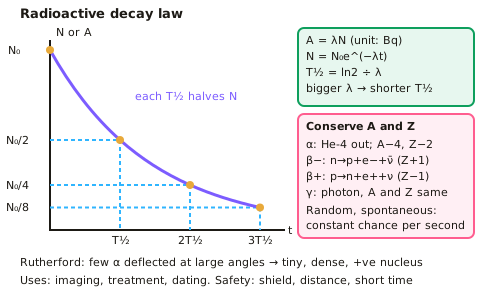
- Rutherford scattering showed the atom has a tiny, dense, positively charged nucleus, with most of the atom being empty space.
- Activity A = λN, where λ is the decay constant; decay law N = N₀e^(−λt). Half-life T½ = ln2 ÷ λ.
- Radioactive decay is random and spontaneous, but with a constant probability per unit time for each nucleus.
- Alpha, beta-minus, beta-plus and gamma emission change the nucleus differently; nuclear equations must conserve nucleon number and proton number.
- Radiation is used in medical imaging and treatment, and radioactive dating, with safety based on shielding, distance and limiting exposure time.
In more detail
- Worked activity: N = 2.0 × 10¹⁸ nuclei with λ = 3.0 × 10⁻⁹ s⁻¹ → A = λN = 6.0 × 10⁹ Bq.
- Worked decay law: after 3 half-lives N = N₀/8; after time t, N = N₀e^(−λt); e.g. λ = 0.10 h⁻¹ for 10 h → N = N₀e⁻¹ = 0.37N₀.
- Half-life link: T½ = ln 2 ÷ λ; λ = 3.0 × 10⁻⁹ s⁻¹ gives T½ = 2.3 × 10⁸ s (about 7 years).
- Medical choice: tracers need short half-lives (hours) and gamma emission so radiation leaves the body and the dose is low.
Practice
Radioactivity and nuclear decay: 10 questions
Pick an answer to check it, or open the answer for the explanation.
1. What did Rutherford scattering demonstrate?
- Electrons orbit in shells
- The atom has a tiny, dense, positive nucleus with mostly empty space
- Neutrons exist
- Atoms are indivisible
Show answer
B: The atom has a tiny, dense, positive nucleus with mostly empty space. A few alpha particles were deflected through large angles.
2. Which equation links half-life and decay constant?
- T½ = λ ÷ ln2
- T½ = ln2 ÷ λ
- T½ = λ²
- T½ = 1 ÷ λ²
Show answer
B: T½ = ln2 ÷ λ. A larger decay constant means a shorter half-life.
3. What is activity?
- The number of undecayed nuclei
- The rate of decay, A = λN
- The energy of emitted radiation
- The mass of the sample
Show answer
B: The rate of decay, A = λN. Activity is measured in becquerels.
4. What is conserved in a nuclear equation?
- Only mass
- Nucleon number and proton number
- Only charge of electrons
- Nothing
Show answer
B: Nucleon number and proton number. Both must balance on each side of the equation.
5. What does 'random' decay mean?
- Decay never happens
- Each nucleus has a constant probability of decaying per unit time, but which decays cannot be predicted
- All nuclei decay at once
- Decay depends on temperature
Show answer
B: Each nucleus has a constant probability of decaying per unit time, but which decays cannot be predicted. Only average behaviour across many nuclei is predictable.
6. A radioactive sample's activity falls from 800 Bq to 100 Bq. How many half-lives have passed?
- 2
- 3
- 4
- 8
Show answer
B: 3. 800 → 400 → 200 → 100 is three halvings.
7. A nuclide has a half-life of 6.0 hours. What is its decay constant?
- 3.2 × 10⁻⁵ s⁻¹
- 1.9 × 10⁻⁴ s⁻¹
- 4.6 × 10⁻⁵ s⁻¹
- 0.12 s⁻¹
Show answer
A: 3.2 × 10⁻⁵ s⁻¹. λ = ln2 ÷ T½ = 0.693 ÷ (6.0 × 3600 s) = 3.2 × 10⁻⁵ s⁻¹. Forgetting ln2 gives 4.6 × 10⁻⁵; using 1 hour = 3600 s but T½ = 1 h gives 1.9 × 10⁻⁴.
8. A sample contains 2.0 × 10⁶ undecayed nuclei and has λ = 3.0 × 10⁻³ s⁻¹. What is its activity?
- 1.5 × 10⁻⁹ Bq
- 6.7 × 10⁸ Bq
- 6.0 × 10³ Bq
- 2.0 × 10⁶ Bq
Show answer
C: 6.0 × 10³ Bq. A = λN = 3.0 × 10⁻³ × 2.0 × 10⁶ = 6.0 × 10³ Bq. Dividing N by λ, or λ by N, are common slips.
9. Which change takes place inside the nucleus during β⁻ decay?
- A proton and electron combine to form a neutron
- A neutron changes into a proton and a positron
- A proton changes into a neutron, positron and neutrino
- A neutron changes into a proton, electron and antineutrino
Show answer
D: A neutron changes into a proton, electron and antineutrino. β⁻ decay converts a neutron to a proton, emitting an electron and an antineutrino. The proton number rises by 1; the nucleon number is unchanged.
10. Why are positron (β⁺) emitters used in PET scanning?
- Positrons make tissue itself radioactive
- Positrons are heavier than electrons so are easier to detect
- Positrons pass straight out of the body to the detector
- Each positron annihilates, producing two gamma photons in opposite directions
Show answer
D: Each positron annihilates, producing two gamma photons in opposite directions. A positron meets an electron and annihilates, giving two gamma photons travelling in opposite directions. Detecting them locates the source. Positrons themselves are absorbed within millimetres.
Keep going in Full Marks
Full Marks has 59 questions on Radioactivity and nuclear decay (49 more than here), set out in practice levels. You also get notes and 3D models for all 8 subtopics of Nuclear physics, plus games, timed exams and past papers.