A-level Physics Year 13 · Topic 7
Fields and their consequences
Fields and their consequences is one of the biggest A2 topics, linking gravity, electricity and magnetism through the idea of a field.
We will compare gravitational and electric fields, field strength and potential, and use them for orbits and charged particles.
Then we cover capacitors and their charging and discharging, and magnetic forces, flux and electromagnetic induction.
- 4 subtopics
- 150 questions
- Free: 7.1 notes and 6 questions
In this topic
- 7.1Gravitational fieldsFree below · 43 questions
- 7.2Electric fieldsOpen in Full Marks · 48 questions
- 7.3CapacitanceOpen in Full Marks · 51 questions
- 7.4Magnetic fields and inductionOpen in Full Marks · 8 questions
7.1 · Free notes
Gravitational fields
Key points
- Newton's law of gravitation: F = Gm₁m₂ ÷ r², an attractive inverse square law force between point masses.
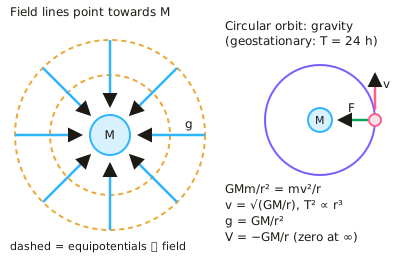
- Gravitational field strength g = F ÷ m = GM ÷ r². Gravitational potential V = −GM ÷ r, always negative, zero at infinity.
- Work done moving a mass in a field: ΔW = mΔV. Field lines point towards the mass, and equipotential surfaces are perpendicular to them.
- For orbits: gravity provides the centripetal force, giving v = √(GM ÷ r) and Kepler's third law T² ∝ r³.
- A geostationary satellite orbits above the equator with a period of 24 hours, staying above the same point on Earth.
In more detail
- Worked g at altitude: at 400 km above Earth (r = 6.77 × 10⁶ m), g = GM/r² = 6.67 × 10⁻¹¹ × 5.97 × 10²⁴ ÷ (6.77 × 10⁶)² = 8.7 N kg⁻¹.
- Worked orbital speed: v = √(GM/r) = √(3.98 × 10¹⁴ ÷ 6.77 × 10⁶) = 7.7 km s⁻¹.
- Geostationary radius: from T² = 4π²r³/GM with T = 86 400 s → r ≈ 4.2 × 10⁷ m (about 36 000 km above the surface).
- Escape velocity: v = √(2GM/r) ≈ 11 km s⁻¹ from Earth's surface; kinetic energy must equal the gravitational potential energy needed to reach infinity.
Practice
Gravitational fields: 6 questions
Pick an answer to check it, or open the answer for the explanation.
1. At a distance 2r from a planet's centre, gravitational field strength becomes:
- g/2
- g/4
- 2g
- 4g
Show answer
B: g/4. g follows an inverse square law.
2. Why is gravitational potential always negative?
- Gravity repels
- Potential is defined as zero at infinity and the force is attractive
- It is a mistake in the definition
- Because mass is negative
Show answer
B: Potential is defined as zero at infinity and the force is attractive. Work must be done against gravity to move a mass to infinity.
3. What provides the centripetal force for a satellite in orbit?
- Air resistance
- Gravitational attraction
- Friction
- Magnetism
Show answer
B: Gravitational attraction. Gravity acts towards the centre of the orbit.
4. What is Kepler's third law?
- T ∝ r
- T² ∝ r³
- T³ ∝ r²
- T ∝ 1/r
Show answer
B: T² ∝ r³. Orbital period squared is proportional to orbital radius cubed.
5. What is the period of a geostationary satellite?
- 1 hour
- 12 hours
- 24 hours
- 365 days
Show answer
C: 24 hours. It matches the Earth's rotation period so it stays above one point.
6. What happens to gravitational potential as you move further from a mass?
- It becomes more negative
- It increases towards zero
- It stays constant
- It becomes positive
Show answer
B: It increases towards zero. Potential is negative and approaches zero at infinite distance.
Keep going in Full Marks
Full Marks has 43 questions on Gravitational fields (37 more than here), set out in practice levels. You also get notes and 3D models for all 4 subtopics of Fields and their consequences, plus games, timed exams and past papers.
On your exam board
- AQATopic 7.2: Gravitational fields, Topic 7.3: Electric fields, Topic 7.4: Capacitance, Topic 7.5: Magnetic fields
- OCR ATopic 5.4: Gravitational fields, Topic 6.1: Capacitors, Topic 6.2: Electric fields, Topic 6.3: Electromagnetism
- OCR BTopic 5.1: Creating models, Topic 5.2: Out into space, Topic 6.1: Charge and field
- EdexcelTopic 7: Electric and magnetic fields, Topic 12: Gravitational fields
- CambridgeTopic 13: Gravitational fields, Topic 18: Electric fields, Topic 19: Capacitance, Topic 20: Magnetic fields