A-level Physics Year 13 · Topic 9
Momentum and collisions
Momentum and collisions applies conservation of momentum and Newton's second law to real collisions and explosions.
We will use momentum and impulse, force–time graphs and safety features, and classify collisions as elastic or inelastic, in one and two dimensions.
Finally we see how video analysis and data loggers are used to investigate collisions in the core practical.
- 4 subtopics
- 246 questions
- Free: 9.1 notes and 10 questions
In this topic
- 9.1Linear momentum and conservation of momentumFree below · 62 questions
- 9.2Force as rate of change of momentum and impulse (F–t graphs, safety features)Open in Full Marks · 60 questions
- 9.3Elastic and inelastic collisions and explosions in one and two dimensionsOpen in Full Marks · 59 questions
- 9.4Practical: analysing collisions using ICTOpen in Full Marks · 65 questions
9.1 · Free notes
Linear momentum and conservation of momentum
Key points
- Linear momentum is mass × velocity, p = mv. It is a vector quantity with unit kg m s⁻¹, which is equivalent to N s.
- Momentum has the same direction as velocity. Choose a positive direction and give opposite directions negative signs in every calculation.
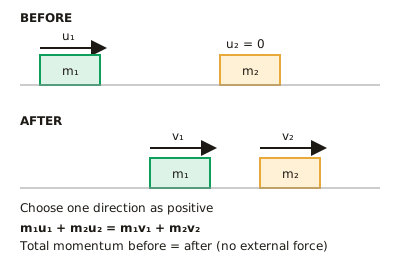
- The principle of conservation of momentum: the total momentum of a closed (isolated) system is constant provided no resultant external force acts on it.
- For two bodies, m₁u₁ + m₂u₂ = m₁v₁ + m₂v₂. If they stick together (coalesce), the right-hand side becomes (m₁ + m₂)v.
- Conservation follows from Newton's third law. The forces are equal and opposite and act for the same time, so the momentum changes are equal and opposite (Δp₁ = −Δp₂).
- Momentum is conserved in every collision or explosion in a closed system, whether or not kinetic energy is conserved.
- In recoil (gun and bullet, astronaut throwing a tool) the total momentum starts at zero. The two momenta are equal in size and opposite in direction, so the lighter object gets the greater speed.
- In two dimensions momentum is conserved independently in two perpendicular directions. Resolve into components, or draw a closed vector triangle of momenta.
- A falling ball gains momentum, but the Earth gains equal and opposite momentum. The momentum of the ball–Earth system is unchanged.
- Required practical: use light gates (v = card length ÷ time) on an air track or friction-compensated runway to keep external forces negligible. Measure masses and velocities before and after, then compare total momentum as a percentage difference.
In more detail
- Worked collision: a 0.40 kg trolley at 2.5 m s⁻¹ hits a stationary 0.60 kg trolley and they stick → v = (0.40 × 2.5) ÷ 1.00 = 1.0 m s⁻¹.
- Worked recoil: a 70 kg astronaut throws a 2.0 kg tool at 7.0 m s⁻¹ → astronaut moves at 0.20 m s⁻¹ in the opposite direction.
- Two dimensions: resolve momenta into x and y components and apply conservation separately to each direction.
- Closed system: a system with no external resultant force; on Earth, friction must be negligible (e.g. an air track).
Practice
Linear momentum and conservation of momentum: 10 questions
Pick an answer to check it, or open the answer for the explanation.
1. A 2.0 kg trolley moving at 3.0 m s⁻¹ collides with a stationary 1.0 kg trolley and they stick together. What is their common speed?
- 2.0 m s⁻¹
- 1.5 m s⁻¹
- 4.0 m s⁻¹
- 3.0 m s⁻¹
Show answer
A: 2.0 m s⁻¹. Momentum before = 2.0 × 3.0 = 6.0 kg m s⁻¹. After, (2.0 + 1.0)v = 6.0, so v = 2.0 m s⁻¹.
2. A 4.0 kg rifle fires a 0.020 kg bullet at 500 m s⁻¹. What is the rifle's initial recoil speed?
- 25 m s⁻¹
- 0.25 m s⁻¹
- 125 m s⁻¹
- 2.5 m s⁻¹
Show answer
D: 2.5 m s⁻¹. Total momentum is initially zero, so 4.0v = 0.020 × 500 = 10 kg m s⁻¹. This gives v = 2.5 m s⁻¹ in the opposite direction.
3. In an inelastic collision between two objects in a closed system, which statement is correct?
- Neither momentum nor kinetic energy is conserved
- Kinetic energy is conserved but momentum is not
- Both are conserved if the objects stick together
- Momentum is conserved but kinetic energy is not
Show answer
D: Momentum is conserved but kinetic energy is not. Momentum is conserved in all collisions in a closed system. Inelastic means some kinetic energy is transferred to other forms such as thermal energy and sound.
4. A ball falls freely and its momentum increases. Why is momentum still conserved for the whole system?
- The Earth gains equal and opposite momentum
- Gravity is a conservative force
- The ball's kinetic energy increases
- No forces act on the ball
Show answer
A: The Earth gains equal and opposite momentum. Gravity acts equally and oppositely on ball and Earth. The Earth gains upward momentum equal in size to the ball's downward gain, so the total is unchanged.
5. A stationary nucleus emits a particle with momentum components 3.0 kg m s⁻¹ east and 4.0 kg m s⁻¹ north. What is the magnitude of the recoil nucleus's momentum?
- 3.5 kg m s⁻¹
- 7.0 kg m s⁻¹
- 5.0 kg m s⁻¹
- 1.0 kg m s⁻¹
Show answer
C: 5.0 kg m s⁻¹. Total momentum was zero, so the nucleus has equal and opposite momentum. Its magnitude is √(3.0² + 4.0²) = 5.0 kg m s⁻¹.
6. Why is an air track used in a momentum conservation experiment?
- It makes the trolleys move faster
- It increases the mass of the trolleys
- It makes the collision elastic
- It reduces friction so external force is negligible
Show answer
D: It reduces friction so external force is negligible. Conservation of momentum applies only if there is no resultant external force. The air cushion removes almost all friction, so the system is close to isolated.
7. A 0.80 kg trolley carries a 0.050 m card that interrupts a light gate for 0.025 s. What is the trolley's momentum?
- 0.64 kg m s⁻¹
- 1.6 kg m s⁻¹
- 0.040 kg m s⁻¹
- 16 kg m s⁻¹
Show answer
B: 1.6 kg m s⁻¹. v = 0.050 ÷ 0.025 = 2.0 m s⁻¹. p = mv = 0.80 × 2.0 = 1.6 kg m s⁻¹.
8. A 0.40 kg trolley at 3.0 m s⁻¹ hits a stationary 0.60 kg trolley and rebounds at 0.60 m s⁻¹. What is the speed of the 0.60 kg trolley afterwards?
- 3.0 m s⁻¹
- 1.6 m s⁻¹
- 2.4 m s⁻¹
- 1.0 m s⁻¹
Show answer
C: 2.4 m s⁻¹. Initial p = 0.40 × 3.0 = 1.2. After: −0.24 + 0.60v = 1.2, so v = 1.44 ÷ 0.60 = 2.4 m s⁻¹. 1.6 m s⁻¹ comes from forgetting the rebound sign.
9. An 80 kg astronaut at rest in space throws a 2.0 kg tool at 6.0 m s⁻¹. What is the astronaut's recoil speed?
- 6.0 m s⁻¹
- 2.4 m s⁻¹
- 0.075 m s⁻¹
- 0.15 m s⁻¹
Show answer
D: 0.15 m s⁻¹. Momentum of tool = 2.0 × 6.0 = 12 kg m s⁻¹. The astronaut has equal and opposite momentum, so v = 12 ÷ 80 = 0.15 m s⁻¹.
10. Which statement about momentum and kinetic energy is correct?
- Momentum is a scalar and kinetic energy is a vector
- Both are scalars
- Both are vectors
- Momentum is a vector and kinetic energy is a scalar
Show answer
D: Momentum is a vector and kinetic energy is a scalar. Momentum = mv has direction, so it is a vector. Kinetic energy = ½mv² has magnitude only, so it is a scalar and cannot be negative.
Keep going in Full Marks
Full Marks has 62 questions on Linear momentum and conservation of momentum (52 more than here), set out in practice levels. You also get notes and 3D models for all 4 subtopics of Momentum and collisions, plus games, timed exams and past papers.
On your exam board
Not in the AQA, OCR A and Cambridge specifications.