A-level Maths Year 13 · Topic 6
Pure: numerical methods and vectors
Numerical methods and vectors give you tools for problems that algebra alone cannot solve exactly.
We will locate roots with a change of sign, and approximate them by iteration and the Newton Raphson method.
Then we estimate areas with the trapezium rule, and work with vectors in three dimensions.
- 5 subtopics
- 311 questions
- Free: 6.1 notes and 10 questions
In this topic
- 6.1Numerical methods and 3D vectorsFree below · 67 questions
- 6.2Iterative methods and the Newton–Raphson methodOpen in Full Marks · 85 questions
- 6.3Numerical integration: the trapezium ruleOpen in Full Marks · 74 questions
- 6.4Vectors in three dimensionsOpen in Full Marks · 42 questions
- 6.5Complex numbers: arithmetic, Argand diagrams, modulus–argument form and lociOpen in Full Marks · 43 questions
6.1 · Free notes
Numerical methods and 3D vectors
Key points
- A root of f(x) = 0 lies between a and b if f(a) and f(b) have opposite signs and f is continuous there.
- Iteration uses xₙ₊₁ = g(xₙ) to converge to a root; staircase and cobweb diagrams show convergence.
- The Newton-Raphson method: xₙ₊₁ = xₙ − f(xₙ) ÷ f'(xₙ), which usually converges quickly but can fail if f'(xₙ) is near zero.
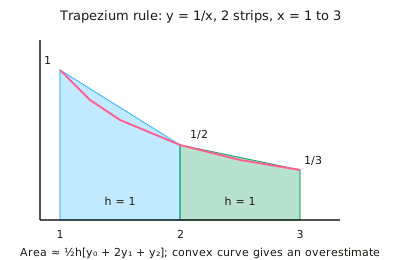
- The trapezium rule estimates the area under a curve; more strips give a better approximation.
- 3D vectors: magnitude = √(x² + y² + z²); vectors are added component-wise and used to describe positions and directions in space.
In more detail
- Worked sign change: f(x) = x³ − 2x − 5: f(2) = −1 and f(3) = 16, so a root lies between 2 and 3.
- Worked Newton–Raphson: f′(x) = 3x² − 2; from x₀ = 2: x₁ = 2 − (−1)/10 = 2.1; x₂ = 2.1 − 0.061/11.23 = 2.0946.
- Worked iteration: x = ∛(2x + 5) from x₀ = 2: x₁ = ∛9 = 2.0801, x₂ = 2.0924, … converging to 2.0946.
- Worked trapezium rule: ∫₀¹ √(1 + x²) dx with 4 strips (h = 0.25): 0.125 × [1 + 1.4142 + 2(1.0308 + 1.1180 + 1.25)] = 1.1515.
- Worked 3D magnitude: |3i − 4j + 12k| = √(9 + 16 + 144) = 13.
Practice
Numerical methods and 3D vectors: 10 questions
Pick an answer to check it, or open the answer for the explanation.
1. A root of f(x) = 0 lies between a and b if:
- f(a) and f(b) are both positive
- f(a) and f(b) have opposite signs
- f(a) = f(b)
- f is discontinuous
Show answer
B: f(a) and f(b) have opposite signs. A continuous function must cross zero between them.
2. What is the Newton-Raphson formula?
- xₙ₊₁ = xₙ + f(xₙ)
- xₙ₊₁ = xₙ − f(xₙ) ÷ f'(xₙ)
- xₙ₊₁ = f(xₙ) ÷ xₙ
- xₙ₊₁ = f'(xₙ)
Show answer
B: xₙ₊₁ = xₙ − f(xₙ) ÷ f'(xₙ). It uses the tangent at the current estimate.
3. What is the magnitude of the vector 2i + 3j + 6k?
- 7
- 11
- 36
- 41
Show answer
A: 7. √(4 + 9 + 36) = √49 = 7.
4. How can the trapezium rule estimate be improved?
- Use fewer strips
- Use more strips
- Use a larger interval
- Use only one trapezium
Show answer
B: Use more strips. Narrower strips follow the curve more closely.
5. When might the Newton-Raphson method fail?
- When f'(xₙ) is close to zero
- When f(x) is continuous
- When the root is positive
- When using many iterations
Show answer
A: When f'(xₙ) is close to zero. A near-zero gradient sends the next estimate far away.
6. What is the magnitude of 3i − 4j + 12k?
- 13
- 19
- 5
- 7
Show answer
A: 13. √(9 + 16 + 144) = √169 = 13.
7. f(2) = −3 and f(3) = 1. What can you conclude?
- No root exists
- A root lies between 2 and 3
- A root lies at x = 2
- The function is discontinuous
Show answer
B: A root lies between 2 and 3. A sign change for a continuous function implies a root.
8. Increasing the number of strips in the trapezium rule usually:
- Reduces accuracy
- Improves the estimate
- Has no effect
- Gives the exact answer always
Show answer
B: Improves the estimate. Narrower strips fit the curve more closely.
9. For f(x) = x³ + x − 5, which interval contains a root of f(x) = 0?
- −1 < x < 0
- 1 < x < 2
- 0 < x < 1
- 2 < x < 3
Show answer
B: 1 < x < 2. f(1) = −3 and f(2) = 5, so there is a sign change and f is continuous. In the other intervals f has the same sign at both ends.
10. Use Newton-Raphson with f(x) = x² − 2 and x₀ = 1. What is x₁?
- 1
- 1.25
- 2
- 1.5
Show answer
D: 1.5. f(1) = −1, f′(1) = 2, so x₁ = 1 − (−1)/2 = 1.5. Subtracting rather than adding the ratio is a common sign error.
Keep going in Full Marks
Full Marks has 67 questions on Numerical methods and 3D vectors (57 more than here), set out in practice levels. You also get notes and 3D models for all 5 subtopics of Pure: numerical methods and vectors, plus games, timed exams and past papers.
On your exam board
- AQATopic 8: Numerical methods, Topic 9: Vectors in three dimensions
- OCR ATopic 8: Numerical methods, Topic 9: Vectors in three dimensions
- OCR BTopic 8: Numerical methods, Topic 9: Vectors in three dimensions
- EdexcelTopic 8: Numerical methods, Topic 9: Vectors in three dimensions
- CambridgeTopic 3.5: Integration, Topic 3.6: Numerical solution of equations, Topic 3.7: Vectors, Topic 3.9: Complex numbers