A-level Maths Year 13 · Topic 5
Pure: integration and differential equations
Integration and differential equations extend your integration skills and use them to model change.
We will integrate by substitution and by parts, and use partial fractions and trigonometric identities.
Then we solve first order separable differential equations and use them to model growth, decay and cooling.
- 3 subtopics
- 169 questions
- Free: 5.1 notes and 10 questions
In this topic
- 5.1Integration by substitution and by partsFree below · 58 questions
- 5.2Integration using partial fractions and trigonometric identitiesOpen in Full Marks · 63 questions
- 5.3First-order separable differential equationsOpen in Full Marks · 48 questions
5.1 · Free notes
Integration by substitution and by parts
Key points
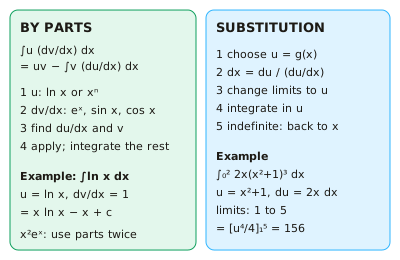
- Integration by parts formula: ∫u (dv/dx) dx = uv − ∫v (du/dx) dx. It is used for a product of two different types of function, such as x eˣ or x sin x.
- Choose u to be the part that becomes simpler when differentiated (ln x, or a power of x). Choose dv/dx to be the part you can integrate easily (eˣ, sin x, cos x).
- For ∫ln x dx use u = ln x and dv/dx = 1, giving x ln x − x + c. Treating a lone function as a product with 1 is a standard trick.
- If the power of x is 2 or more (for example x²eˣ), apply by parts repeatedly. Each application lowers the power of x by one.
- For definite integrals by parts, evaluate the uv term between the limits: [uv]ₐᵇ − ∫ₐᵇ v (du/dx) dx. Do not forget the limits on the remaining integral.
- With integration by substitution, choose u = g(x), find du/dx and replace dx by du/(du/dx). Every x must disappear from the integrand.
- For a definite integral by substitution, change the limits into values of u. Then there is no need to return to x.
- Reverse chain rule (recognition): ∫f′(x)[f(x)]ⁿ dx = [f(x)]ⁿ⁺¹/(n + 1) + c and ∫f′(x)/f(x) dx = ln|f(x)| + c. For example, ∫tan x dx = −ln|cos x| + c.
- Check by differentiating your answer. Include + c on every indefinite integral and give exact values (e, ln, π) unless a decimal is requested.
- Some questions give the substitution (for example u = x + 1 or u = sin x); use exactly that. If the integrand then has an extra factor of x, rewrite x in terms of u.
In more detail
- Worked by parts: ∫x cos x dx = x sin x − ∫sin x dx = x sin x + cos x + c.
- Worked ln x: ∫₁^e ln x dx = [x ln x − x]₁^e = (e − e) − (0 − 1) = 1.
- Worked twice: ∫x²eˣ dx = x²eˣ − 2∫xeˣ dx = eˣ(x² − 2x + 2) + c.
- Worked substitution: ∫2x(x² + 1)⁴ dx with u = x² + 1 → ∫u⁴ du = (x² + 1)⁵/5 + c.
- Worked with limits: ∫₀¹ x√(1 − x²) dx with u = 1 − x² → ½∫₀¹ u^(1/2) du = ½ × ⅔ = ⅓.
- Worked recognition: ∫2x/(x² + 3) dx = ln(x² + 3) + c; ∫cos x sin³x dx = ¼sin⁴x + c.
Practice
Integration by substitution and by parts: 10 questions
Pick an answer to check it, or open the answer for the explanation.
1. Using u = x + 1, evaluate ∫₀³ x√(x + 1) dx.
- 64/15
- 116/15
- 8√3/5
- 58/15
Show answer
B: 116/15. x = u − 1 with limits 1 to 4. ∫(u^(3/2) − u^(1/2)) du = [2u^(5/2)/5 − 2u^(3/2)/3]₁⁴ = 116/15.
2. Using u = x² and dv/dx = e³ˣ, what is the first step for ∫x²e³ˣ dx?
- x²e³ˣ/3 − (2/3)∫x e³ˣ dx
- x²e³ˣ/3 − ∫2x e³ˣ dx
- 3x²e³ˣ − ∫6x e³ˣ dx
- x³e³ˣ/3 − ∫x²e³ˣ dx
Show answer
A: x²e³ˣ/3 − (2/3)∫x e³ˣ dx. v = e³ˣ/3 and du/dx = 2x. So uv − ∫v du/dx dx = x²e³ˣ/3 − ∫(2x)(e³ˣ/3) dx = x²e³ˣ/3 − (2/3)∫x e³ˣ dx.
3. Find ∫6x/(3x² + 1) dx.
- (3x² + 1)⁻¹ + c
- ln(3x² + 1) + c
- ln|6x| + c
- 2 ln(3x² + 1) + c
Show answer
B: ln(3x² + 1) + c. The numerator 6x is exactly the derivative of 3x² + 1. So the integral has the form ∫f′/f dx = ln|f| + c.
4. Using u = sin x, evaluate ∫₀^(π/2) cos x sin³x dx.
- 4
- 1/3
- 0
- 1/4
Show answer
D: 1/4. du = cos x dx, and the limits become 0 to 1. ∫₀¹ u³ du = [u⁴/4]₀¹ = 1/4.
5. Using u = x² + 1 for ∫₀² 2x(x² + 1)³ dx, which are the correct limits for the u-integral?
- 0 to 5
- 0 to 2
- 1 to 3
- 1 to 5
Show answer
D: 1 to 5. When x = 0, u = 0² + 1 = 1. When x = 2, u = 2² + 1 = 5. So the limits are 1 to 5.
6. Evaluate ∫₁^e ln x dx.
- e
- e − 1
- 0
- 1
Show answer
D: 1. ∫ln x dx = x ln x − x. So [x ln x − x]₁^e = (e − e) − (0 − 1) = 1.
7. Which choice of u is best when integrating x³ ln x dx by parts?
- u = ln x
- u = x³
- u = x³ ln x
- u = 1/x
Show answer
A: u = ln x. Choose u to be the part that simplifies on differentiation. ln x becomes 1/x, while x³ is easy to integrate for dv/dx.
8. A particle has velocity v = t e^(−t) m/s. Find the distance travelled in the first 1 s.
- 1 − 1/e m
- 1/e m
- 1 − 2/e m
- 2/e − 1 m
Show answer
C: 1 − 2/e m. ∫₀¹ te^(−t) dt = [−te^(−t) − e^(−t)]₀¹ = (−2/e) − (−1) = 1 − 2/e m, about 0.264 m.
9. Find ∫eˣ/(eˣ + 3) dx.
- eˣ + 3 ln x + c
- (eˣ + 3)²/2 + c
- ln(eˣ + 3) + c
- eˣ ln(eˣ + 3) + c
Show answer
C: ln(eˣ + 3) + c. The numerator is the derivative of the denominator, so ∫f′/f dx = ln|f|. Since eˣ + 3 > 0, the result is ln(eˣ + 3) + c.
10. Using u = 4 − x², evaluate ∫₀² x√(4 − x²) dx.
- 16/3
- 16
- 4/3
- 8/3
Show answer
D: 8/3. du = −2x dx, and the limits change from x = 0, 2 to u = 4, 0. The integral becomes ½∫₀⁴ √u du = ½ · (2/3) · 8 = 8/3.
Keep going in Full Marks
Full Marks has 58 questions on Integration by substitution and by parts (48 more than here), set out in practice levels. You also get notes and 3D models for all 3 subtopics of Pure: integration and differential equations, plus games, timed exams and past papers.
On your exam board
- AQATopic 7: Further integration and differential equations
- OCR ATopic 7: Further integration and differential equations
- OCR BTopic 7: Further integration and differential equations
- EdexcelTopic 7: Further integration and differential equations
- CambridgeTopic 3.5: Integration, Topic 3.8: Differential equations