A-level Maths Year 13 · Topic 4
Pure: differentiation
Differentiation at A2 level lets you differentiate almost any function you will meet.
We will use the chain, product and quotient rules, and differentiate trigonometric, exponential and log functions.
Then we differentiate parametric and implicit equations, and solve problems with connected rates of change.
- 3 subtopics
- 175 questions
- Free: 4.1 notes and 10 questions
In this topic
- 4.1Further differentiation and integrationFree below · 56 questions
- 4.2Differentiating and integrating parametric equationsOpen in Full Marks · 54 questions
- 4.3Implicit differentiation and connected rates of changeOpen in Full Marks · 65 questions
4.1 · Free notes
Further differentiation and integration
Key points
- Chain rule: dy/dx = dy/du × du/dx. Product rule: d(uv)/dx = u'v + uv'. Quotient rule: d(u/v)/dx = (u'v − uv') ÷ v².
- Standard derivatives: d/dx(sinx) = cosx; d/dx(cosx) = −sinx; d/dx(eˣ) = eˣ; d/dx(lnx) = 1 ÷ x.
- Implicit differentiation differentiates both sides with respect to x, using the chain rule for terms in y.
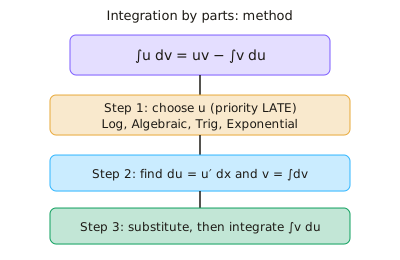
- Integration by substitution and integration by parts (∫u dv = uv − ∫v du) handle more complex integrals.
- Integration is used for areas between curves, volumes of revolution and solving differential equations, including separating variables.
In more detail
- Worked chain rule: y = (3x² + 1)⁵ → dy/dx = 5(3x² + 1)⁴ × 6x = 30x(3x² + 1)⁴.
- Worked product rule: y = x² sin x → dy/dx = 2x sin x + x² cos x.
- Worked quotient rule: y = eˣ/(x + 1) → dy/dx = [eˣ(x + 1) − eˣ]/(x + 1)² = xeˣ/(x + 1)².
- Worked log: y = ln(3x² + 2) → dy/dx = 6x/(3x² + 2).
- Worked by parts: ∫xeˣ dx = xeˣ − ∫eˣ dx = xeˣ − eˣ + c.
Practice
Further differentiation and integration: 10 questions
Pick an answer to check it, or open the answer for the explanation.
1. Differentiate y = x sin x
- cos x
- sin x + x cos x
- x cos x
- sin x − x cos x
Show answer
B: sin x + x cos x. Product rule: u'v + uv'.
2. What is ∫ 1/x dx?
- x⁻² + c
- ln|x| + c
- eˣ + c
- 1 ÷ x² + c
Show answer
B: ln|x| + c. The derivative of ln x is 1 ÷ x.
3. What is the derivative of cos x?
- sin x
- −sin x
- cos x
- −cos x
Show answer
B: −sin x. The negative sign is essential.
4. Which rule is used to differentiate a function of a function?
- Product rule
- Quotient rule
- Chain rule
- Sum rule
Show answer
C: Chain rule. dy/dx = dy/du × du/dx.
5. Which technique uses the formula ∫u dv = uv − ∫v du?
- Substitution
- Integration by parts
- Partial fractions
- Implicit differentiation
Show answer
B: Integration by parts. It is especially useful for products such as x eˣ.
6. Differentiate y = e^(3x)
- e^(3x)
- 3e^(3x)
- 3xe^(3x)
- e^(3x)/3
Show answer
B: 3e^(3x). Chain rule: multiply by the derivative of 3x.
7. Differentiate y = ln(5x)
- 5/x
- 1/x
- 1/(5x)
- 5
Show answer
B: 1/x. The derivative of ln(kx) is 1/x.
8. Which method is best for ∫ x e^x dx?
- Substitution
- Integration by parts
- Partial fractions
- Direct integration
Show answer
B: Integration by parts. It is a product of two different function types.
9. Differentiate y = (2x + 1)⁵.
- 5(2x + 1)⁴
- 2(2x + 1)⁵
- 10x(2x + 1)⁴
- 10(2x + 1)⁴
Show answer
D: 10(2x + 1)⁴. Chain rule: 5(2x + 1)⁴ × 2 = 10(2x + 1)⁴. Forgetting the inner derivative 2 gives the tempting 5(2x + 1)⁴.
10. Differentiate y = x² eˣ.
- eˣ(x² + 2x)
- 2x eˣ
- x² eˣ
- eˣ(2x − x²)
Show answer
A: eˣ(x² + 2x). Product rule: u = x², v = eˣ, so dy/dx = 2x eˣ + x² eˣ = eˣ(x² + 2x). Differentiating each factor separately is not allowed.
Keep going in Full Marks
Full Marks has 56 questions on Further differentiation and integration (46 more than here), set out in practice levels. You also get notes and 3D models for all 3 subtopics of Pure: differentiation, plus games, timed exams and past papers.
On your exam board
- AQATopic 3: Parametric equations, Topic 6: Further differentiation
- OCR ATopic 3: Parametric equations, Topic 6: Further differentiation
- OCR BTopic 3: Parametric equations, Topic 6: Further differentiation
- EdexcelTopic 3: Parametric equations, Topic 6: Further differentiation
- CambridgeTopic 3.4: Differentiation