A-level Geography Year 13 · Topic 6
Global systems and global governance
Global systems and global governance examines how the world economy and its shared spaces are organised and controlled.
We will study globalisation and trade, the global shift, and transnational corporations and production networks.
Then we weigh up the winners and losers of globalisation, global governance institutions, and Antarctica as a global commons.
- 7 subtopics
- 173 questions
- Free: 6.1 notes and 6 questions
In this topic
- 6.1Globalisation and tradeFree below · 14 questions
- 6.2Global commons and governanceOpen in Full Marks · 14 questions
- 6.3Globalisation: causes, indicators (KOF index) and the global shiftOpen in Full Marks · 31 questions
- 6.4Transnational corporations and global production networksOpen in Full Marks · 25 questions
- 6.5Winners and losers: economic, social, cultural and environmental impacts of globalisation and anti-globalisation responsesOpen in Full Marks · 23 questions
- 6.6Global governance institutions: UN, WTO, IMF, World Bank, G7/G20 and NGOsOpen in Full Marks · 34 questions
- 6.7Antarctica as a global commons: Antarctic Treaty System, Madrid Protocol and pressuresOpen in Full Marks · 32 questions
6.1 · Free notes
Globalisation and trade
Key points
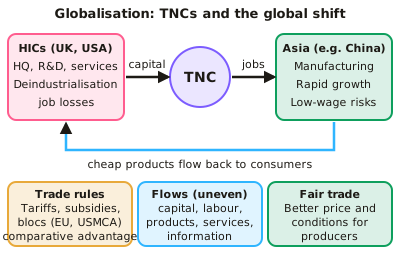
- Globalisation is the increasing interconnection of economies, cultures and populations, driven by trade, technology, transport and transnational corporations.
- Flows include capital, labour, products, services and information; these are unevenly distributed, creating winners and losers.
- TNCs locate production to reduce costs and access markets, bringing investment and jobs but sometimes exploiting labour and environmental standards.
- Trade patterns are shaped by comparative advantage, trade blocs, tariffs, subsidies and trade agreements; fair trade aims to give producers a better deal.
- The global shift of manufacturing to Asia has created rapid development in some countries and deindustrialisation elsewhere.
- Globalisation raises questions about inequality, cultural diffusion, environmental cost and sovereignty.
In more detail
- Scale of trade: world merchandise trade was worth about $24 trillion in 2023.
- Commodity dependence: copper makes up about 70% of Zambia's exports, leaving it exposed to price swings.
- Terms of trade: if raw material prices fall while manufactured goods get dearer, commodity exporters lose out.
- Export-led growth: East Asian economies grew rapidly by exporting manufactured goods.
- Unequal shares: Africa accounts for only about 3% of world trade.
Practice
Globalisation and trade: 6 questions
Pick an answer to check it, or open the answer for the explanation.
1. What is a TNC?
- A trade union
- A transnational corporation operating in more than one country
- A national government
- A tariff system
Show answer
B: A transnational corporation operating in more than one country. TNCs shape global production and investment flows.
2. What is the global shift?
- Migration to rural areas
- The movement of manufacturing from HICs to lower-cost countries, especially in Asia
- Changing ocean currents
- Increased tariffs
Show answer
B: The movement of manufacturing from HICs to lower-cost countries, especially in Asia. It created growth in Asia and deindustrialisation elsewhere.
3. What is a trade bloc?
- A ban on trade
- A group of countries agreeing to reduce trade barriers between members
- A shipping route
- A tariff on imports
Show answer
B: A group of countries agreeing to reduce trade barriers between members. Examples include free trade areas and customs unions.
4. What is the aim of fair trade?
- Lower prices for consumers only
- A better, more stable deal for producers in lower-income countries
- Ending all international trade
- Increasing tariffs
Show answer
B: A better, more stable deal for producers in lower-income countries. It guarantees a minimum price and social premium.
5. Which is a criticism of globalisation?
- It reduces communication
- Benefits and costs are unevenly distributed, increasing some inequalities
- It stops all trade
- It prevents investment
Show answer
B: Benefits and costs are unevenly distributed, increasing some inequalities. Some places and groups gain far more than others.
6. Which is an example of a flow within globalisation?
- A national border
- A flow of foreign direct investment between countries
- A single country's population
- A local market only
Show answer
B: A flow of foreign direct investment between countries. Capital, labour, goods and information all flow internationally.
Keep going in Full Marks
Full Marks has 14 questions on Globalisation and trade (8 more than here), set out in practice levels. You also get notes and 3D models for all 7 subtopics of Global systems and global governance, plus games, timed exams and past papers.
On your exam board
- AQATopic 3: Global systems and global governance
- OCR ATopic 1.1: Global connections: trade in the contemporary world, Topic 2.1: Global governance: human rights
- EdexcelTopic 8: Superpowers
- CambridgeTopic 11: Production, location and change, Topic 13: Global interdependence, Topic 14: Economic transition