A-level Geography Year 13 · Topic 7
Contemporary urban environments
Contemporary urban environments explores how cities grow, change and affect the environment.
We will study urbanisation, megacities and world cities, urban change, and regeneration and rebranding.
Then we look at urban climate, drainage, waste and pollution, urban form and inequality, sustainability, and two contrasting cities.
- 7 subtopics
- 418 questions
- Free: 7.1 notes and 6 questions
In this topic
- 7.1Urban climate, drainage and wasteFree below · 55 questions
- 7.2Urban form, inequality and sustainabilityOpen in Full Marks · 50 questions
- 7.3Urbanisation processes and global urban trends: rural-urban migration, megacities and world citiesOpen in Full Marks · 64 questions
- 7.4Urban change: deindustrialisation, suburbanisation, counter-urbanisation and re-urbanisationOpen in Full Marks · 77 questions
- 7.5Urban regeneration and rebranding: strategies, partnerships and evaluationOpen in Full Marks · 67 questions
- 7.6Urban pollution and air quality: sources, impacts and managementOpen in Full Marks · 70 questions
- 7.7Contrasting city case studies: one city in a lower-income/emerging country and one in a higher-income countryOpen in Full Marks · 35 questions
7.1 · Free notes
Urban climate, drainage and waste
Key points
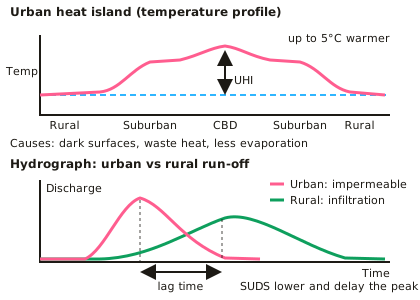
- The urban heat island effect makes cities warmer than surrounding rural areas, due to heat from buildings, vehicles and industry, plus dark surfaces absorbing radiation and reduced evaporation.
- Urban areas also affect precipitation, fog, wind (channelling between buildings) and air quality, with pollutants including particulates and nitrogen oxides causing photochemical smog.
- Urban surfaces are largely impermeable, increasing surface run-off, reducing lag time and raising flood risk; SUDS (sustainable drainage systems) use permeable surfaces, swales and retention ponds.
- Waste management approaches include landfill, incineration, recycling, recovery and trade in waste; the volume and type of waste depend on lifestyle, affluence and regulation.
- Ecological footprint measures the area needed to sustain a population's resource use and absorb its waste.
- Strategies for sustainable cities include reducing car use, improving public transport, greening urban space and energy-efficient design.
In more detail
- Urban heat island: on calm, clear nights central London can be up to about 10 °C warmer than the surrounding countryside.
- Why cities are warmer: dark surfaces absorb heat, there is less evapotranspiration, and buildings, traffic and air conditioning release waste heat.
- Sustainable drainage: permeable paving, swales, green roofs and ponds slow runoff, as in Sheffield's "Grey to Green" scheme.
- Waste: England recycles about 44% of household waste; in Lagos, huge dumps such as Olusosun receive much of the city's rubbish.
- Urban wind: tall buildings funnel wind into dangerous gusts, as around Bridgewater Place in Leeds.
Practice
Urban climate, drainage and waste: 6 questions
Pick an answer to check it, or open the answer for the explanation.
1. What causes the urban heat island effect?
- More vegetation in cities
- Heat from buildings, vehicles and industry, plus dark absorbent surfaces
- Higher altitude
- More rainfall
Show answer
B: Heat from buildings, vehicles and industry, plus dark absorbent surfaces. Reduced evaporation from vegetation also plays a part.
2. Why does urban development increase flood risk?
- More infiltration occurs
- Impermeable surfaces increase run-off and reduce lag time
- Rainfall decreases
- Rivers become wider
Show answer
B: Impermeable surfaces increase run-off and reduce lag time. Water reaches drains and channels much faster.
3. What are SUDS designed to do?
- Increase run-off
- Manage drainage sustainably using permeable surfaces, swales and ponds
- Replace all rivers
- Increase impermeable surfaces
Show answer
B: Manage drainage sustainably using permeable surfaces, swales and ponds. They mimic natural drainage processes.
4. What does an ecological footprint measure?
- City population
- The area needed to sustain resource use and absorb waste
- Building height
- Air temperature
Show answer
B: The area needed to sustain resource use and absorb waste. It expresses environmental impact as land area.
5. What is photochemical smog associated with?
- Cold, wet weather
- Sunlight reacting with vehicle pollutants such as nitrogen oxides
- Heavy rainfall
- Volcanic ash
Show answer
B: Sunlight reacting with vehicle pollutants such as nitrogen oxides. It is common in warm, sunny, traffic-heavy cities.
6. Why do urban areas typically experience higher rainfall in some circumstances than surrounding rural areas?
- Cooler urban temperatures suppress convection
- Warmer rising air and particulates can encourage localised convectional rainfall
- Cities have no water vapour
- Urban areas always have less rainfall
Show answer
B: Warmer rising air and particulates can encourage localised convectional rainfall. This is linked to the urban heat island effect.
Keep going in Full Marks
Full Marks has 55 questions on Urban climate, drainage and waste (49 more than here), set out in practice levels. You also get notes and 3D models for all 7 subtopics of Contemporary urban environments, plus games, timed exams and past papers.
On your exam board
Not in the OCR A, Edexcel and Cambridge specifications.