A-level Geography Year 13 · Topic 8
Population, resources and development
Population, resources and development explores how many people the Earth can support, and how resources are shared.
We will study population change, structure and policies, and the links between population and the environment.
Then we look at resource security, mineral resources like rare earths, and sustainable resource stewardship.
- 8 subtopics
- 345 questions
- Free: 8.1 notes and 6 questions
In this topic
- 8.1Population and the environmentFree below · 53 questions
- 8.2Resource securityOpen in Full Marks · 14 questions
- 8.3Population change: fertility, mortality, migration and the demographic transition modelOpen in Full Marks · 66 questions
- 8.4Population structure: pyramids, ageing, youth bulge and dependency ratiosOpen in Full Marks · 66 questions
- 8.5Population policies and strategies: pronatalist, anti-natalist and case studyOpen in Full Marks · 64 questions
- 8.6Natural resources: classification, distribution, reserves and resource frontiersOpen in Full Marks · 26 questions
- 8.7Mineral resources: security of supply, rare earths and environmental impactsOpen in Full Marks · 24 questions
- 8.8Resource stewardship: circular economy, recycling and sustainable resource managementOpen in Full Marks · 32 questions
8.1 · Free notes
Population and the environment
Key points
- Population distribution and density are influenced by physical factors (climate, relief, soils, water) and human factors (economy, politics, history).
- Population change = natural increase (births − deaths) ± migration; the demographic transition model and population pyramids show structural change.
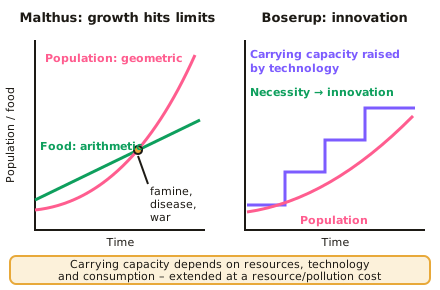
- Malthus argued population growth would outstrip food supply, leading to checks; Boserup argued necessity drives innovation to increase food production.
- Health and disease vary with development: LICs face more communicable disease, HICs more non-communicable conditions linked to lifestyle and ageing.
- Carrying capacity is the population an environment can sustain; environmental limits can be extended by technology, but with resource and pollution costs.
- Ageing populations and youthful populations create contrasting economic and social challenges.
In more detail
- Milestone: the world population reached 8 billion in November 2022, and the UN projects a peak of about 10.3 billion in the 2080s.
- Malthus vs Boserup: Malthus warned population would outstrip food; Boserup argued that pressure drives new technology to raise output.
- Ecological footprint: humanity currently uses resources as if it had about 1.7 Earths.
- Earth Overshoot Day: the date we use up a year's worth of renewable resources now falls around late July or early August.
- Environmental limits: dense populations cluster on fertile, well-watered plains such as the Ganges, but are sparse in deserts like the Sahara.
Practice
Population and the environment: 6 questions
Pick an answer to check it, or open the answer for the explanation.
1. What did Malthus argue?
- Population growth drives innovation
- Population would grow faster than food supply, leading to checks
- Population always falls
- Food supply is unlimited
Show answer
B: Population would grow faster than food supply, leading to checks. Boserup took the opposite view.
2. What does a population pyramid show?
- Migration routes
- The age and sex structure of a population
- Only birth rate
- Land use
Show answer
B: The age and sex structure of a population. Its shape reveals dependency and future change.
3. What is carrying capacity?
- The maximum number of species
- The population an environment can support sustainably
- The rate of migration
- Total land area
Show answer
B: The population an environment can support sustainably. It depends on resources, technology and consumption.
4. Which type of disease is generally more common in HICs?
- Communicable diseases
- Non-communicable diseases linked to lifestyle and ageing
- Waterborne diseases
- Vector-borne diseases
Show answer
B: Non-communicable diseases linked to lifestyle and ageing. Epidemiological transition accompanies development.
5. What is natural increase?
- Births minus deaths
- Immigration minus emigration
- Total population
- Population density
Show answer
A: Births minus deaths. Migration is considered separately.
6. According to Boserup, what happens as population pressure increases?
- Famine is inevitable
- Necessity drives people to innovate and increase food production
- Population always collapses
- Technology never improves
Show answer
B: Necessity drives people to innovate and increase food production. This is the opposite view to Malthus's pessimistic prediction.
Keep going in Full Marks
Full Marks has 53 questions on Population and the environment (47 more than here), set out in practice levels. You also get notes and 3D models for all 8 subtopics of Population, resources and development, plus games, timed exams and past papers.
On your exam board
- AQATopic 5: Population and the environment, Topic 6: Resource security
- EdexcelTopic 6: The carbon cycle and energy security
- CambridgeTopic 12: Environmental management
Not in the OCR A specification.