A-level Chemistry Year 13 · Topic 8
Mathematical and practical skills for Year 13 chemistry
Mathematical and practical skills for Year 13 chemistry make sure you can handle the harder calculations and planning questions in the final exams.
We will practise logarithms and pH calculations, then graphs, tangents and Arrhenius plots.
Finally we deal with significant figures, units and uncertainty, and how to plan, analyse and evaluate practical investigations.
- 4 subtopics
- 189 questions
- Free: 8.1 notes and 10 questions
In this topic
- 8.1Maths skills: logarithms and antilogs, rearranging equations, pH, pKa and Kw calculationsFree below · 53 questions
- 8.2Maths skills: graphs, tangents, gradients and intercepts (rate graphs, Arrhenius ln k against 1/T)Open in Full Marks · 66 questions
- 8.3Maths skills: significant figures, units, percentage error and uncertainty in measurementsOpen in Full Marks · 36 questions
- 8.4Planning, analysing and evaluating practical investigations (variables, apparatus, reliability, validity)Open in Full Marks · 34 questions
8.1 · Free notes
Maths skills: logarithms and antilogs, rearranging equations, pH, pKa and Kw calculations
Key points
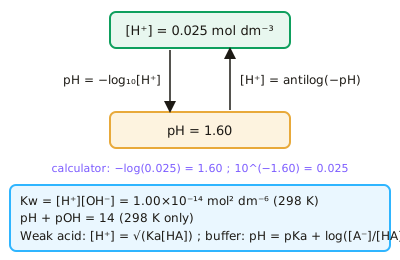
- pH = −log₁₀[H⁺]. To reverse it, [H⁺] = 10^(−pH), the antilog (10ˣ or shift-log on the calculator). pH has no units, and it is quoted to as many decimal places as [H⁺] has significant figures.
- Log rules: log(ab) = log a + log b; log(a/b) = log a − log b; log(aⁿ) = n log a. Also ln x = 2.303 × log₁₀ x, which is needed for Arrhenius work.
- Kw = [H⁺][OH⁻] = 1.00 × 10⁻¹⁴ mol² dm⁻⁶ at 298 K. pKw = 14, and pH + pOH = 14 only at 298 K.
- The ionisation of water is endothermic, so Kw increases with temperature and the pH of pure water falls below 7. The water is still neutral because [H⁺] = [OH⁻].
- Strong monobasic acid: [H⁺] = [HA]. For a strong base, find [OH⁻] (multiply by the number of OH⁻ per formula unit), then [H⁺] = Kw ÷ [OH⁻], or use pOH and pH = 14 − pOH.
- Ka = [H⁺][A⁻] ÷ [HA] (units mol dm⁻³). pKa = −log₁₀Ka, so a smaller pKa means a stronger acid.
- Weak acid: assume [H⁺] = [A⁻] (water's ionisation is negligible) and [HA]equilibrium ≈ [HA]initial. Then [H⁺] = √(Ka × [HA]) and pH = ½(pKa − log[HA]). Examiners award marks for stating both assumptions.
- Buffer: [H⁺] = Ka × [HA] ÷ [A⁻], so pH = pKa + log([A⁻]/[HA]). When [A⁻] = [HA] (half-neutralisation) pH = pKa, and a buffer works best within pKa ± 1.
- Mixing strong acid and alkali: work in moles, subtract, then divide the excess by the total volume in dm³ before taking −log. Each 10-fold dilution of a strong acid raises its pH by 1.
- Rearranging: do the same operation to both sides, convert cm³ to dm³ (÷1000), and check units at each step. For example Ka = [H⁺]²/[HA] rearranges to [H⁺] = √(Ka[HA]). Do not round until the final answer.
In more detail
- Worked pH: pH 3.40 → [H⁺] = 10⁻³·⁴⁰ = 3.98 × 10⁻⁴ mol dm⁻³.
- Worked strong base: 0.0500 mol dm⁻³ Ba(OH)₂ → [OH⁻] = 0.100 → [H⁺] = 1.00 × 10⁻¹³ → pH = 13.00.
- Worked mixing: 25.0 cm³ of 0.100 HCl + 20.0 cm³ of 0.100 NaOH → excess H⁺ = 5.00 × 10⁻⁴ mol in 45.0 cm³ → [H⁺] = 0.0111 → pH = 1.95.
- Pure water at higher temperature: at 50 °C Kw = 5.48 × 10⁻¹⁴, so [H⁺] = 2.34 × 10⁻⁷ and pH = 6.63, but the water is still neutral because [H⁺] = [OH⁻].
Practice
Maths skills: logarithms and antilogs, rearranging equations, pH, pKa and Kw calculations: 10 questions
Pick an answer to check it, or open the answer for the explanation.
1. Calculate the pH of 0.020 mol dm⁻³ hydrochloric acid.
- 2.00
- 1.40
- 1.70
- 1.00
Show answer
C: 1.70. HCl is a strong monobasic acid, so [H⁺] = 0.020 mol dm⁻³. pH = −log(0.020) = 1.70.
2. Calculate the pH of 0.050 mol dm⁻³ Ba(OH)₂(aq) at 298 K.
- 13.00
- 1.30
- 1.00
- 12.70
Show answer
A: 13.00. Each formula unit gives 2 OH⁻, so [OH⁻] = 0.100 mol dm⁻³. pOH = 1.00 and pH = 14 − 1.00 = 13.00.
3. Ethanoic acid has Ka = 1.7×10⁻⁵ mol dm⁻³. Calculate the pH of 0.100 mol dm⁻³ ethanoic acid.
- 1.00
- 2.88
- 4.77
- 5.77
Show answer
B: 2.88. [H⁺] = √(1.7×10⁻⁵ × 0.100) = 1.30×10⁻³ mol dm⁻³. pH = 2.88. Taking pH = 1.00 wrongly treats the acid as strong.
4. At 323 K, Kw = 5.5×10⁻¹⁴ mol² dm⁻⁶. What is the pH of pure water at this temperature?
- 7.37
- 6.63
- 7.00
- 13.26
Show answer
B: 6.63. In pure water [H⁺] = √Kw = 2.35×10⁻⁷ mol dm⁻³, so pH = 6.63. The water is still neutral because [H⁺] = [OH⁻].
5. A buffer contains 0.20 mol ethanoic acid (pKa 4.76) and 0.10 mol ethanoate ions in the same solution. What is its pH?
- 5.06
- 4.76
- 4.46
- 4.16
Show answer
C: 4.46. pH = pKa + log([A⁻]/[HA]) = 4.76 + log(0.10/0.20) = 4.76 − 0.30 = 4.46. The ratio must be base over acid.
6. 10.0 cm³ of 0.100 mol dm⁻³ HCl is diluted to 1000 cm³ with water. What is the pH of the diluted acid?
- 1.00
- 4.00
- 2.00
- 3.00
Show answer
D: 3.00. The dilution factor is 100, so [H⁺] = 1.00×10⁻³ mol dm⁻³ and pH = 3.00.
7. 25.0 cm³ of 0.200 mol dm⁻³ HCl is mixed with 15.0 cm³ of 0.100 mol dm⁻³ NaOH. What is the pH of the mixture?
- 0.70
- 0.85
- 1.06
- 1.36
Show answer
C: 1.06. Excess H⁺ = 5.00×10⁻³ − 1.50×10⁻³ = 3.50×10⁻³ mol in 0.0400 dm³ gives 0.0875 mol dm⁻³. pH = 1.06.
8. A buffer of pH 5.00 is made from an acid with pKa 4.76. What ratio [A⁻]/[HA] is needed?
- 0.24
- 1.05
- 1.74
- 0.575
Show answer
C: 1.74. log([A⁻]/[HA]) = 5.00 − 4.76 = 0.24, so the ratio is 10^0.24 = 1.74.
9. Which pair of assumptions gives [H⁺] = √(Ka[HA]) for a weak acid HA in water?
- Ka = Kw; [A⁻] = [HA]
- [H⁺] = [HA]; [A⁻] is negligible
- [H⁺] = [OH⁻]; equilibrium [HA] = 0
- [H⁺] = [A⁻]; equilibrium [HA] ≈ initial [HA]
Show answer
D: [H⁺] = [A⁻]; equilibrium [HA] ≈ initial [HA]. Ka = [H⁺][A⁻]/[HA]. Setting [A⁻] = [H⁺] and [HA] ≈ initial value gives Ka = [H⁺]²/[HA].
10. Calculate the pH of 0.0050 mol dm⁻³ nitric acid, a strong monobasic acid.
- 2.70
- 3.00
- 11.70
- 2.30
Show answer
D: 2.30. Fully ionised, so [H⁺] = 0.0050 mol dm⁻³ and pH = −log(5.0×10⁻³) = 2.30. 2 s.f. in the concentration gives 2 d.p. in the pH.
Keep going in Full Marks
Full Marks has 53 questions on Maths skills: logarithms and antilogs, rearranging equations, pH, pKa and Kw calculations (43 more than here), set out in practice levels. You also get notes and 3D models for all 4 subtopics of Mathematical and practical skills for Year 13 chemistry, plus games, timed exams and past papers.