A-level Geography Year 12 · Topic 2
Landscape systems: coasts
Landscape systems: coasts explains how coastlines form, change and are managed.
We will treat coasts as systems, with energy from waves, tides, currents and wind, and sediment cells and budgets.
Then we study marine and sub aerial processes, the role of geology, sea level change, coastal ecosystems and management.
- 8 subtopics
- 331 questions
- Free: 2.1 notes and 10 questions
In this topic
- 2.1Coastal processes and landformsFree below · 21 questions
- 2.2Coastal managementOpen in Full Marks · 19 questions
- 2.3Coasts as systems: energy, sediment sources, sediment cells and budgetsOpen in Full Marks · 43 questions
- 2.4Waves, tides, currents and wind: coastal energyOpen in Full Marks · 51 questions
- 2.5Sub-aerial processes: weathering and mass movement at the coastOpen in Full Marks · 86 questions
- 2.6Geology and the coast: lithology, structure and coastal morphologyOpen in Full Marks · 37 questions
- 2.7Sea level change and landforms of emergence and submergenceOpen in Full Marks · 34 questions
- 2.8Coastal ecosystems: sand dunes, saltmarshes and successionOpen in Full Marks · 40 questions
2.1 · Free notes
Coastal processes and landforms
Key points
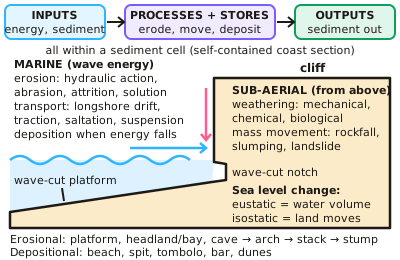
- The coast is an open system with inputs (energy, sediment), processes, stores and outputs; the sediment cell concept describes largely self-contained sections of coastline.
- Marine processes: erosion (hydraulic action, abrasion, attrition, solution), transport (longshore drift, traction, saltation, suspension, solution) and deposition.
- Sub-aerial processes: weathering (mechanical, chemical, biological) and mass movement (rockfall, slumping, landslides) shape cliffs.
- Erosional landforms: wave-cut platforms, headlands and bays, caves, arches, stacks and stumps. Depositional landforms: beaches, spits, tombolos, bars and dune systems.
- Eustatic sea level change results from changes in the volume of water; isostatic change results from land rising or sinking, producing emergent and submergent landforms.
- Sediment budgets compare inputs and outputs, determining whether a coastline is advancing or retreating.
In more detail
- Holderness: the boulder-clay coast erodes about 1.8 m a year, and dozens of villages have been lost to the sea since Roman times.
- Coast types: Swanage Bay and Studland are on a discordant coast; Lulworth Cove is on a concordant coast.
- Sea level landforms: raised beaches on the Isle of Arran show emergence; rias like the Kingsbridge Estuary and Norway's fjords show submergence.
- Spurn Head: a spit about 5.5 km long, curving across the mouth of the Humber.
- Sediment budget: when inputs exceed outputs, the coast builds outwards; when outputs exceed inputs, it erodes.
Practice
Coastal processes and landforms: 10 questions
Pick an answer to check it, or open the answer for the explanation.
1. What is a sediment cell?
- A single beach
- A largely self-contained section of coastline where sediment moves
- A type of wave
- A management strategy
Show answer
B: A largely self-contained section of coastline where sediment moves. Sediment cells are used as units for coastal management.
2. Which is a sub-aerial process?
- Hydraulic action
- Longshore drift
- Mass movement such as slumping
- Abrasion
Show answer
C: Mass movement such as slumping. Sub-aerial processes act on the cliff face from above the waterline.
3. What causes eustatic sea level change?
- Land rising after ice melts
- A change in the volume of water in the oceans
- Tectonic uplift
- Longshore drift
Show answer
B: A change in the volume of water in the oceans. Isostatic change involves the land moving instead.
4. How does a tombolo form?
- Erosion of a headland
- Deposition linking the mainland to an island
- A river depositing sediment
- Wave-cut platform erosion
Show answer
B: Deposition linking the mainland to an island. A sediment ridge connects an island to the shore.
5. What does a negative sediment budget indicate?
- The coastline is building outwards
- More sediment is leaving than entering, so the coast retreats
- No sediment movement
- Only deposition occurs
Show answer
B: More sediment is leaving than entering, so the coast retreats. Outputs exceed inputs in that sediment cell.
6. What is a sediment cell?
- A single grain of sand
- A largely self-contained stretch of coastline where sediment movement takes place
- A wave type
- A depositional landform only
Show answer
B: A largely self-contained stretch of coastline where sediment movement takes place. Sediment budgets are usually studied at this scale.
7. Air trapped in cracks in a cliff is compressed by breaking waves, weakening the rock. Which erosion process is this?
- Solution
- Attrition
- Hydraulic action
- Abrasion
Show answer
C: Hydraulic action. Hydraulic action is the force of water and compressed air in cracks. Abrasion uses sediment as a tool, attrition wears the load itself, and solution is chemical dissolving.
8. Which sequence shows the correct order of landform development as a headland is eroded?
- Stack, arch, cave, crack, stump
- Crack, arch, cave, stump, stack
- Crack, cave, arch, stack, stump
- Cave, crack, arch, stack, stump
Show answer
C: Crack, cave, arch, stack, stump. Waves exploit a crack to form a cave. Erosion through the headland makes an arch, whose collapse leaves a stack, then a stump.
9. Land in northern Scotland is rising after the ice melted. Which landform is most likely to be found there?
- A drowned estuary (ria)
- A raised beach above the present high tide
- A submerged forest
- A growing spit
Show answer
B: A raised beach above the present high tide. Isostatic uplift lifts former shorelines out of reach of the sea, giving an emergent coast with raised beaches. Rias and submerged forests show submergence.
10. Sand grains bounce along the seabed in short hops, carried by the flow. Which transport process is this?
- Traction
- Suspension
- Saltation
- Solution
Show answer
C: Saltation. Saltation is the hopping of medium-sized particles. Traction rolls heavy particles along the bed, suspension carries fine particles in the water, and solution carries dissolved minerals.
Keep going in Full Marks
Full Marks has 21 questions on Coastal processes and landforms (11 more than here), set out in practice levels. You also get notes and 3D models for all 8 subtopics of Landscape systems: coasts, plus games, timed exams and past papers.