A-level Geography Year 12 · Topic 1
Water and carbon cycles
Water and carbon cycles looks at the two great natural systems that support life on Earth.
We will use systems ideas, study drainage basin hydrology, storm hydrographs, precipitation and the cryosphere.
Then we examine the carbon cycle, feedback loops, and how human activity is changing both cycles.
- 9 subtopics
- 410 questions
- Free: 1.1 notes and 10 questions
In this topic
- 1.1The water cycleFree below · 17 questions
- 1.2The carbon cycle and feedbackOpen in Full Marks · 20 questions
- 1.3Systems concepts: open and closed systems, feedback and dynamic equilibriumOpen in Full Marks · 40 questions
- 1.4Drainage basin hydrology: inputs, stores, flows and the water balanceOpen in Full Marks · 38 questions
- 1.5Runoff and storm hydrographs: factors affecting flood riskOpen in Full Marks · 76 questions
- 1.6Precipitation, the cryosphere and variability in the water cycle over timeOpen in Full Marks · 40 questions
- 1.7Human impacts on the water cycle: land use change, urbanisation and abstractionOpen in Full Marks · 78 questions
- 1.8Human impacts on the carbon cycle: fossil fuels, deforestation and land use changeOpen in Full Marks · 41 questions
- 1.9Atmosphere and weather: energy budgets, the global circulation, weather processes and the urban heat islandOpen in Full Marks · 60 questions
1.1 · Free notes
The water cycle
Key points
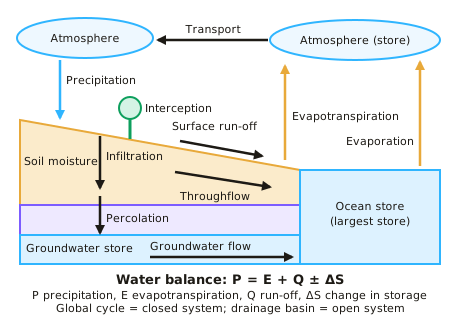
- The water cycle is a closed system globally but an open system at drainage basin scale, with inputs, flows, stores and outputs.
- Stores: oceans (the largest), ice caps and glaciers, groundwater, lakes, soil moisture and the atmosphere.
- Flows: precipitation, interception, infiltration, percolation, throughflow, groundwater flow, surface run-off, evaporation and transpiration (together, evapotranspiration).
- Drainage basin water balance: precipitation = evapotranspiration + run-off ± changes in storage.
- Storm hydrographs show discharge after rainfall; lag time and peak discharge are affected by rock type, relief, soil, vegetation, land use and antecedent conditions.
- Human impacts include deforestation, farming, urbanisation and water abstraction, all of which alter flows and stores.
In more detail
- Global stores: the oceans hold about 97% of Earth's water, ice sheets and glaciers about 2%, and the atmosphere only about 0.001%.
- Residence times: about 9 days in the atmosphere, but around 3000 years in the oceans and up to 10 000 years in deep groundwater.
- Worked water balance: P = 900 mm, E = 500 mm and ΔS = +50 mm → Q = 900 − 500 − 50 = 350 mm.
- Human example: Amazon deforestation reduces evapotranspiration, which reduces rainfall further downwind.
Practice
The water cycle: 10 questions
Pick an answer to check it, or open the answer for the explanation.
1. What is infiltration?
- Water flowing over the surface
- Water soaking into the soil from the surface
- Water moving through rock
- Water evaporating
Show answer
B: Water soaking into the soil from the surface. Percolation then moves water deeper into the rock.
2. Which is the largest store of water on Earth?
- Groundwater
- Oceans
- Ice caps
- Atmosphere
Show answer
B: Oceans. Oceans hold the vast majority of the Earth's water.
3. What is lag time on a storm hydrograph?
- Total rainfall
- The time between peak rainfall and peak discharge
- The time for a river to dry up
- The steepness of the falling limb
Show answer
B: The time between peak rainfall and peak discharge. Shorter lag times indicate a flashier response.
4. How does urbanisation affect a storm hydrograph?
- Longer lag time, lower peak
- Shorter lag time and higher peak discharge
- No effect
- Less surface run-off
Show answer
B: Shorter lag time and higher peak discharge. Impermeable surfaces and drains speed water to the channel.
5. What does the drainage basin water balance compare?
- Temperature and rainfall
- Precipitation with evapotranspiration, run-off and storage change
- Ocean and atmospheric stores
- River length and discharge
Show answer
B: Precipitation with evapotranspiration, run-off and storage change. It shows how water inputs are accounted for in a basin.
6. Which store of water is generally the largest globally?
- Groundwater
- Rivers
- Oceans
- Atmosphere
Show answer
C: Oceans. Oceans hold the overwhelming majority of the Earth's water.
7. Which flow moves water from the soil down into the underlying permeable rock?
- Interception
- Throughflow
- Percolation
- Stemflow
Show answer
C: Percolation. Percolation is the downward movement of water from the soil into underlying rock. Throughflow is lateral flow within the soil, and stemflow and interception happen at the vegetation level.
8. A basin receives 1000 mm of precipitation and loses 450 mm to evapotranspiration. Storage does not change. What is run-off?
- 450 mm
- 1450 mm
- 550 mm
- 1000 mm
Show answer
C: 550 mm. P = Q + E ± ΔS with ΔS = 0, so Q = P − E = 1000 − 450 = 550 mm. Adding the values (1450 mm) is a common error.
9. Why is the global water cycle closed but a drainage basin open?
- Global water is fixed; a basin gains and loses water across its edge
- A basin has no outputs; the global cycle loses water to space
- The global cycle has only stores; a basin has only flows
- Both are closed because rivers never cross a watershed
Show answer
A: Global water is fixed; a basin gains and loses water across its edge. Globally the amount of water is effectively constant, so the cycle is closed. A basin is open because precipitation enters it and discharge and evapotranspiration leave it.
10. Which human activity is most likely to reduce the groundwater store in an area?
- Building wetland reserves
- Removing paved surfaces
- Pumping boreholes for irrigation
- Planting upland forests
Show answer
C: Pumping boreholes for irrigation. Abstraction by boreholes removes groundwater faster than it is recharged, so the store falls. The other options tend to increase infiltration and recharge.
Keep going in Full Marks
Full Marks has 17 questions on The water cycle (7 more than here), set out in practice levels. You also get notes and 3D models for all 9 subtopics of Water and carbon cycles, plus games, timed exams and past papers.
On your exam board
- AQATopic 1: Water and carbon cycles
- OCR ATopic 2: Earth's life support systems
- CambridgeTopic 1: Hydrology and fluvial geomorphology, Topic 2: Atmosphere and weather
Not in the Edexcel specification.