A-level Chemistry Year 12 · Topic 2
Bonding, energetics and kinetics
Bonding, energetics and kinetics explains how atoms are held together, how much energy is involved when bonds break and form, and how fast reactions happen.
We will look at covalent and dative bonds, molecular shapes, electronegativity and intermolecular forces.
Then we measure and calculate enthalpy changes using calorimetry, Hess's law and bond enthalpies, and use the Maxwell–Boltzmann distribution to explain reaction rates.
- 4 subtopics
- 192 questions
- Free: 2.1 notes and 10 questions
In this topic
- 2.1BondingFree below · 38 questions
- 2.2EnergeticsOpen in Full Marks · 64 questions
- 2.3KineticsOpen in Full Marks · 67 questions
- 2.4Ionic and metallic bonding, and how structure affects physical propertiesOpen in Full Marks · 23 questions
2.1 · Free notes
Bonding
Key points
- Covalent bonding is a shared pair of electrons between two atoms; a dative covalent (coordinate) bond occurs when both shared electrons come from the same atom.
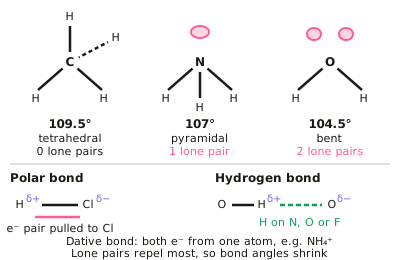
- Electron pair repulsion theory predicts molecular shapes: electron pairs around a central atom repel to minimise repulsion, with lone pairs repelling more strongly than bonding pairs, e.g. methane is tetrahedral (109.5°), ammonia pyramidal (107°), water bent (104.5°).
- Electronegativity is an atom's ability to attract the bonding electron pair in a covalent bond; differences in electronegativity create polar bonds.
- Van der Waals forces exist between all molecules and increase with more electrons; permanent dipole-dipole forces exist between polar molecules; hydrogen bonding occurs when H is bonded directly to N, O or F, giving unusually high boiling points.
In more detail
- Shapes and angles: 2 pairs linear 180°; 3 trigonal planar 120°; 4 tetrahedral 109.5°; 5 trigonal bipyramidal 90° and 120°; 6 octahedral 90°. Each lone pair reduces the angle by about 2.5°.
- Examples: NH₃ pyramidal 107°; H₂O bent 104.5°; SF₆ octahedral 90°; NH₄⁺ tetrahedral 109.5° (formed by a dative bond from N to H⁺).
- Hydrogen bonding: between H attached to N, O or F and a lone pair on N, O or F of another molecule; explains the high boiling point of water and why ice is less dense than water.
- Polar molecules: a molecule with polar bonds can be non-polar overall if it is symmetrical (e.g. CO₂, CCl₄), because the dipoles cancel.
Practice
Bonding: 10 questions
Pick an answer to check it, or open the answer for the explanation.
1. What is a dative covalent bond?
- A bond where electrons transfer completely
- A bond where both electrons in the shared pair come from one atom
- A bond between two metals
- A weak intermolecular force
Show answer
B: A bond where both electrons in the shared pair come from one atom. Both bonding electrons originate from a single atom, e.g. in the ammonium ion.
2. What shape does methane (CH₄) have?
- Linear
- Trigonal planar
- Tetrahedral
- Bent
Show answer
C: Tetrahedral. Four bonding pairs repel equally to give a tetrahedral shape.
3. Why is ammonia's bond angle (107°) smaller than methane's (109.5°)?
- Ammonia has fewer electrons
- The lone pair in ammonia repels more strongly than bonding pairs
- Ammonia has more protons
- Nitrogen is bigger than carbon
Show answer
B: The lone pair in ammonia repels more strongly than bonding pairs. Lone pair-bonding pair repulsion is greater than bonding pair-bonding pair repulsion.
4. Which intermolecular force exists between all molecules?
- Hydrogen bonding
- Permanent dipole-dipole forces
- Van der Waals forces
- Ionic bonding
Show answer
C: Van der Waals forces. Even non-polar molecules experience these instantaneous dipole forces.
5. What condition is needed for hydrogen bonding?
- Any two atoms bonded together
- Hydrogen bonded directly to N, O or F
- A metal must be present
- High pressure only
Show answer
B: Hydrogen bonded directly to N, O or F. These highly electronegative atoms create a strong enough dipole.
6. Why does water have an unusually high boiling point for its size?
- Its covalent bonds break easily
- Hydrogen bonding between molecules requires more energy to overcome
- It has ionic bonds
- It has no intermolecular forces
Show answer
B: Hydrogen bonding between molecules requires more energy to overcome. Extra energy is needed to break the hydrogen bonds between molecules.
7. Which shape does a molecule with 2 bonding pairs and 2 lone pairs adopt?
- Linear
- Tetrahedral
- Bent (V-shaped)
- Trigonal pyramidal
Show answer
C: Bent (V-shaped). Water is the classic example, with a bond angle of about 104.5°.
8. What are the shape and bond angle of a BF₃ molecule?
- Pyramidal, 107°
- T-shaped, 90°
- Tetrahedral, 109.5°
- Trigonal planar, 120°
Show answer
D: Trigonal planar, 120°. Boron has three bonding pairs and no lone pairs, which repel to be 120° apart in a plane.
9. Sulfur hexafluoride, SF₆, has six bonding pairs and no lone pairs around sulfur. What is its shape?
- Trigonal bipyramidal
- Square planar
- Tetrahedral
- Octahedral
Show answer
D: Octahedral. Six equal bonding pairs minimise repulsion by pointing to the corners of an octahedron, with 90° bond angles.
10. How many dative covalent bonds are in an ammonium ion, NH₄⁺?
- 0
- 3
- 1
- 4
Show answer
C: 1. Three N–H bonds are normal covalent bonds. The fourth forms when N donates its lone pair to H⁺, giving one dative bond.
Keep going in Full Marks
Full Marks has 38 questions on Bonding (28 more than here), set out in practice levels. You also get notes and 3D models for all 4 subtopics of Bonding, energetics and kinetics, plus games, timed exams and past papers.
On your exam board
- AQATopic 3.1.3: Bonding, Topic 3.1.4: Energetics, Topic 3.1.5: Kinetics
- OCR ATopic 2.2: Electrons, bonding and structure, Topic 3.2.1: Enthalpy changes, Topic 3.2.2: Reaction rates
- OCR BTopic EL: Elements of life, Topic DF: Developing fuels
- EdexcelTopic 2: Bonding and structure, Topic 8: Energetics I, Topic 9: Kinetics I
- CambridgeTopic 3: Chemical bonding, Topic 5: Chemical energetics, Topic 8: Reaction kinetics