A-level Chemistry Year 12 · Topic 3
Equilibria, redox and acids
Equilibria, redox and acids covers three big ideas that run through the whole A-level course.
We will look at dynamic equilibrium, Le Chatelier's principle and the equilibrium constant Kc, then oxidation states, half-equations and redox equations.
Finally we look at acids, bases and salts, neutralisation and titrations.
- 3 subtopics
- 144 questions
- Free: 3.1 notes and 10 questions
In this topic
- 3.1Chemical equilibria and KcFree below · 27 questions
- 3.2Oxidation, reduction and redox equationsOpen in Full Marks · 54 questions
- 3.3Acids, bases, salts and neutralisationOpen in Full Marks · 63 questions
3.1 · Free notes
Chemical equilibria and Kc
Key points
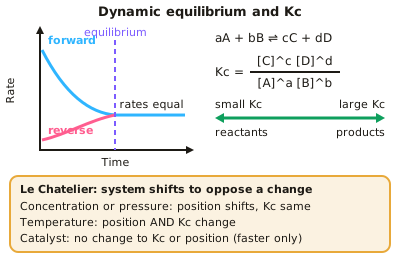
- A reaction reaches dynamic equilibrium in a closed system when the forward and backward reaction rates are equal, so concentrations of reactants and products stay constant.
- Le Chatelier's principle: if a system at equilibrium is subjected to a change, the position of equilibrium shifts to counteract that change.
- The equilibrium constant, Kc, is calculated from equilibrium concentrations, e.g. for aA + bB ⇌ cC + dD, Kc = [C]^c[D]^d ÷ [A]^a[B]^b.
- Kc is only affected by a change in temperature; changing concentration or pressure changes the position of equilibrium but not Kc. A catalyst affects neither Kc nor the position of equilibrium.
- A large Kc indicates equilibrium lies to the right (favouring products); a small Kc indicates it lies to the left (favouring reactants).
In more detail
- Worked Kc: H₂ + I₂ ⇌ 2HI with [H₂] = 0.10, [I₂] = 0.10, [HI] = 0.70 mol dm⁻³ → Kc = 0.70² ÷ (0.10 × 0.10) = 49 (no units, as the powers cancel).
- Units of Kc: for N₂ + 3H₂ ⇌ 2NH₃, Kc = [NH₃]² ÷ ([N₂][H₂]³), units = (mol dm⁻³)² ÷ (mol dm⁻³)⁴ = mol⁻² dm⁶.
- Temperature and Kc: for an exothermic forward reaction, increasing temperature decreases Kc (equilibrium shifts left); for endothermic, Kc increases.
- Industrial compromise: conditions are chosen to balance yield (equilibrium position), rate, cost and safety, e.g. the Haber and Contact processes.
Practice
Chemical equilibria and Kc: 10 questions
Pick an answer to check it, or open the answer for the explanation.
1. What is true at dynamic equilibrium?
- The reaction has stopped
- The forward and backward reaction rates are equal
- Only the forward reaction occurs
- Concentrations of reactants and products are always equal
Show answer
B: The forward and backward reaction rates are equal. Both reactions continue, but at matching rates.
2. What does a large value of Kc indicate?
- Equilibrium favours the reactants
- Equilibrium favours the products
- The reaction is very slow
- No reaction occurs
Show answer
B: Equilibrium favours the products. A larger numerator (products) than denominator (reactants) gives a large Kc.
3. What is the only factor that changes the value of Kc?
- Concentration
- Pressure
- Temperature
- A catalyst
Show answer
C: Temperature. Kc is fixed at a given temperature.
4. Does adding a catalyst change the position of equilibrium?
- Yes, it shifts towards products
- Yes, it shifts towards reactants
- No, it only affects the rate of reaching equilibrium
- It stops the reaction
Show answer
C: No, it only affects the rate of reaching equilibrium. A catalyst speeds up both forward and backward reactions equally.
5. Why must concentrations be at equilibrium to calculate Kc?
- Kc can be calculated at any point in the reaction
- The Kc expression only applies once concentrations are no longer changing
- Kc doesn't depend on concentration
- Equilibrium isn't needed
Show answer
B: The Kc expression only applies once concentrations are no longer changing. Before equilibrium, concentrations are still changing, so the ratio isn't constant.
6. A reaction has Kc = 500. What does this suggest?
- The reaction barely proceeds
- The equilibrium lies well towards the products
- The reaction is at absolute equilibrium concentration of 500 mol/dm³
- Kc has no meaning here
Show answer
B: The equilibrium lies well towards the products. A large Kc means a large proportion of products at equilibrium.
7. At equilibrium [H₂] = 0.20, [I₂] = 0.20 and [HI] = 0.80 mol dm⁻³. What is Kc for H₂ + I₂ ⇌ 2HI?
- 4.0
- 0.64
- 16
- 0.0625
Show answer
C: 16. Kc = 0.80² ÷ (0.20 × 0.20) = 0.64 ÷ 0.040 = 16, with no units as they cancel. Forgetting to square [HI] gives 4.0.
8. Why does raising the pressure shift N₂ + 3H₂ ⇌ 2NH₃ to the right?
- It speeds up only the reverse reaction
- More gas moles on the right lower the pressure
- Fewer gas moles on the right lower the pressure
- It increases the value of Kc
Show answer
C: Fewer gas moles on the right lower the pressure. The right has 2 mol of gas against 4 mol on the left, so shifting right reduces the pressure and counteracts the change. Kc is unchanged.
9. N₂ + 3H₂ ⇌ 2NH₃ has ΔH = −92 kJ mol⁻¹. What happens when temperature is raised?
- Kc is unchanged and equilibrium shifts left
- Kc increases and equilibrium shifts right
- Kc decreases and equilibrium shifts left
- Kc decreases and equilibrium shifts right
Show answer
C: Kc decreases and equilibrium shifts left. Raising temperature favours the endothermic reverse reaction, so equilibrium shifts left and Kc falls.
10. Why is a moderate temperature (about 450 °C) used in the Haber process?
- Compromise between reasonable rate and acceptable yield
- It gives the highest possible Kc
- It prevents the catalyst being used up
- It maximises both yield and rate
Show answer
A: Compromise between reasonable rate and acceptable yield. Low temperature favours yield (exothermic) but is too slow; high temperature is fast but gives low yield. About 450 °C is a compromise.
Keep going in Full Marks
Full Marks has 27 questions on Chemical equilibria and Kc (17 more than here), set out in practice levels. You also get notes and 3D models for all 3 subtopics of Equilibria, redox and acids, plus games, timed exams and past papers.
On your exam board
- AQATopic 3.1.6: Chemical equilibria, Le Chatelier's principle and Kc, Topic 3.1.7: Oxidation, reduction and redox equations
- OCR ATopic 2.1.4: Acids, Topic 2.1.5: Redox, Topic 3.2.3: Chemical equilibrium
- OCR BTopic ES: Elements from the sea
- EdexcelTopic 3: Redox I, Topic 5: Formulae, equations and amounts of substance, Topic 10: Equilibrium I
- CambridgeTopic 6: Electrochemistry, Topic 7: Equilibria