A-level Chemistry Year 12 · Topic 1
Atomic structure and amount of substance
Atomic structure and amount of substance lays the foundations for all of A-level Chemistry.
We will look inside the atom at orbitals, sub-shells and ionisation energies, use mass spectrometry, and see the evidence behind each model of the atom.
Then we master the mole: formulae and equations, ionic equations, gas volumes and the ideal gas equation, titrations and hydrated salts.
- 6 subtopics
- 353 questions
- Free: 1.1 notes and 10 questions
In this topic
- 1.1Atomic structureFree below · 55 questions
- 1.2Development of models of the atom and evidence for atomic structureOpen in Full Marks · 60 questions
- 1.3Amount of substanceOpen in Full Marks · 61 questions
- 1.4Writing formulae of ions and compounds, balanced equations, state symbols and ionic equationsOpen in Full Marks · 45 questions
- 1.5Molar gas volume and gas volume calculationsOpen in Full Marks · 62 questions
- 1.6Hydrated salts, water of crystallisation and percentage compositionOpen in Full Marks · 70 questions
1.1 · Free notes
Atomic structure
Key points
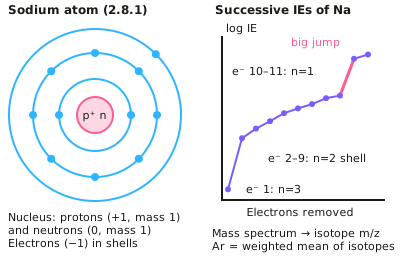
- Atoms contain protons (+1, mass 1) and neutrons (0, mass 1) in the nucleus, and electrons (−1, negligible mass) in shells around it.
- Mass spectrometry measures the relative isotopic masses and abundances of isotopes in a sample, allowing relative atomic mass (Ar) to be calculated as a weighted mean.
- Electrons occupy orbitals within shells and sub-shells (s, p, d), each orbital holding a maximum of 2 electrons; the filling order is 1s, 2s, 2p, 3s, 3p, 4s, 3d...
- Ionisation energy is the energy needed to remove one mole of electrons from one mole of gaseous atoms (or ions); it depends on nuclear charge, atomic radius and electron shielding.
- Successive ionisation energies show large jumps when an electron is removed from a shell closer to the nucleus, providing evidence for the shell structure of atoms.
In more detail
- Order of filling: 1s 2s 2p 3s 3p 4s 3d 4p. Exceptions: Cr is [Ar] 3d⁵ 4s¹ and Cu is [Ar] 3d¹⁰ 4s¹. When transition metals form ions, 4s electrons are lost first.
- Time-of-flight mass spectrometry: ionisation (electrospray or electron impact) → acceleration by an electric field → ions drift → detection; lighter ions arrive first. Ar = Σ(m/z × abundance) ÷ Σabundance.
- Trends in first IE: increases across a period (more protons, similar shielding); decreases down a group (larger radius, more shielding). Dips: Be→B (2p higher in energy) and N→O (pairing repulsion in 2p).
- Worked successive IEs: if the big jump is between the 3rd and 4th ionisation energies, the element has 3 outer electrons and is in Group 13 (Group 3).
Practice
Atomic structure: 10 questions
Pick an answer to check it, or open the answer for the explanation.
1. What is the relative charge of a proton?
- −1
- 0
- +1
- +2
Show answer
C: +1. Protons carry a single positive charge.
2. What technique measures the relative abundance of isotopes?
- Chromatography
- Mass spectrometry
- Titration
- Electrolysis
Show answer
B: Mass spectrometry. Mass spectrometry ionises and separates isotopes by mass.
3. What is the maximum number of electrons in one orbital?
- 1
- 2
- 3
- 8
Show answer
B: 2. Each orbital holds two electrons with opposite spins.
4. What is ionisation energy?
- Energy released when an electron is gained
- Energy needed to remove one mole of electrons from one mole of gaseous atoms
- Energy stored in the nucleus
- The mass of an atom
Show answer
B: Energy needed to remove one mole of electrons from one mole of gaseous atoms. It's always measured for atoms or ions in the gas phase.
5. Why do successive ionisation energies show a big jump at certain points?
- The atom gains a proton
- An electron is removed from a shell closer to the nucleus, with less shielding
- The atom becomes a metal
- The temperature changes
Show answer
B: An electron is removed from a shell closer to the nucleus, with less shielding. This is strong evidence for electrons existing in distinct shells.
6. Which orbital fills before 3d, despite having a lower shell number written after it in the sequence?
- 3p
- 4s
- 4p
- 5s
Show answer
B: 4s. 4s has a lower energy than 3d and fills first.
7. Which sub-shell can hold a maximum of 10 electrons?
- s
- p
- d
- f
Show answer
C: d. The d sub-shell holds up to 10 electrons across 5 orbitals.
8. How many neutrons are in an atom of ³⁵Cl (atomic number 17)?
- 17
- 18
- 35
- 52
Show answer
B: 18. Neutrons = mass number − atomic number = 35 − 17 = 18. The number 17 is the number of protons.
9. Why does first ionisation energy decrease down Group 2 from Mg to Ba?
- Nuclear charge decreases down the group
- Atoms have fewer protons in the nucleus
- Outer electron is further away and more shielded
- Outer electrons are held more tightly by the nucleus
Show answer
C: Outer electron is further away and more shielded. Greater atomic radius and more shielding outweigh the increased nuclear charge, so the outer electron is easier to remove.
10. An element's successive ionisation energies (kJ mol⁻¹) are 738, 1451, 7733 and 10543. Which group is it in?
- Group 3
- Group 2
- Group 4
- Group 1
Show answer
B: Group 2. The big jump after the 2nd ionisation energy shows the 3rd electron comes from an inner shell, so there are 2 outer electrons: Group 2.
Keep going in Full Marks
Full Marks has 55 questions on Atomic structure (45 more than here), set out in practice levels. You also get notes and 3D models for all 6 subtopics of Atomic structure and amount of substance, plus games, timed exams and past papers.
On your exam board
- AQATopic 3.1.1: Atomic structure, Topic 3.1.2: Amount of substance
- OCR ATopic 2.1.1: Atomic structure and isotopes, Topic 2.1.2: Compounds, formulae and equations, Topic 2.1.3: Amount of substance
- OCR BTopic EL: Elements of life
- EdexcelTopic 1: Atomic structure and the periodic table, Topic 5: Formulae, equations and amounts of substance
- CambridgeTopic 1: Atomic structure, Topic 2: Atoms, molecules and stoichiometry, Topic 4: States of matter