A-level Biology Year 12 · Topic 2
Cells
Cells takes you inside the basic unit of life, in far more detail than at GCSE.
We will look at the organelles of eukaryotic and prokaryotic cells, how microscopes reveal them, and how cell fractionation separates them for study.
Then we cover the cell cycle and mitosis, how substances cross membranes, how cells recognise each other in the immune system, and how cells specialise and signal to one another.
- 10 subtopics
- 490 questions
- Free: 2.1 notes and 10 questions
In this topic
- 2.1Cell structureFree below · 71 questions
- 2.2Cell division and the cell cycleOpen in Full Marks · 51 questions
- 2.3Transport across cell membranesOpen in Full Marks · 31 questions
- 2.4Cell recognition and the immune systemOpen in Full Marks · 36 questions
- 2.5Microscopy: magnification, resolution and light, TEM, SEM and laser scanning microscopesOpen in Full Marks · 70 questions
- 2.6Cell fractionation and ultracentrifugationOpen in Full Marks · 39 questions
- 2.7Cell differentiation, stem cells, tissues, organs and organ systemsOpen in Full Marks · 73 questions
- 2.8Cell signalling and the role of membrane receptorsOpen in Full Marks · 39 questions
- 2.9Clonal selection, vaccination, herd immunity, monoclonal antibodies and autoimmune diseaseOpen in Full Marks · 20 questions
- 2.10The cytoskeleton, centrioles and how cells make and secrete proteinsOpen in Full Marks · 60 questions
2.1 · Free notes
Cell structure
Key points
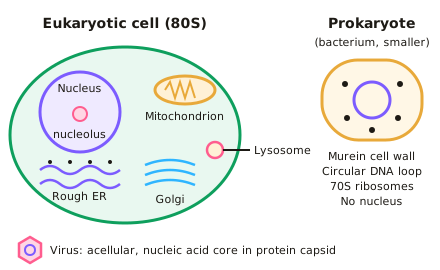
- Eukaryotic cells contain a nucleus and membrane-bound organelles. Prokaryotic cells (bacteria) are smaller, with a single circular DNA loop, no nucleus, 70S ribosomes and often a cell wall of murein.
- Key organelles: nucleus (nucleolus makes ribosomal RNA, nuclear envelope has pores), rough endoplasmic reticulum (folds and processes proteins made by attached ribosomes), smooth ER (makes and processes lipids), Golgi apparatus (modifies, packages and labels proteins and lipids into vesicles), mitochondria (site of aerobic respiration, with cristae and matrix), lysosomes (contain digestive enzymes), ribosomes (protein synthesis, 80S in eukaryotes).
- Viruses are acellular and non-living: a nucleic acid core surrounded by a protein coat (capsid), sometimes with an outer envelope. They can only replicate inside host cells.
- Cell fractionation prepares organelles for study: tissue is homogenised in a cold, buffered, isotonic solution, then separated by ultracentrifugation — denser organelles (nuclei) settle out first at low speed, lighter organelles (ribosomes) settle at high speed.
In more detail
- Prokaryotic features: cell wall made of murein (peptidoglycan), 70S ribosomes, circular DNA not associated with histones, and sometimes plasmids, a capsule and flagella.
- Eukaryotic ribosomes are 80S in the cytoplasm, but mitochondria and chloroplasts contain 70S ribosomes and their own circular DNA, evidence for endosymbiosis.
- Golgi apparatus: modifies proteins (e.g. adds carbohydrates to make glycoproteins), packages them into vesicles and forms lysosomes.
- Virus replication: viruses attach to host cells using attachment proteins, inject their nucleic acid and use the host's ribosomes to make new viral particles.
Practice
Cell structure: 10 questions
Pick an answer to check it, or open the answer for the explanation.
1. Which organelle processes and packages proteins for secretion?
- Rough ER
- Golgi apparatus
- Lysosome
- Ribosome
Show answer
B: Golgi apparatus. It also adds sugar chains and forms vesicles.
2. Why is the solution used in cell fractionation kept cold?
- To speed up enzyme activity
- To reduce enzyme activity that would break down organelles
- To increase respiration
- To dissolve the cell wall
Show answer
B: To reduce enzyme activity that would break down organelles. Slowing enzyme activity prevents organelles being digested by their own enzymes.
3. What is the role of ribosomes attached to the rough ER?
- Lipid synthesis
- Protein synthesis
- Energy release
- DNA replication
Show answer
B: Protein synthesis. They synthesise proteins that are then processed by the ER.
4. Why are viruses considered non-living?
- They contain no nucleic acid
- They cannot reproduce without a host cell
- They have no protein coat
- They are too small
Show answer
B: They cannot reproduce without a host cell. They rely entirely on a host cell's machinery to replicate.
5. In cell fractionation, why is the solution isotonic?
- To prevent water moving in or out of organelles by osmosis, keeping them intact
- To speed up centrifugation
- To digest the cell wall
- To colour the organelles
Show answer
A: To prevent water moving in or out of organelles by osmosis, keeping them intact. An isotonic solution has the same water potential as the cell contents.
6. Which organelle is the site of aerobic respiration?
- Chloroplast
- Mitochondrion
- Nucleus
- Golgi apparatus
Show answer
B: Mitochondrion. Mitochondria have a folded inner membrane called cristae.
7. Which organelle contains its own DNA?
- Golgi apparatus
- Mitochondrion
- Lysosome
- Ribosome
Show answer
B: Mitochondrion. Mitochondria (and chloroplasts) contain a small circular DNA molecule.
8. Why must tissue be kept cold during cell fractionation?
- To speed up enzymes
- To reduce enzyme activity that could damage organelles
- To dissolve the cell membrane
- To increase respiration
Show answer
B: To reduce enzyme activity that could damage organelles. This helps preserve the organelles intact.
9. What is the sedimentation coefficient of ribosomes in bacterial cells?
- 50S
- 60S
- 70S
- 80S
Show answer
C: 70S. Prokaryotes have 70S ribosomes. The larger 80S ribosomes are found in the cytoplasm of eukaryotic cells.
10. Which substance forms the cell wall of a bacterium?
- Cellulose
- Chitin
- Murein
- Lignin
Show answer
C: Murein. Bacterial walls are made of murein, a peptide-polysaccharide. Cellulose is found in plant walls and chitin in fungal walls.
Keep going in Full Marks
Full Marks has 71 questions on Cell structure (61 more than here), set out in practice levels. You also get notes and 3D models for all 10 subtopics of Cells, plus games, timed exams and past papers.
On your exam board
- AQATopic 2: Cells
- OCR ATopic 2.1.1: Cell structure, Topic 2.1.5: Biological membranes, Topic 2.1.6: Cell division, cell diversity and cellular organisation, Topic 4.1.1: Communicable diseases, disease prevention and the immune system
- OCR BTopic 2.1: Cells and microscopy, Topic 2.3: Transport and gas exchange, Topic 3.1: Cell division, Topic 3.2: Development of organisms, Topic 3.3: Disease and the immune system
- EdexcelTopic 2: Cells, viruses and reproduction of living things, Topic 4: Exchange and transport
- CambridgeTopic 1: Cell structure, Topic 4: Cell membranes and transport, Topic 5: The mitotic cell cycle, Topic 11: Immunity