A-level Biology Year 12 · Topic 1
Biological molecules
Biological molecules is the chemistry that underpins the whole A-level course. Every cell, enzyme and gene is built from the molecules in this topic.
We will look at carbohydrates, lipids, proteins and enzymes, nucleic acids and ATP, and the special properties of water and inorganic ions.
You will also learn the biochemical tests and the practical skills for measuring enzyme activity, both of which are tested in every exam series.
- 8 subtopics
- 355 questions
- Free: 1.1 notes and 10 questions
In this topic
- 1.1Monomers, polymers and carbohydratesFree below · 35 questions
- 1.2LipidsOpen in Full Marks · 28 questions
- 1.3Proteins and enzyme actionOpen in Full Marks · 67 questions
- 1.4Nucleic acids and ATPOpen in Full Marks · 28 questions
- 1.5Water and inorganic ionsOpen in Full Marks · 29 questions
- 1.6Biochemical tests for carbohydrates, lipids and proteins (Benedict's, iodine, biuret, emulsion)Open in Full Marks · 39 questions
- 1.7Enzyme cofactors, coenzymes and prosthetic groupsOpen in Full Marks · 69 questions
- 1.8Practical: investigating factors affecting the rate of enzyme-controlled reactionsOpen in Full Marks · 60 questions
1.1 · Free notes
Monomers, polymers and carbohydrates
Key points
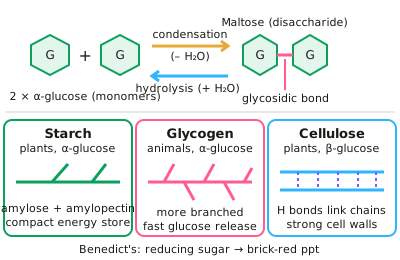
- A monomer is a small, basic molecular unit. Polymers are molecules made from many monomers joined together.
- Condensation reactions join monomers, releasing water and forming a chemical bond. Hydrolysis reactions break bonds using water.
- Monosaccharides include glucose, fructose and galactose. Two monosaccharides join by a glycosidic bond to form a disaccharide, for example maltose (glucose + glucose) and sucrose (glucose + fructose).
- Starch (amylose and amylopectin) is the storage polysaccharide in plants, made of α-glucose. Glycogen is the storage polysaccharide in animals, more branched than starch.
- Cellulose is made of β-glucose chains linked by hydrogen bonds into strong microfibrils, giving plant cell walls strength.
- The benedict's test detects reducing sugars (heat with Benedict's reagent, brick-red precipitate) and, after hydrolysis with acid, non-reducing sugars such as sucrose.
In more detail
- α vs β glucose: both are C₆H₁₂O₆ hexoses. In α-glucose the OH on carbon 1 is below the ring; in β-glucose it is above. To join β-glucose, alternate molecules are flipped 180°.
- Disaccharides: glucose + glucose → maltose; glucose + fructose → sucrose; glucose + galactose → lactose. Each forms a glycosidic bond and releases one water molecule.
- Structure–function of starch: helical amylose is compact; branched amylopectin has many ends for fast hydrolysis; it is insoluble so does not affect water potential; large so cannot leave cells.
- Glycogen vs amylopectin: glycogen is more highly branched with 1,6 links, so it can be hydrolysed even faster to release glucose for the higher metabolic rate of animals.
Practice
Monomers, polymers and carbohydrates: 10 questions
Pick an answer to check it, or open the answer for the explanation.
1. What type of reaction joins two monosaccharides?
- Hydrolysis
- Condensation
- Oxidation
- Phosphorylation
Show answer
B: Condensation. A condensation reaction forms a glycosidic bond and releases water.
2. Which bond joins monosaccharides together?
- Peptide bond
- Glycosidic bond
- Ester bond
- Hydrogen bond
Show answer
B: Glycosidic bond. Glycosidic bonds link sugar units.
3. Starch is a polymer of which monomer?
- β-glucose
- α-glucose
- Fructose
- Amino acids
Show answer
B: α-glucose. Both amylose and amylopectin are made of α-glucose.
4. Why is cellulose strong?
- It is branched like glycogen
- β-glucose chains are linked by hydrogen bonds into microfibrils
- It contains nitrogen
- It dissolves in water
Show answer
B: β-glucose chains are linked by hydrogen bonds into microfibrils. The straight chains and cross-linking hydrogen bonds give tensile strength.
5. A food sample turns brick-red with Benedict's reagent without heating with acid first. What does this show?
- No sugar present
- A non-reducing sugar is present
- A reducing sugar is present
- Only starch is present
Show answer
C: A reducing sugar is present. Reducing sugars give a positive result directly on heating with Benedict's reagent.
6. Why is glycogen more branched than starch?
- To dissolve in water
- To be released and used quickly for energy
- To store more water
- To make the molecule stronger
Show answer
B: To be released and used quickly for energy. More branches mean more ends for enzymes to act on, releasing glucose fast.
7. What monomer makes up a triglyceride's backbone along with fatty acids?
- Glucose
- Glycerol
- An amino acid
- A nucleotide
Show answer
B: Glycerol. One glycerol molecule joins with three fatty acids.
8. Which bond is broken when starch is digested into maltose?
- Peptide bond
- Glycosidic bond
- Ester bond
- Hydrogen bond in DNA
Show answer
B: Glycosidic bond. Amylase hydrolyses the glycosidic bonds between glucose units.
9. Which of these sugars is a non-reducing sugar?
- Galactose
- Glucose
- Maltose
- Sucrose
Show answer
D: Sucrose. Sucrose has no free reducing group because its glycosidic bond links both anomeric carbons. It only gives a positive Benedict's result after hydrolysis. The other three are reducing sugars.
10. Which two monosaccharides join to form lactose?
- Glucose and glucose
- Fructose and galactose
- Glucose and fructose
- Glucose and galactose
Show answer
D: Glucose and galactose. Lactose is a disaccharide of glucose and galactose. Glucose + glucose gives maltose, and glucose + fructose gives sucrose.
Keep going in Full Marks
Full Marks has 35 questions on Monomers, polymers and carbohydrates (25 more than here), set out in practice levels. You also get notes and 3D models for all 8 subtopics of Biological molecules, plus games, timed exams and past papers.
On your exam board
- AQATopic 1: Biological molecules
- OCR ATopic 2.1.2: Biological molecules, Topic 2.1.3: Nucleotides and nucleic acids, Topic 2.1.4: Enzymes
- OCR BTopic 2.2: Chemicals for life
- EdexcelTopic 1: Biological molecules
- CambridgeTopic 2: Biological molecules, Topic 3: Enzymes, Topic 6: Nucleic acids and protein synthesis