GCSE Psychology · Topic 2
Development
Development is about how children grow and learn, from the earliest brain development to the bonds they form with carers.
We will study theories of learning, like Piaget's stages and Dweck's mindset theory, and how the brain develops.
Then we look at attachment, including Bowlby's theory and Ainsworth's Strange Situation, and the effects of deprivation and day care.
- 4 subtopics
- 205 questions
- Free: 2.1 notes and 10 questions
In this topic
- 2.1Development and learningFree below · 22 questions
- 2.2Early brain development and the effects of early experienceOpen in Full Marks · 48 questions
- 2.3Attachment: Bowlby's theory and Ainsworth's Strange SituationOpen in Full Marks · 90 questions
- 2.4Deprivation, privation and the effects of day careOpen in Full Marks · 45 questions
2.1 · Free notes
Development and learning
Key points
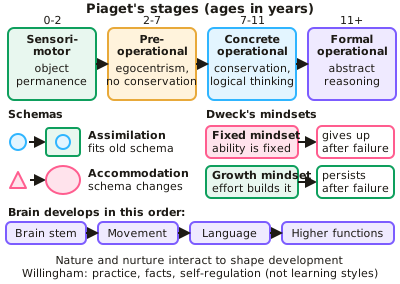
- Early brain development follows a sequence, with the brain stem developing first, then areas controlling movement, language and higher functions.
- Piaget's stages: sensorimotor (object permanence), pre-operational (egocentrism, lack of conservation), concrete operational (conservation, logical thinking about concrete things) and formal operational (abstract reasoning).
- Assimilation fits new information into existing schemas; accommodation changes schemas to fit new information.
- Dweck's mindset theory contrasts a fixed mindset (ability is unchangeable) with a growth mindset (ability develops with effort), affecting motivation and resilience.
- Willingham's learning theory rejects fixed learning styles and stresses practice, factual knowledge and self-regulation.
- Nature and nurture both shape development; most psychologists see them as interacting rather than competing.
In more detail
- Piaget's stages: sensorimotor (0–2), pre-operational (2–7), concrete operational (7–11) and formal operational (11+).
- Three mountains task: Piaget and Inhelder found pre-operational children chose their own view of a model, showing egocentrism.
- Naughty Teddy: McGarrigle and Donaldson (1974) found 62% of young children conserved number when a "naughty teddy" moved the counters, compared with 16% when an adult did.
- Growth mindset: Blackwell et al. (2007) found students taught that intelligence can grow improved their maths grades.
- Learning styles myth: Willingham argues there is no good evidence that matching teaching to "visual" or "auditory" learners helps.
Practice
Development and learning: 10 questions
Pick an answer to check it, or open the answer for the explanation.
1. In which Piaget stage do children typically fail conservation tasks?
- Sensorimotor
- Pre-operational
- Concrete operational
- Formal operational
Show answer
B: Pre-operational. They focus on one feature, such as the height of liquid.
2. What is accommodation in Piaget's theory?
- Fitting new information into an existing schema
- Changing a schema to fit new information
- Forgetting information
- Copying others
Show answer
B: Changing a schema to fit new information. Assimilation, by contrast, keeps the schema unchanged.
3. What characterises a growth mindset?
- Believing ability is fixed
- Believing ability can develop through effort
- Avoiding challenge
- Relying on talent alone
Show answer
B: Believing ability can develop through effort. Dweck linked this to greater persistence after failure.
4. What did Willingham argue about learning styles?
- They should determine all teaching
- Evidence does not support fixed learning styles; practice and knowledge matter more
- Only visual learners succeed
- Learning styles are genetic
Show answer
B: Evidence does not support fixed learning styles; practice and knowledge matter more. He emphasised factual knowledge and self-regulation.
5. Which develops first in the brain?
- The frontal lobe
- The brain stem, controlling basic functions
- Language areas
- Abstract reasoning
Show answer
B: The brain stem, controlling basic functions. Development proceeds from basic survival functions upwards.
6. According to Piaget, what does 'object permanence' mean?
- Understanding that objects still exist even when out of sight
- The ability to speak in full sentences
- Conserving volume
- Formal logical reasoning
Show answer
A: Understanding that objects still exist even when out of sight. This develops during the sensorimotor stage.
7. An 8-year-old agrees the amount of plasticine is unchanged when a ball is rolled into a sausage, but cannot solve abstract 'what if' puzzles. Which Piaget stage is this?
- Concrete operational
- Pre-operational
- Formal operational
- Sensorimotor
Show answer
A: Concrete operational. Passing conservation and thinking logically about concrete things is typical of the concrete operational stage. Abstract, hypothetical reasoning only appears in the formal operational stage.
8. A toddler who knows the word 'dog' sees a new breed of dog and also calls it 'dog'. Which process is this?
- Assimilation
- Conservation
- Accommodation
- Egocentrism
Show answer
A: Assimilation. Assimilation fits new information into an existing schema. The new dog fits the child's 'dog' schema, so the schema does not need to change.
9. Which task is a child at the formal operational stage most able to do, but a younger child is not?
- Reason about a hypothetical question such as 'What if there were no laws?'
- Say that a row of counters is unchanged when spread out
- Sort toy cars into size order
- Find a toy hidden under a blanket
Show answer
A: Reason about a hypothetical question such as 'What if there were no laws?'. Abstract and hypothetical reasoning is the key feature of the formal operational stage. The other tasks are achieved in earlier stages.
10. A 4-year-old is asked what a doll sitting opposite her can see and describes her own view. Which Piaget idea does this show?
- Conservation
- Egocentrism
- Object permanence
- Abstract reasoning
Show answer
B: Egocentrism. Pre-operational children struggle to take another person's viewpoint and assume others see what they see. This is egocentrism.
Keep going in Full Marks
Full Marks has 22 questions on Development and learning (12 more than here), set out in practice levels. You also get notes and 3D models for all 4 subtopics of Development, plus games, timed exams and past papers.
On your exam board
Not in the Cambridge specification.