GCSE Psychology · Topic 1
Cognition and behaviour
Cognition and behaviour is about how we remember, forget and perceive the world around us.
We will study models of memory, eyewitness testimony, forgetting, and ways to improve memory.
Then we explore perception: depth cues, constancies, visual illusions, theories of perception, and what affects how we see things.
- 8 subtopics
- 291 questions
- Free: 1.1 notes and 10 questions
In this topic
- 1.1MemoryFree below · 29 questions
- 1.2PerceptionOpen in Full Marks · 26 questions
- 1.3Eyewitness testimony and the cognitive interviewOpen in Full Marks · 36 questions
- 1.4Forgetting: interference, retrieval failure and decayOpen in Full Marks · 44 questions
- 1.5Improving memory: mnemonics and revision techniquesOpen in Full Marks · 36 questions
- 1.6Depth cues and perceptual constanciesOpen in Full Marks · 48 questions
- 1.7Visual illusions and theories of perception (Gregory and Gibson)Open in Full Marks · 34 questions
- 1.8Factors affecting perception: perceptual set, culture, emotion and motivationOpen in Full Marks · 38 questions
1.1 · Free notes
Memory
Key points
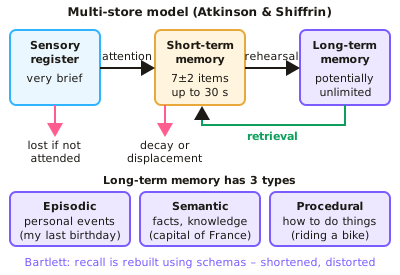
- The multi-store model (Atkinson and Shiffrin) has three stores: sensory register, short-term memory (capacity about 7±2 items, duration up to 30 seconds) and long-term memory (potentially unlimited).
- Information moves from short-term to long-term memory through rehearsal; it is lost through decay and displacement.
- Memory types: episodic (personal events), semantic (facts and knowledge) and procedural (how to do things).
- Reconstructive memory (Bartlett's War of the Ghosts) shows memory is not a perfect recording — it is influenced by schemas, so recall becomes shortened and distorted to fit expectations.
- Interference occurs when similar memories disrupt each other; context and false memories also affect the accuracy of recall.
In more detail
- Capacity: Miller (1956) found short-term memory holds about 7 ± 2 items, while long-term memory is thought to be unlimited.
- Duration: Peterson and Peterson (1959) found recall of trigrams fell from about 90% after 3 seconds to about 10% after 18 seconds when rehearsal was prevented.
- Encoding: Baddeley (1966) found short-term memory is mainly acoustic (similar-sounding words were confused) and long-term memory mainly semantic.
- Serial position effect: Murdock (1962) found people recall the first items (primacy, in LTM) and last items (recency, still in STM) of a list best.
- Reconstructive memory: in Bartlett's "War of the Ghosts" (1932), participants changed the unfamiliar story to fit their own culture.
Practice
Memory: 10 questions
Pick an answer to check it, or open the answer for the explanation.
1. According to Miller, the capacity of short-term memory is about:
- 2 ± 1 items
- 7 ± 2 items
- 20 items
- Unlimited
Show answer
B: 7 ± 2 items. Miller described the 'magic number seven, plus or minus two'.
2. Which type of long-term memory stores knowing how to ride a bike?
- Episodic
- Semantic
- Procedural
- Sensory
Show answer
C: Procedural. Procedural memories are skills, often recalled without conscious effort.
3. What did Bartlett's War of the Ghosts study demonstrate?
- Memory is a perfect recording
- Memory is reconstructive and influenced by schemas
- Short-term memory is unlimited
- Rehearsal is unnecessary
Show answer
B: Memory is reconstructive and influenced by schemas. Participants' recall became shorter and more conventional over time.
4. What is a schema?
- A brain structure
- A mental framework of knowledge built from experience
- A type of rehearsal
- A memory store
Show answer
B: A mental framework of knowledge built from experience. Schemas help us interpret information but can distort recall.
5. How does information move from short-term to long-term memory?
- By interference
- By rehearsal
- By decay
- By displacement
Show answer
B: By rehearsal. Repeating information helps encode it into long-term memory.
6. Which memory store has the largest capacity?
- Sensory register
- Short-term memory
- Long-term memory
- None have a measurable capacity
Show answer
C: Long-term memory. Long-term memory is thought to have potentially unlimited capacity.
7. What is the main way information is lost from short-term memory?
- Repression
- Decay and displacement
- Reconstruction
- Interference between long-term memories only
Show answer
B: Decay and displacement. New information can displace old information in this limited-capacity store.
8. In the multi-store model, which store first receives information from the environment?
- Long-term memory
- Sensory register
- Episodic memory
- Short-term memory
Show answer
B: Sensory register. Atkinson and Shiffrin proposed that information from the senses enters the sensory register first. Only attended information passes on to short-term memory.
9. Jo vividly remembers the day she passed her driving test. Which type of long-term memory is this?
- Sensory memory
- Procedural memory
- Semantic memory
- Episodic memory
Show answer
D: Episodic memory. Episodic memory stores personal events and experiences. Semantic memory is facts, and procedural memory is how to do things.
10. Knowing that water boils at 100°C is an example of which type of long-term memory?
- Sensory register
- Procedural memory
- Episodic memory
- Semantic memory
Show answer
D: Semantic memory. Semantic memory stores facts and general knowledge, not personal events or skills.
Keep going in Full Marks
Full Marks has 29 questions on Memory (19 more than here), set out in practice levels. You also get notes and 3D models for all 8 subtopics of Cognition and behaviour, plus games, timed exams and past papers.