GCSE Physics · Topic 3
Particle model of matter
The particle model of matter explains the properties of solids, liquids and gases using the movement of tiny particles.
We will calculate density, look at changes of state and internal energy, and use specific heat capacity and specific latent heat.
Then we explain gas pressure using particles, and carry out the required practicals on density and specific heat capacity.
- 5 subtopics
- 286 questions
- Free: 3.1 notes and 6 questions
In this topic
- 3.1Density and changes of stateFree below · 53 questions
- 3.2Particle motion in gasesOpen in Full Marks · 48 questions
- 3.3Required practical: density of regular and irregular solids and liquidsOpen in Full Marks · 64 questions
- 3.4Internal energy and specific heat capacityOpen in Full Marks · 63 questions
- 3.5Required practical: specific heat capacityOpen in Full Marks · 58 questions
3.1 · Free notes
Density and changes of state
Key points
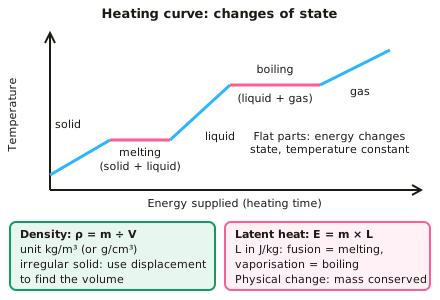
- Density = mass ÷ volume (ρ = m ÷ V), measured in kg/m³. Density can be found by measuring mass and volume, using displacement for irregular solids.
- Changes of state are physical changes: the substance's mass is conserved and the material recovers its original properties if the change is reversed.
- Internal energy is the total kinetic and potential energy of the particles in a system. Heating raises either temperature or causes a change of state.
- Specific latent heat is the energy needed to change the state of 1 kg of a substance with no temperature change: E = mL (latent heat of fusion for melting, vaporisation for boiling).
In more detail
- Worked density: a block of mass 540 g and volume 200 cm³ has ρ = 540 ÷ 200 = 2.7 g/cm³ = 2700 kg/m³ (aluminium).
- Worked latent heat: melting 0.50 kg of ice (L = 334 000 J/kg) needs E = 0.50 × 334 000 = 167 000 J.
- Heating curve: flat sections show changes of state, where energy breaks bonds between particles instead of raising temperature.
- Fusion vs vaporisation: latent heat of fusion is for melting/freezing; latent heat of vaporisation is for boiling/condensing, and it is usually much larger.
Practice
Density and changes of state: 6 questions
Pick an answer to check it, or open the answer for the explanation.
1. What is the equation for density?
- mass × volume
- mass ÷ volume
- volume ÷ mass
- mass ÷ temperature
Show answer
B: mass ÷ volume. ρ = m ÷ V, usually in kg/m³.
2. A 600 g block has a volume of 200 cm³. What is its density?
- 0.33 g/cm³
- 3 g/cm³
- 120 g/cm³
- 800 g/cm³
Show answer
B: 3 g/cm³. 600 ÷ 200 = 3 g/cm³.
3. Why is a change of state a physical change?
- A new substance is made
- The material recovers its original properties if reversed
- Mass is lost
- It cannot be reversed
Show answer
B: The material recovers its original properties if reversed. No new substance is formed and mass is conserved.
4. What happens to the temperature while a pure substance is melting?
- It rises steadily
- It stays constant
- It falls
- It rises then falls
Show answer
B: It stays constant. The energy supplied breaks bonds rather than raising temperature.
5. What does specific latent heat measure?
- Energy to raise 1 kg by 1 °C
- Energy to change the state of 1 kg with no temperature change
- The mass of a substance
- The temperature of boiling
Show answer
B: Energy to change the state of 1 kg with no temperature change. E = mL is used for melting and boiling.
6. A gas is heated in a sealed, rigid container. What happens to its pressure?
- It decreases
- It increases, as particles collide more often and with more force
- It stays the same
- The gas escapes
Show answer
B: It increases, as particles collide more often and with more force. Fixed volume means pressure rises with temperature.
Keep going in Full Marks
Full Marks has 53 questions on Density and changes of state (47 more than here), set out in practice levels. You also get notes and 3D models for all 5 subtopics of Particle model of matter, plus games, timed exams and past papers.