GCSE Physics · Topic 1
Energy
Energy is the big idea that connects every part of physics. In this topic we learn how energy is stored, transferred and wasted.
We will calculate kinetic, gravitational and elastic energy, work done and power, efficiency and specific heat capacity.
Then we compare the energy resources used to generate electricity, and look at how insulation reduces energy loss from buildings, including the required practical.
- 6 subtopics
- 397 questions
- Free: 1.1 notes and 10 questions
In this topic
- 1.1Energy stores, transfers and efficiencyFree below · 65 questions
- 1.2Energy resourcesOpen in Full Marks · 62 questions
- 1.3Kinetic and gravitational potential energy calculationsOpen in Full Marks · 70 questions
- 1.4Work done and powerOpen in Full Marks · 65 questions
- 1.5Conduction, convection and thermal insulationOpen in Full Marks · 70 questions
- 1.6Required practical: thermal insulation and rate of energy transferOpen in Full Marks · 65 questions
1.1 · Free notes
Energy stores, transfers and efficiency
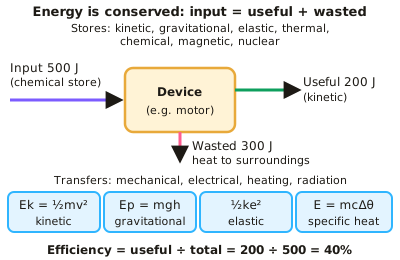
Key points
- Energy is stored in kinetic, gravitational potential, elastic potential, thermal, chemical, magnetic and nuclear stores, and is transferred mechanically, electrically, by heating or by radiation.
- Kinetic energy Eₖ = ½mv². Gravitational potential energy Eₚ = mgh. Elastic potential energy = ½ke².
- Specific heat capacity: E = mcΔθ — the energy needed to raise 1 kg of a substance by 1 °C.
- Power is the rate of energy transfer: P = E ÷ t, measured in watts. Efficiency = useful output energy ÷ total input energy.
- Energy is conserved: it cannot be created or destroyed, only transferred. Wasted energy is usually dissipated to the surroundings by heating.
In more detail
- Worked efficiency: a motor uses 500 J and gives 350 J of useful kinetic energy → efficiency = 350 ÷ 500 = 0.70 = 70%. Wasted = 150 J, mostly as thermal energy.
- Worked specific heat capacity: heating 2.0 kg of water (c = 4200 J/kg °C) by 15 °C needs E = 2.0 × 4200 × 15 = 126 000 J.
- Reducing wasted energy: lubrication reduces friction; thermal insulation reduces heat loss; streamlining reduces air resistance.
- Sankey diagrams: arrow widths show the amount of energy; the input width equals the total of the useful and wasted outputs.
Practice
Energy stores, transfers and efficiency: 10 questions
Pick an answer to check it, or open the answer for the explanation.
1. What is the kinetic energy of a 4 kg object moving at 3 m/s?
- 6 J
- 12 J
- 18 J
- 36 J
Show answer
C: 18 J. Eₖ = ½ × 4 × 3² = 18 J.
2. Which equation gives gravitational potential energy?
- ½mv²
- mgh
- ½ke²
- mcΔθ
Show answer
B: mgh. Mass × gravitational field strength × height.
3. A device transfers 200 J usefully from 500 J supplied. What is its efficiency?
- 20%
- 40%
- 60%
- 250%
Show answer
B: 40%. 200 ÷ 500 = 0.4, which is 40%.
4. What is power?
- Total energy stored
- The rate of energy transfer
- Force × distance
- Energy ÷ efficiency
Show answer
B: The rate of energy transfer. Power is measured in watts (joules per second).
5. How much energy raises 2 kg of water by 10 °C? (c = 4200 J/kg°C)
- 8 400 J
- 42 000 J
- 84 000 J
- 21 000 J
Show answer
C: 84 000 J. E = mcΔθ = 2 × 4200 × 10 = 84 000 J.
6. A spring stores 4 J of elastic potential energy when stretched by 0.2 m. What is its spring constant?
- 20 N/m
- 40 N/m
- 100 N/m
- 200 N/m
Show answer
D: 200 N/m. E = ½ke², so 4 = ½ × k × 0.04, giving k = 200 N/m.
7. A 2 kg book is lifted 3 m onto a shelf. What is its gain in gravitational potential energy? (g = 10 N/kg)
- 600 J
- 6 J
- 15 J
- 60 J
Show answer
D: 60 J. Ep = mgh = 2 × 10 × 3 = 60 J. Multiplying only mass and height (6 J) leaves out the gravitational field strength.
8. A car's speed doubles. How does its kinetic energy change?
- It increases by a factor of eight
- It increases by a factor of four
- It doubles
- It stays the same
Show answer
B: It increases by a factor of four. Ek = ½mv², so Ek is proportional to v². Doubling v multiplies kinetic energy by 2² = 4, not 2.
9. A kettle transfers 360 000 J of energy in 3 minutes. What is its power?
- 1200 W
- 120 000 W
- 20 W
- 2000 W
Show answer
D: 2000 W. Convert time to seconds: 3 × 60 = 180 s. P = E ÷ t = 360 000 ÷ 180 = 2000 W. Using 3 as the time gives the wrong answer of 120 000 W.
10. Which efficiency value for a machine is impossible?
- 1.20
- 0.05
- 0.95
- 0.50
Show answer
A: 1.20. Useful output can never exceed total input, so efficiency cannot be above 1 (100%). An efficiency of 1.20 would mean energy was created.
Keep going in Full Marks
Full Marks has 65 questions on Energy stores, transfers and efficiency (55 more than here), set out in practice levels. You also get notes and 3D models for all 6 subtopics of Energy, plus games, timed exams and past papers.