GCSE Economics · Topic 9
Money and Financial Markets
This topic is about money, banks and financial markets, and how they affect everyday life.
We will look at what money is and how payments are changing, the role of banks and the Bank of England, and saving and borrowing.
Finally we look at risk and return in financial markets, with a case study of the 2008 financial crisis.
- 4 subtopics
- 199 questions
- Free: 9.1 notes and 10 questions
In this topic
- 9.1The functions and characteristics of money, and the move to digital paymentsFree below · 39 questions
- 9.2Banks, financial institutions and the role of the central bankOpen in Full Marks · 40 questions
- 9.3Saving, borrowing and interest: simple and compound interest calculationsOpen in Full Marks · 58 questions
- 9.4Financial markets, risk and return, and case study of the 2008 financial crisisOpen in Full Marks · 62 questions
9.1 · Free notes
The functions and characteristics of money, and the move to digital payments
Key points
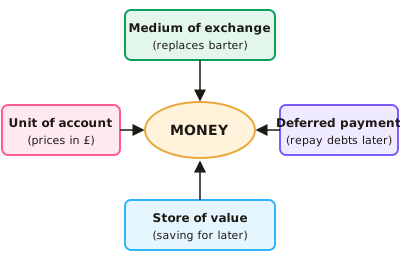
- Money is anything generally acceptable as payment for goods and services and for settling debts. Modern UK money is fiat money: it has value because the government declares it legal tender and people trust it, not because it is backed by gold.
- Medium of exchange: money is used to buy and sell goods, so it removes the need for barter. Barter needs a double coincidence of wants, meaning each person must have what the other wants.
- Store of value: money lets people save purchasing power for the future. High inflation damages this function because each £1 buys less over time.
- Unit of account: money gives a common measure for prices, wages and the value of goods, such as £2.50 for a coffee. This makes comparing prices easy.
- Standard of deferred payment: money lets people borrow now and repay later, as with loans, mortgages and credit. This only works well if money keeps a fairly stable value.
- Key characteristics of money: acceptable, durable, portable, divisible (into small denominations for change), uniform (units are identical) and scarce (limited supply). If supply is too easy to increase, money loses value.
- Digital payments include contactless cards, mobile wallets (Apple Pay, Google Pay), online banking and Faster Payments. The UK contactless limit per transaction is £100 (raised from £45 in 2021). Cash now makes up only a small share of UK payments.
- Benefits of digital payments: faster and more convenient, cheaper for firms to process than handling cash, easier record-keeping, and less risk of cash theft. Drawbacks: card fraud, cyber-security risks, system or power outages, and digital exclusion for people without bank accounts, smartphones or internet access.
- Cryptocurrencies such as Bitcoin are digital but are not legal tender and are not widely accepted. Their values are very volatile, so they are poor at being a store of value. They are not seen as money in the same way as pounds.
- Exam tip: when asked to evaluate the move to a cashless society, give a benefit and a drawback. Name the affected groups (elderly people, rural communities, low-income households) and reach a judgement.
In more detail
- Cigarettes as money: in prisoner-of-war camps cigarettes were used as money, because they were widely accepted, portable and easy to divide, which shows what makes something work as money.
- Cash is fading: cash was used for more than half of UK payments around 2010, but only about 12% by 2023 (UK Finance).
- Who gets left behind: some older people, people in rural areas with poor internet, and people without bank accounts can lose out in a cashless society.
- Exam tip: test any form of money against its four functions: medium of exchange, store of value, unit of account and standard of deferred payment.
Practice
The functions and characteristics of money, and the move to digital payments: 10 questions
Pick an answer to check it, or open the answer for the explanation.
1. Tom has apples but wants shoes; the shoemaker wants fish, not apples. Which problem of barter does this show?
- Lack of a unit of account
- Goods being too divisible
- Absence of a double coincidence of wants
- Money losing its value
Show answer
C: Absence of a double coincidence of wants. Barter only works if each party has what the other wants. Tom and the shoemaker lack a double coincidence of wants, which money solves by acting as a medium of exchange.
2. A shop labels a jumper £30 and a hat £10. Which function of money does this best show?
- Unit of account
- Store of value
- Medium of exchange
- Standard of deferred payment
Show answer
A: Unit of account. Prices expressed in pounds give a common measure of value, so goods can be compared. That is the unit of account function.
3. Maya puts £50 into a savings account to spend next year. Which function of money is she using?
- Unit of account
- Medium of exchange
- Store of value
- Legal tender
Show answer
C: Store of value. Money kept to buy things later is acting as a store of value. Medium of exchange would apply only when she actually pays for something.
4. Banknotes come in £5, £10, £20 and £50 so exact change can be given. Which characteristic of money is this?
- Portability
- Scarcity
- Durability
- Divisibility
Show answer
D: Divisibility. Divisibility means money can be split into smaller units, so payments of different sizes can be made and change given.
5. Which statement about UK money is correct?
- Its value cannot change
- It has value because it is legal tender and people trust it
- It is valuable because it is made of precious metal
- Its value is guaranteed by a gold reserve
Show answer
B: It has value because it is legal tender and people trust it. The pound is fiat money. Its value rests on government backing, legal tender status and public confidence, not gold or the material it is made of.
6. Prices in a country double over several years. Which function of money is damaged most?
- Portability
- Divisibility
- Uniformity
- Store of value
Show answer
D: Store of value. With high inflation, each pound buys less over time, so savings lose purchasing power. This weakens money as a store of value.
7. What is the maximum value of a single UK contactless card payment without a PIN (since 2021)?
- £100
- £30
- £45
- £250
Show answer
A: £100. The UK single-transaction contactless limit rose from £45 to £100 in October 2021. Larger payments need other verification.
8. A firm lends £10,000 to a customer to be repaid in 12 months in pounds. Which function of money is being used?
- Unit of account
- Standard of deferred payment
- Store of value
- Medium of exchange
Show answer
B: Standard of deferred payment. Money is a standard of deferred payment when it is used to measure debts that will be settled in the future, as in loans and mortgages.
9. Which is a likely disadvantage of the move to a cashless society?
- Easier record-keeping for firms
- Digital exclusion for people without bank accounts or smartphones
- Lower cost of handling cash for firms
- Faster payment at tills
Show answer
B: Digital exclusion for people without bank accounts or smartphones. Some elderly, rural or low-income people cannot easily use digital payments, so a cashless society can exclude them. The other options are benefits.
10. Bitcoin's price rose 20% one week and fell 30% the next. Which function does this volatility weaken most?
- Store of value
- Divisibility
- Unit of production
- Legal tender
Show answer
A: Store of value. Rapid, unpredictable changes in value mean savers cannot rely on holding it to keep purchasing power. It is also not UK legal tender.
Keep going in Full Marks
Full Marks has 39 questions on The functions and characteristics of money, and the move to digital payments (29 more than here), set out in practice levels. You also get notes and 3D models for all 4 subtopics of Money and Financial Markets, plus games, timed exams and past papers.