A-level Psychology Year 13 · Topic 9
Sport and exercise psychology
Sport and exercise psychology looks at the mental side of performance, and why people do or don't exercise.
We will cover motivation, arousal and anxiety, audience effects, team dynamics, leadership, personality and aggression.
Then we look at psychological skills like imagery and goal setting, and at exercise adherence, mental health benefits and exercise addiction.
- 11 subtopics
- 435 questions
- Free: 9.1 notes and 10 questions
In this topic
- 9.1Motivation in sport: intrinsic and extrinsic, achievement goals and self-efficacyFree below · 32 questions
- 9.2Arousal, anxiety and performance: drive theory, inverted-U, catastrophe theory and IZOFOpen in Full Marks · 33 questions
- 9.3Social facilitation, audience effects and home advantageOpen in Full Marks · 28 questions
- 9.4Group dynamics in sport: team cohesion, Tuckman's stages, Steiner's model and social loafingOpen in Full Marks · 70 questions
- 9.5Leadership in sport: Fiedler's contingency model and Chelladurai's multidimensional modelOpen in Full Marks · 70 questions
- 9.6Personality, mental toughness and aggression in sportOpen in Full Marks · 39 questions
- 9.7Psychological skills training: imagery, goal setting, self-talk and relaxationOpen in Full Marks · 77 questions
- 9.8Exercise psychology: adherence, mental health benefits and exercise addictionOpen in Full Marks · 34 questions
- 9.9Organisational psychology: motivation to work and rewardsOpen in Full Marks · 16 questions
- 9.10Organisational psychology: leadership, management and group behaviour at workOpen in Full Marks · 19 questions
- 9.11Organisational psychology: working conditions and satisfaction at workOpen in Full Marks · 17 questions
9.1 · Free notes
Motivation in sport: intrinsic and extrinsic, achievement goals and self-efficacy
Key points
- Intrinsic motivation comes from within the performer: enjoyment, mastery, curiosity and satisfaction. Extrinsic motivation comes from external rewards such as trophies, money, praise or avoiding punishment.
- Self-determination theory (Deci and Ryan) says motivation sits on a continuum from amotivation through extrinsic types to intrinsic. It is fostered by three needs: autonomy, competence and relatedness.
- Cognitive evaluation theory: controlling, tangible rewards can undermine intrinsic motivation (the overjustification effect). Informational feedback that supports competence can enhance it.
- Deci (1971): students paid to solve the Soma puzzle spent less free time on it afterwards than unpaid students. This suggests that payment reduced their intrinsic interest.
- Elite athletes usually have a mix of both types. Extrinsic rewards (scholarships, sponsorship) can help at first, but long-term persistence is linked to intrinsic motivation.
- Achievement goal theory (Nicholls, 1984): a task (mastery) orientation judges success by self-referenced improvement and effort. An ego (outcome) orientation judges success by beating others. The two are independent, so an athlete can be high in both.
- Task orientation is linked to persistence, enjoyment and challenge-seeking. Ego orientation with low perceived ability is linked to avoiding challenges, reduced effort and dropout. Orientation is measured with questionnaires such as the TEOSQ.
- Motivational climate (Ames, 1992) is set by the coach. A mastery climate rewards effort and improvement. A performance climate stresses winning and social comparison.
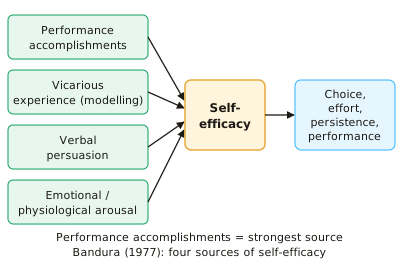
- Self-efficacy (Bandura, 1977) is the belief in one's ability to succeed at a specific task. It is task-specific, unlike general self-confidence. It is raised by four sources: performance accomplishments (strongest), vicarious experience (modelling), verbal persuasion and emotional/physiological arousal.
- Evaluation: self-efficacy and performance are positively correlated, but this is correlational and reciprocal (success raises self-efficacy). Evidence relies on self-report and mostly Western samples. Applications include modelling, task-focused goal setting and positive feedback.
In more detail
- Worked undermining example: a girl who loves swimming is paid for every length; when the payments stop, she swims less than before, because swimming now feels like work (the overjustification effect).
- Task vs ego example: a task-oriented runner is pleased with a personal best even when finishing fifth; an ego-oriented runner feels they failed because others beat them.
- Sources of self-efficacy: performance accomplishments (the strongest), vicarious experience, verbal persuasion and emotional arousal (Bandura, 1977).
- Exam tip: rewards that give information about competence (e.g. 'most improved player') can raise intrinsic motivation, while controlling rewards can lower it.
Practice
Motivation in sport: intrinsic and extrinsic, achievement goals and self-efficacy: 10 questions
Pick an answer to check it, or open the answer for the explanation.
1. A teenager joins a basketball club purely because she loves the game and enjoys improving her skills. Which type of motivation is this?
- Extrinsic motivation
- Ego orientation
- Amotivation
- Intrinsic motivation
Show answer
D: Intrinsic motivation. Taking part for enjoyment and self-improvement comes from within the performer, so it is intrinsic motivation. No external reward is driving it.
2. In Deci's (1971) Soma puzzle study, what happened to students who were paid to solve the puzzle once the payment stopped?
- There was no difference between the groups
- They spent less free time on it than unpaid students
- They spent more free time on it than unpaid students
- Their puzzle performance improved further
Show answer
B: They spent less free time on it than unpaid students. The paid group spent less free time on the puzzle than the unpaid group. This suggests that the reward undermined intrinsic motivation (overjustification effect).
3. According to Nicholls, an athlete with a high task orientation judges success mainly by:
- Beating opponents with minimal effort
- Approval from spectators
- Winning trophies and prize money
- Personal improvement and mastery of skills
Show answer
D: Personal improvement and mastery of skills. A task (mastery) orientation defines success as self-referenced improvement and effort. Beating others is an ego orientation.
4. A novice archer gains belief she can hit the target after watching a similar-ability teammate succeed. Which source of self-efficacy is this?
- Performance accomplishments
- Vicarious experience
- Verbal persuasion
- Emotional arousal
Show answer
B: Vicarious experience. Seeing a similar person succeed is vicarious experience (modelling), one of Bandura's four sources. She has not yet performed the task herself.
5. Which source of self-efficacy did Bandura (1977) argue is the most powerful?
- Verbal persuasion from a coach
- Vicarious experience
- Physiological and emotional states
- Performance accomplishments (past success)
Show answer
D: Performance accomplishments (past success). Bandura argued that actual mastery experiences, i.e. past success, give the most reliable evidence of ability, so they have the strongest effect.
6. Which statement about self-efficacy is correct?
- It is a general trait that applies equally to all sports
- It is a task-specific belief in one's ability to succeed
- It is the same thing as extrinsic motivation
- It is the desire to outperform other athletes
Show answer
B: It is a task-specific belief in one's ability to succeed. Self-efficacy is a situation- or task-specific belief about ability. A player may have high efficacy for free throws but low efficacy for three-pointers.
7. After losing heavily, an ego-orientated athlete with low perceived ability is most likely, according to achievement goal theory, to:
- Increase effort because the goal is self-improvement
- Seek out detailed feedback on technique
- Withdraw effort or drop out to protect self-esteem
- Judge the result by personal progress
Show answer
C: Withdraw effort or drop out to protect self-esteem. Ego-orientated performers with low perceived ability see failure as proof of low ability, so they often avoid challenge, reduce effort or drop out.
8. Which set lists the three basic psychological needs in self-determination theory?
- Task, ego, climate
- Arousal, anxiety, confidence
- Efficacy, effort, enjoyment
- Autonomy, competence, relatedness
Show answer
D: Autonomy, competence, relatedness. Deci and Ryan's self-determination theory proposes that autonomy, competence and relatedness must be satisfied to sustain intrinsic motivation.
9. A coach tells a player, 'Your passing accuracy has improved by 10% since September.' According to cognitive evaluation theory this feedback will most likely:
- Have no effect on motivation
- Create a performance climate
- Increase intrinsic motivation by supporting competence
- Undermine intrinsic motivation because it is controlling
Show answer
C: Increase intrinsic motivation by supporting competence. Informational feedback that shows progress supports the need for competence, so it tends to enhance intrinsic motivation rather than undermine it.
10. In a Deci-style study, rewarded students spent a mean of 4 minutes and unrewarded students 6 minutes of an 8-minute free period on the task. What is the difference?
- 25 percentage points
- 33 percentage points
- 2 percentage points
- 50 percentage points
Show answer
A: 25 percentage points. 4/8 = 50% and 6/8 = 75%. The difference is 25 percentage points, with the rewarded group showing less free-choice interest.
Keep going in Full Marks
Full Marks has 32 questions on Motivation in sport: intrinsic and extrinsic, achievement goals and self-efficacy (22 more than here), set out in practice levels. You also get notes and 3D models for all 11 subtopics of Sport and exercise psychology, plus games, timed exams and past papers.
On your exam board
Not in the AQA and Edexcel specifications.