A-level Physics Year 13 · Topic 14
Cosmology
Cosmology is the study of the Universe as a whole: its origin, its expansion and its future.
We will use the Doppler effect and red shift to measure speeds, and Hubble's law to estimate the age of the Universe.
Then we look at the evidence for the Big Bang, dark matter and dark energy, quasars, and how exoplanets are found.
- 6 subtopics
- 243 questions
- Free: 14.1 notes and 10 questions
In this topic
- 14.1The Doppler effect and red shiftFree below · 26 questions
- 14.2Hubble's law and the age of the UniverseOpen in Full Marks · 18 questions
- 14.3The Big Bang, cosmic microwave background and evolution of the UniverseOpen in Full Marks · 62 questions
- 14.4Dark matter, dark energy, critical density and the fate of the UniverseOpen in Full Marks · 60 questions
- 14.5Quasars and active galaxiesOpen in Full Marks · 21 questions
- 14.6Detecting exoplanets: transit and radial velocity methodsOpen in Full Marks · 56 questions
14.1 · Free notes
The Doppler effect and red shift
Key points
- The Doppler effect is the apparent change in the frequency and wavelength of a wave when the source and observer move relative to each other along the line of sight.
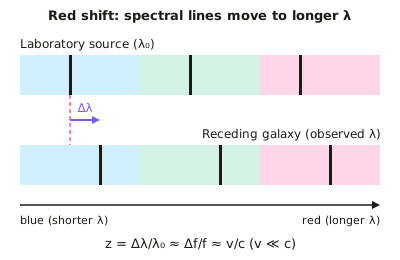
- A source moving away gives a longer observed wavelength (red shift). A source moving towards the observer gives a shorter wavelength (blue shift). The speed of light in a vacuum stays constant at c.
- For speeds v ≪ c: z = Δλ/λ₀ = Δf/f ≈ v/c, where Δλ = λ(observed) − λ₀. z has no units, and v is only the radial component of velocity along the line of sight.
- To measure a shift, compare the wavelengths of absorption (or emission) lines in the star or galaxy spectrum with the laboratory wavelengths of the same element, e.g. hydrogen Balmer lines or the calcium H and K lines.
- Light from a rotating star or galaxy is blue shifted on the side turning towards us and red shifted on the side turning away. The spread of the line gives the rotation speed.
- Binary stars show periodic red and blue shifts as they orbit. A star with an unseen exoplanet shows a small periodic shift because it orbits the centre of mass. This is the radial-velocity method.
- Almost all distant galaxies show red shift. This cosmological red shift is caused by the expansion of space stretching the light's wavelength in transit. It is not simply galaxies moving through space. 1 + z = λ(observed)/λ₀.
- The simple relation v ≈ cz is only valid for small z (below about 0.1). Quasars have very large red shifts, so they are extremely distant and need a relativistic treatment.
- For sound, f′ = f·c_s/(c_s ∓ v_s), with the minus sign for an approaching source and the plus sign for a receding one. The source still emits its original frequency, and only the observed value changes.
- Exam tip: in Δλ/λ₀ the units cancel, so nm can stay as nm. Convert km s⁻¹ to m s⁻¹ if you use c = 3.00 × 10⁸ m s⁻¹, and always say whether the source is receding or approaching.
In more detail
- Worked red shift: a line at 486.1 nm is observed at 491.0 nm → z = 4.9 ÷ 486.1 = 0.0101 → v = 0.0101 × 3.00 × 10⁸ = 3.0 × 10⁶ m s⁻¹ away.
- Worked blue shift: Andromeda approaches at about 300 km s⁻¹ → Δλ/λ = 1.0 × 10⁻³, so a 656.3 nm line moves 0.66 nm to the blue.
- Worked sound: a 700 Hz siren approaching at 20 m s⁻¹ (sound at 340 m s⁻¹) → f′ = 700 × 340 ÷ 320 = 744 Hz.
- Spectroscopic binaries: the lines of each star shift back and forth (and split) periodically; the period of the shift is the orbital period.
Practice
The Doppler effect and red shift: 10 questions
Pick an answer to check it, or open the answer for the explanation.
1. A galaxy recedes at 6.0 × 10⁶ m s⁻¹. At what wavelength is a line observed if its laboratory wavelength is 500 nm? (c = 3.00 × 10⁸ m s⁻¹)
- 505 nm
- 520 nm
- 490 nm
- 510 nm
Show answer
D: 510 nm. Δλ/λ₀ = v/c = 0.020, so Δλ = 10 nm. The source is receding, so the wavelength increases to 510 nm.
2. Which statement about light from a source receding from the observer is correct?
- Its wavelength is unchanged but its intensity falls
- It travels through a vacuum at less than c
- Its wavelength is longer and its frequency higher than emitted
- Its wavelength is longer and its frequency lower than emitted
Show answer
D: Its wavelength is longer and its frequency lower than emitted. Recession lengthens the observed wavelength. Since c = fλ and c is constant, the observed frequency falls.
3. Why is light from distant galaxies red shifted on a cosmological scale?
- Space expands while the light travels, stretching its wavelength
- Our own galaxy's gravity pulls on the photons
- Intergalactic dust absorbs the blue light
- The light slows down as it crosses space
Show answer
A: Space expands while the light travels, stretching its wavelength. Cosmological red shift is caused by the expansion of space stretching the wavelength of light in transit. The speed of light stays c.
4. A star rotates about its axis. Compared with light from its centre, light from the limb moving towards the observer is:
- blue shifted, with a longer wavelength
- unshifted because rotation does not change wavelength
- red shifted, with a longer wavelength
- blue shifted, with a shorter wavelength
Show answer
D: blue shifted, with a shorter wavelength. The limb moving towards us has a radial velocity towards the observer, so its light has a shorter wavelength (blue shift).
5. A quasar spectrum shows a line with laboratory wavelength 434 nm at a red shift z = 0.050. What is the observed wavelength?
- 434 nm
- 21.7 nm
- 456 nm
- 412 nm
Show answer
C: 456 nm. Δλ = zλ₀ = 0.050 × 434 = 21.7 nm. The observed wavelength is 434 + 21.7 = 456 nm (to 3 s.f.).
6. Why does an orbiting planet cause the spectral lines of its star to shift periodically?
- Star and planet orbit their common centre of mass, so the star's radial velocity varies
- The planet's gravity bends the starlight
- The planet reflects light of a different wavelength
- The planet absorbs some starlight at certain wavelengths
Show answer
A: Star and planet orbit their common centre of mass, so the star's radial velocity varies. The star moves in a small orbit about the centre of mass. Its radial velocity alternately points towards and away from us, giving a periodic Doppler shift.
7. A galaxy moves across our line of sight at 2000 km s⁻¹ with no component towards or away from us. Its spectral lines will show:
- both a red and a blue shift
- a blue shift
- a red shift
- no Doppler shift to first order
Show answer
D: no Doppler shift to first order. Doppler shift depends only on the radial component of velocity. With none, there is no first-order shift.
8. The 21 cm hydrogen line has frequency 1.42 GHz. A galaxy recedes at 3.0 × 10⁶ m s⁻¹. By how much does the observed frequency change? (c = 3.00 × 10⁸ m s⁻¹)
- 14 MHz lower
- 14 MHz higher
- 1.4 GHz lower
- 4.7 MHz lower
Show answer
A: 14 MHz lower. Δf = f v/c = 1.42 × 10⁹ × 0.010 = 1.4 × 10⁷ Hz. The source is receding, so the observed frequency is lower.
9. The calcium K line has laboratory wavelength 393.4 nm. It is observed at 396.7 nm in galaxy A and 400.0 nm in galaxy B. What can be concluded?
- B is receding at twice the speed of A
- A is approaching and B is receding
- B is receding at about 1.01 times the speed of A
- A is receding faster than B
Show answer
A: B is receding at twice the speed of A. Δλ for A is 3.3 nm and for B is 6.6 nm. Since v ∝ Δλ, B recedes at twice A's speed. Both are red shifted.
10. An ambulance siren emits 700 Hz. As it approaches a stationary observer, the observer hears:
- a frequency above 700 Hz, though the siren still emits 700 Hz
- a frequency above 700 Hz because the siren's frequency rises
- 700 Hz but louder
- a frequency below 700 Hz
Show answer
A: a frequency above 700 Hz, though the siren still emits 700 Hz. Wavefronts are compressed in front of the source, so the observed frequency is higher. The source's emitted frequency is unchanged.
Keep going in Full Marks
Full Marks has 26 questions on The Doppler effect and red shift (16 more than here), set out in practice levels. You also get notes and 3D models for all 6 subtopics of Cosmology, plus games, timed exams and past papers.