A-level Maths Year 13 · Topic 2
Pure: sequences, series and binomial expansion
Sequences, series and the binomial expansion are about patterns of numbers and how to add them up.
We will use arithmetic and geometric series, sigma notation and recurrence relations.
Then we extend the binomial expansion to negative and fractional powers, and use it for approximations.
- 5 subtopics
- 276 questions
- Free: 2.1 notes and 10 questions
In this topic
- 2.1Sequences, series and binomial expansionFree below · 69 questions
- 2.2Arithmetic sequences and seriesOpen in Full Marks · 53 questions
- 2.3Geometric sequences, series and the sum to infinityOpen in Full Marks · 53 questions
- 2.4Sigma notation, recurrence relations and types of sequenceOpen in Full Marks · 57 questions
- 2.5Binomial expansion for any rational power, and when it is validOpen in Full Marks · 44 questions
2.1 · Free notes
Sequences, series and binomial expansion
Key points
- Arithmetic series: nth term a + (n − 1)d; sum Sₙ = (n ÷ 2)[2a + (n − 1)d].
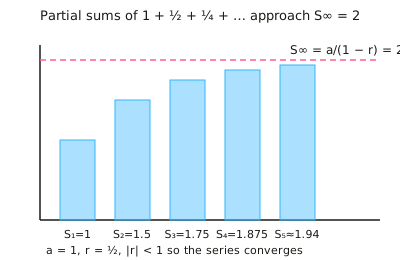
- Geometric series: nth term arⁿ⁻¹; sum Sₙ = a(1 − rⁿ) ÷ (1 − r); sum to infinity S∞ = a ÷ (1 − r) for |r| < 1.
- Recurrence relations define each term from the previous one; sequences may be increasing, decreasing or periodic.
- The binomial expansion extends to negative and fractional powers for |x| < 1, which is used to make approximations.
- Sigma notation Σ compactly represents a sum of terms.
In more detail
- Worked arithmetic series: 5 + 8 + 11 + … to 20 terms → S = 20/2 × (2 × 5 + 19 × 3) = 10 × 67 = 670.
- Worked geometric series: 8 + 4 + 2 + … → S∞ = 8 ÷ (1 − ½) = 16, and S₁₀ = 8(1 − 0.5¹⁰) ÷ 0.5 = 15.98.
- Worked sigma: Σ(3r − 1) from r = 1 to 10 = 3 × 55 − 10 = 155.
- Worked binomial, fractional power: (1 − 2x)^(1/2) = 1 − x − ½x² − ½x³ − …, valid for |x| < ½.
- Worked approximation: √0.98 = (1 − 2 × 0.01)^(1/2) ≈ 1 − 0.01 − 0.00005 = 0.98995.
- Worked recurrence: uₙ₊₁ = 3uₙ − 1 with u₁ = 2 → 2, 5, 14, 41, …, an increasing sequence.
Practice
Sequences, series and binomial expansion: 10 questions
Pick an answer to check it, or open the answer for the explanation.
1. Find the sum to infinity of a geometric series with a = 4 and r = ½
- 2
- 6
- 8
- 16
Show answer
C: 8. S∞ = a ÷ (1 − r) = 4 ÷ 0.5 = 8.
2. What is the 10th term of the arithmetic sequence 3, 7, 11, ...?
- 36
- 39
- 40
- 43
Show answer
B: 39. a + (n − 1)d = 3 + 9 × 4 = 39.
3. For what values of r does a geometric series have a sum to infinity?
- |r| > 1
- |r| < 1
- r = 1
- All values
Show answer
B: |r| < 1. Otherwise the terms don't tend to zero.
4. What does a recurrence relation do?
- Gives the nth term directly
- Defines each term using the previous term(s)
- Sums a series
- Finds the limit
Show answer
B: Defines each term using the previous term(s). For example, uₙ₊₁ = 2uₙ + 1.
5. The binomial expansion for a negative power is valid when:
- |x| > 1
- |x| < 1
- x = 1
- x is an integer
Show answer
B: |x| < 1. Otherwise the infinite series doesn't converge.
6. What is the sum of the first 20 terms of 2, 5, 8, ...?
- 590
- 610
- 620
- 600
Show answer
B: 610. S = (20/2)[2(2) + 19(3)] = 10 × (4 + 57) = 10 × 61 = 610.
7. A geometric sequence has a = 3 and r = 2. What is the 5th term?
- 24
- 48
- 96
- 15
Show answer
B: 48. arⁿ⁻¹ = 3 × 2⁴ = 48.
8. For which value of r does a geometric series converge?
- r = 2
- r = −0.5
- r = 1
- r = −3
Show answer
B: r = −0.5. Convergence requires |r| < 1.
9. An arithmetic series has first term 5 and common difference 3. What is the sum of its first 15 terms?
- 390
- 345
- 195
- 780
Show answer
A: 390. S₁₅ = (15/2)[2(5) + 14(3)] = 7.5 × 52 = 390. The value 780 comes from forgetting to halve the bracket (the n ÷ 2 factor).
10. A geometric series has first term 2 and common ratio 3. What is the sum of the first 6 terms?
- 728
- 486
- 364
- 1458
Show answer
A: 728. S₆ = 2(3⁶ − 1)/(3 − 1) = 2 × 728/2 = 728. The value 486 is only the 6th term (2 × 3⁵ = 486), not the sum.
Keep going in Full Marks
Full Marks has 69 questions on Sequences, series and binomial expansion (59 more than here), set out in practice levels. You also get notes and 3D models for all 5 subtopics of Pure: sequences, series and binomial expansion, plus games, timed exams and past papers.