A-level Maths Year 13 · Topic 1
Pure: proof, functions and modulus
Proof, functions and modulus builds the rigorous algebra that the rest of year thirteen relies on.
We will prove results by contradiction, and split fractions into partial fractions.
Then we sketch and solve modulus graphs, equations and inequalities, and work with composite and inverse functions, their domains and ranges.
- 6 subtopics
- 225 questions
- Free: 1.1 notes and 10 questions
In this topic
- 1.1Proof, functions and partial fractionsFree below · 26 questions
- 1.2Modulus functions: graphs, equations and inequalitiesOpen in Full Marks · 44 questions
- 1.3Composite and inverse functions, domain and rangeOpen in Full Marks · 69 questions
- 1.4Proof by contradictionOpen in Full Marks · 13 questions
- 1.5Partial fractions: linear factors, repeated factors and improper fractionsOpen in Full Marks · 37 questions
- 1.6Logarithmic and exponential functions: ln x, eˣ, solving equations and linear formsOpen in Full Marks · 36 questions
1.1 · Free notes
Proof, functions and partial fractions
Key points
- Proof by contradiction assumes the opposite of what is to be proved and derives a contradiction, e.g. proving √2 is irrational.
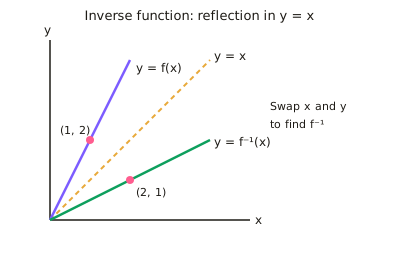
- Functions: domain is the set of inputs, range the set of outputs. Composite functions fg(x) mean apply g first; the inverse f⁻¹(x) reverses f and reflects the graph in y = x.
- The modulus function |x| gives the magnitude; solving modulus equations often requires considering both positive and negative cases.
- Partial fractions split an algebraic fraction into simpler fractions, useful for integration and binomial expansions.
In more detail
- Worked contradiction, √2: assume √2 = a/b in lowest terms → a² = 2b², so a is even; a = 2k → b² = 2k², so b is even too, contradicting lowest terms.
- Worked contradiction, primes: assume finitely many primes p₁ … pₙ; N = p₁p₂…pₙ + 1 leaves remainder 1 on division by each, so it has a prime factor not in the list.
- Worked partial fractions: (5x + 1)/((x + 1)(x − 1)): 5x + 1 = A(x − 1) + B(x + 1); x = 1 gives B = 3, x = −1 gives A = 2 → 2/(x + 1) + 3/(x − 1).
- Worked repeated factor: (x + 5)/((x − 1)(x + 1)²) = 3/(2(x − 1)) − 3/(2(x + 1)) − 2/(x + 1)².
- Worked modulus: |2x − 3| = 5 → 2x − 3 = 5 or −5 → x = 4 or x = −1.
Practice
Proof, functions and partial fractions: 10 questions
Pick an answer to check it, or open the answer for the explanation.
1. In proof by contradiction, what is the first step?
- Assume the statement is true
- Assume the negation of the statement
- Test a few values
- Draw a graph
Show answer
B: Assume the negation of the statement. A contradiction then shows the assumption was false.
2. For composite function fg(x), which function is applied first?
- f
- g
- Both at once
- Neither
Show answer
B: g. Work from the inside out.
3. What does the graph of an inverse function look like relative to the original?
- A translation
- A reflection in y = x
- A stretch
- Identical
Show answer
B: A reflection in y = x. The x and y coordinates are swapped.
4. Solve |x| = 5
- x = 5 only
- x = −5 only
- x = 5 or x = −5
- No solution
Show answer
C: x = 5 or x = −5. The modulus gives the magnitude, so both signs work.
5. What are partial fractions used for?
- Differentiating products
- Splitting an algebraic fraction into simpler fractions
- Finding gradients
- Solving quadratics only
Show answer
B: Splitting an algebraic fraction into simpler fractions. This makes integration and expansion far easier.
6. If f(x) = 2x + 1 and g(x) = x², what is fg(3)?
- 19
- 49
- 13
- 7
Show answer
A: 19. g(3) = 9, then f(9) = 19.
7. What is the domain of f(x) = √x for real values?
- All real numbers
- x ≥ 0
- x > 1
- x ≤ 0
Show answer
B: x ≥ 0. The square root of a negative number is not real.
8. Solve |2x − 4| = 6
- x = 5 only
- x = 5 or x = −1
- x = −1 only
- x = 3
Show answer
B: x = 5 or x = −1. 2x − 4 = 6 or 2x − 4 = −6.
9. In the proof by contradiction that √2 is irrational, assuming √2 = p/q in lowest terms, what contradiction is reached?
- q turns out to be negative
- p and q are both even, so the fraction was not in lowest terms
- p is shown to be odd and even simultaneously for all p
- p² = 2q² has no integer solutions at all
Show answer
B: p and q are both even, so the fraction was not in lowest terms. p² = 2q² makes p even, then q is even too. So p/q was not in lowest terms, contradicting the assumption. p² = 2q² does have solutions such as p = q = 0.
10. If f(x) = 2x + 1 and g(x) = x − 4, what is fg(x)?
- 2x − 3
- 2x + 1 − 4
- 2x − 7
- 2x − 8
Show answer
C: 2x − 7. fg(x) = f(g(x)) = 2(x − 4) + 1 = 2x − 7. The option 2x − 3 comes from gf(x) = (2x + 1) − 4, which applies the functions in the wrong order.
Keep going in Full Marks
Full Marks has 26 questions on Proof, functions and partial fractions (16 more than here), set out in practice levels. You also get notes and 3D models for all 6 subtopics of Pure: proof, functions and modulus, plus games, timed exams and past papers.
On your exam board
- AQATopic 1: Proof by contradiction, Topic 2: Functions, modulus and partial fractions
- OCR ATopic 1: Proof by contradiction, Topic 2: Functions, modulus and partial fractions
- OCR BTopic 1: Proof by contradiction, Topic 2: Functions, modulus and partial fractions
- EdexcelTopic 1: Proof by contradiction, Topic 2: Functions, modulus and partial fractions
- CambridgeTopic 3.1: Algebra, Topic 3.2: Logarithmic and exponential functions