A-level Chemistry Year 13 · Topic 4
Aromatics, amines, polymers and proteins
Aromatics, amines, polymers and proteins covers benzene and its compounds, nitrogen-containing compounds, and the giant molecules of plastics and life.
We will see why benzene is unusually stable and reacts by electrophilic substitution, and why amines are bases and nucleophiles.
Then we compare addition and condensation polymers and their disposal, and look at amino acids, proteins and DNA.
- 4 subtopics
- 108 questions
- Free: 4.1 notes and 10 questions
In this topic
- 4.1Aromatic chemistryFree below · 23 questions
- 4.2AminesOpen in Full Marks · 16 questions
- 4.3PolymersOpen in Full Marks · 28 questions
- 4.4Amino acids, proteins and DNAOpen in Full Marks · 41 questions
4.1 · Free notes
Aromatic chemistry
Key points
- Benzene has a planar, hexagonal ring with delocalised electron density above and below the ring, giving it extra stability compared with a structure of three alternating double bonds.
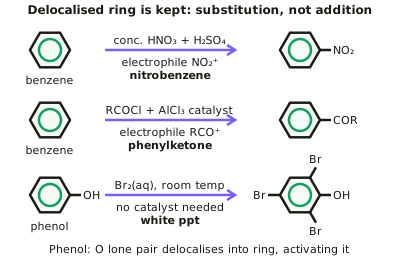
- Because of this stability, benzene undergoes electrophilic substitution rather than addition, keeping the ring intact.
- Nitration uses concentrated nitric and sulfuric acids to generate the electrophile NO₂⁺, forming nitrobenzene.
- Friedel-Crafts acylation uses an acyl chloride with an AlCl₃ catalyst to substitute an acyl group onto the ring.
- Phenol is more acidic than typical alcohols, as the oxygen lone pair delocalises into the ring; it reacts readily with bromine water without a catalyst, as the ring is activated by the -OH group.
In more detail
- Evidence for delocalisation: all C–C bonds are the same length (between single and double); the enthalpy of hydrogenation is about 152 kJ mol⁻¹ less exothermic than expected for cyclohexatriene.
- Nitration mechanism: HNO₃ + 2H₂SO₄ → NO₂⁺ + H₃O⁺ + 2HSO₄⁻; NO₂⁺ attacks the ring, forming an intermediate; H⁺ is lost and the delocalised ring is restored. Keep below 55 °C to avoid multiple substitution.
- Friedel–Crafts: CH₃COCl + AlCl₃ → CH₃CO⁺ + AlCl₄⁻; the acylium ion attacks benzene to give phenylethanone; H⁺ + AlCl₄⁻ → AlCl₃ + HCl regenerates the catalyst.
- Uses: nitrobenzene is reduced (Sn/HCl) to phenylamine for dyes; Friedel–Crafts products are used in medicines and fragrances.
Practice
Aromatic chemistry: 10 questions
Pick an answer to check it, or open the answer for the explanation.
1. How are the six extra electrons arranged in benzene, according to the delocalised model?
- As three fixed double bonds
- Delocalised in a ring of electron density above and below the plane
- Fixed on alternating carbons only
- Removed from the molecule
Show answer
B: Delocalised in a ring of electron density above and below the plane. This delocalisation gives benzene extra stability.
2. Why does benzene undergo substitution rather than addition reactions?
- It has no double bonds
- Substitution retains the stable delocalised ring system
- Addition is always faster
- Benzene is ionic
Show answer
B: Substitution retains the stable delocalised ring system. Addition would disrupt the stable delocalised electron system.
3. What is used as a catalyst in the nitration of benzene?
- AlCl₃
- Concentrated sulfuric acid
- Iron
- Nickel
Show answer
B: Concentrated sulfuric acid. Sulfuric acid helps generate the NO₂⁺ electrophile.
4. What catalyst is used in Friedel-Crafts acylation?
- H₂SO₄
- AlCl₃
- NaOH
- HCl
Show answer
B: AlCl₃. AlCl₃ helps generate the acylium electrophile.
5. Why does phenol react with bromine water without a catalyst, unlike benzene?
- Phenol has no ring
- The -OH group donates electron density into the ring, activating it
- Phenol is a strong acid
- Phenol has no delocalised electrons
Show answer
B: The -OH group donates electron density into the ring, activating it. This makes the ring much more reactive to electrophiles.
6. What does Kekulé's model of benzene (alternating double bonds) fail to explain?
- The molecular formula of benzene
- Why benzene is more stable and less reactive towards addition than expected
- The number of carbon atoms
- The colour of benzene
Show answer
B: Why benzene is more stable and less reactive towards addition than expected. The actual bond lengths in benzene are all equal, unlike Kekulé's model would predict.
7. Which statement describes carbon–carbon bond lengths in benzene?
- All equal and the same as a C=C bond
- All equal and the same as a C–C in alkanes
- All equal, between single and double bond lengths
- Three short and three long, alternating
Show answer
C: All equal, between single and double bond lengths. Delocalisation makes all six C–C bonds equal in length, intermediate between C–C and C=C. Alternating lengths would match Kekulé's model.
8. What is the C–C–C bond angle in the benzene ring?
- 180°
- 109.5°
- 90°
- 120°
Show answer
D: 120°. Each carbon is bonded to three atoms in a plane with trigonal planar geometry, so the angle is 120°.
9. Why is nitration of benzene kept below about 55 °C?
- To stop NO₂⁺ forming
- To limit formation of dinitrobenzene
- To prevent the ring being destroyed
- To make the reaction reversible
Show answer
B: To limit formation of dinitrobenzene. At higher temperatures a second nitro group can substitute, giving dinitrobenzene as an unwanted product.
10. Benzene reacts with ethanoyl chloride and AlCl₃. What is the organic product?
- Phenylethanone
- Ethylbenzene
- Phenyl ethanoate
- Chlorobenzene
Show answer
A: Phenylethanone. Friedel–Crafts acylation substitutes CH₃CO– for H on the ring, giving C₆H₅COCH₃ (phenylethanone) and HCl.
Keep going in Full Marks
Full Marks has 23 questions on Aromatic chemistry (13 more than here), set out in practice levels. You also get notes and 3D models for all 4 subtopics of Aromatics, amines, polymers and proteins, plus games, timed exams and past papers.
On your exam board
- AQATopic 3.3.10: Aromatic chemistry, Topic 3.3.11: Amines, Topic 3.3.12: Polymers, Topic 3.3.13: Amino acids, proteins and DNA
- OCR ATopic 6.1.1: Aromatic compounds, Topic 6.2.1: Amines, Topic 6.2.2: Amino acids, amides and chirality, Topic 6.2.3: Polyesters and polyamides
- OCR BTopic PL: Polymers and life, Topic CD: Colour by design
- EdexcelTopic 18: Organic chemistry III
- CambridgeTopic 30: Hydrocarbons, Topic 34: Nitrogen compounds, Topic 35: Polymerisation