A-level Physics Year 12 · Topic 3
Waves
Waves at A-level covers both the properties shared by all waves and the special behaviour of light and sound.
We will look at progressive and stationary waves, polarisation, the electromagnetic spectrum and intensity, and refraction including total internal reflection and optical fibres.
Then we use superposition to explain interference and diffraction, and carry out practicals on strings, the speed of sound, and the wavelength of light.
- 8 subtopics
- 446 questions
- Free: 3.1 notes and 10 questions
In this topic
- 3.1Progressive and stationary wavesFree below · 55 questions
- 3.2Refraction, diffraction and interferenceOpen in Full Marks · 26 questions
- 3.3Longitudinal and transverse waves and polarisationOpen in Full Marks · 74 questions
- 3.4The electromagnetic spectrum and intensity of wavesOpen in Full Marks · 61 questions
- 3.5Total internal reflection, critical angle and optical fibresOpen in Full Marks · 45 questions
- 3.6Practical: stationary waves on a string (frequency, length, tension and mass per unit length)Open in Full Marks · 60 questions
- 3.7Practical: speed of sound in air (oscilloscope method and resonance tubes)Open in Full Marks · 70 questions
- 3.8Practical: wavelength of light using double slits and diffraction gratingsOpen in Full Marks · 55 questions
3.1 · Free notes
Progressive and stationary waves
Key points
- Progressive waves transfer energy; key quantities are amplitude, frequency, wavelength, period, speed (c = fλ) and phase difference.
- Polarisation only occurs for transverse waves, confirming that light is transverse.
- Superposition: when waves meet, displacements add. Constructive interference occurs when waves are in phase; destructive interference occurs when they are antiphase.
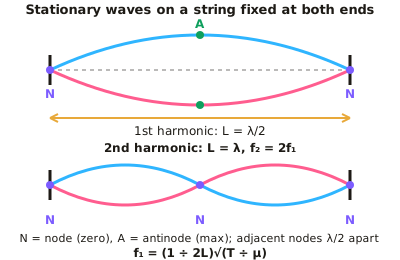
- Stationary waves form when two waves of the same frequency travelling in opposite directions superpose, producing nodes (zero amplitude) and antinodes (maximum amplitude); adjacent nodes are half a wavelength apart.
- The first harmonic of a string fixed at both ends has a node at each end and one antinode in the middle; f = (1 ÷ 2L)√(T ÷ μ).
In more detail
- Path difference: constructive interference when path difference = nλ; destructive when it is (n + ½)λ, for coherent sources in phase.
- Harmonics on a string: f₁ = (1/2L)√(T/μ); the nth harmonic has frequency nf₁ and n loops.
- Phase in stationary waves: all points between two adjacent nodes are in phase; points in adjacent loops are in antiphase.
- Progressive vs stationary: progressive waves transfer energy and all points have the same amplitude; stationary waves store energy and amplitude varies from zero (nodes) to maximum (antinodes).
Practice
Progressive and stationary waves: 10 questions
Pick an answer to check it, or open the answer for the explanation.
1. What is the distance between adjacent nodes on a stationary wave?
- λ/4
- λ/2
- λ
- 2λ
Show answer
B: λ/2. Nodes are half a wavelength apart.
2. What does polarisation demonstrate about light?
- It is longitudinal
- It is transverse
- It has no wavelength
- It travels slower than sound
Show answer
B: It is transverse. Only transverse waves can be polarised.
3. When do two waves interfere constructively?
- When they are in antiphase
- When they are in phase
- When their frequencies differ
- Never
Show answer
B: When they are in phase. In-phase waves add to give a larger amplitude.
4. What forms at a node on a stationary wave?
- Maximum amplitude
- Zero amplitude
- Maximum speed
- Maximum wavelength
Show answer
B: Zero amplitude. Destructive interference occurs permanently at these points.
5. Does a stationary wave transfer energy along the wave?
- Yes, in both directions
- No, energy is stored rather than transferred along it
- Yes, in one direction
- Only at the nodes
Show answer
B: No, energy is stored rather than transferred along it. Energy is not transferred along a stationary wave.
6. What is the phase difference between two points exactly one wavelength apart on a progressive wave?
- 90°
- 180°
- 270°
- 360° (0°, in phase)
Show answer
D: 360° (0°, in phase). Points one wavelength apart oscillate in phase.
7. A progressive wave has a frequency of 50 Hz and a wavelength of 0.40 m. What is its speed?
- 0.008 m s⁻¹
- 125 m s⁻¹
- 20 m s⁻¹
- 2.0 m s⁻¹
Show answer
C: 20 m s⁻¹. Use v = fλ = 50 Hz × 0.40 m = 20 m s⁻¹.
8. A string fixed at both ends vibrates in its first harmonic. The string is 0.60 m long. What is the wavelength of the stationary wave?
- 0.30 m
- 2.4 m
- 0.60 m
- 1.2 m
Show answer
D: 1.2 m. The first harmonic has one antinode between two nodes, which is half a wavelength. So L = λ/2 and λ = 2L = 1.2 m.
9. A string of length 0.50 m, tension 100 N and mass per unit length 1.0 × 10⁻³ kg m⁻¹ vibrates in its first harmonic. What is the frequency?
- 316 Hz
- 32 Hz
- 158 Hz
- 632 Hz
Show answer
A: 316 Hz. f = (1/2L)√(T/μ) = (1/1.0 m) × √(100/1.0×10⁻³) = √(1.0×10⁵) ≈ 316 Hz.
10. The tension in a stretched string is increased fourfold. Its length and mass per unit length are unchanged. What happens to the first harmonic frequency?
- It doubles
- It quadruples
- It halves
- It increases by a factor of √2
Show answer
A: It doubles. f ∝ √T, so multiplying T by 4 multiplies f by √4 = 2. The frequency doubles.
Keep going in Full Marks
Full Marks has 55 questions on Progressive and stationary waves (45 more than here), set out in practice levels. You also get notes and 3D models for all 8 subtopics of Waves, plus games, timed exams and past papers.